
Let me ask you guys one simple question. How many of you know about or have seen Aihole, Pattadakallu, Badami, Banashankari, Hampi, Bijapur, etc…. I know, I am going to get very few hands saying yes. These places with great historical stories are present in the northern part of Karnataka. Or we can simply divide it as North Karnataka.
Since childhood, we have grown up hearing the same complaint from our elders that our side of Karnataka is always neglected. Unlike South Karnataka, our region has not seen much development. Maybe that is the main reason, youngsters go in search of better job opportunities in Bangalore or Mysore. And gradually they all try to settle in here.
But when you talk about the history, North Karnataka has seen many historical events. And even today, it has rich historical sites compared to South Karnataka. But most of them are not well preserved by the government. The best example of this is Hampi. Hampi, which was once the Vijayanagara Empire, is now slowly turning into ruins.
One such historical site that I want to show you today is the Badami Cave Temples.
My Connection with Badami Cave Temples
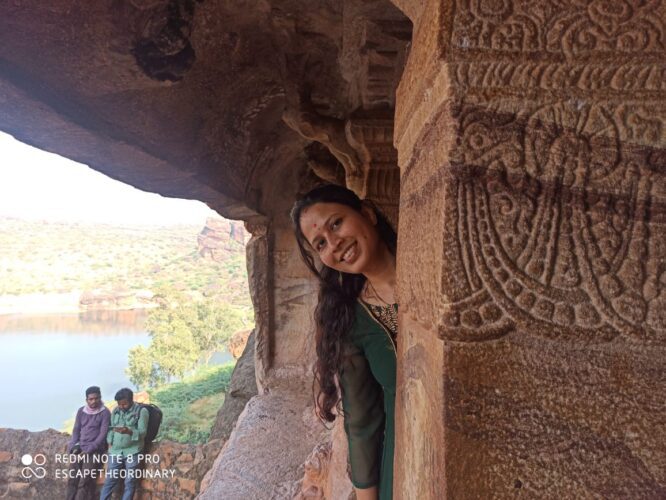
As I have already shared with you, I studied at JNV Bagalkot. And our school’s temporary campus was located between Badami and Banashankari, near Kalidasa school. From 6th to 9th standard, we stayed near Badami. Most of our school and childhood memories are connected with that place, and so are the Badami Cave Temples.
Since these cave temples are also an excellent educational trip site, we were often taken there as students. Back then, we knew them as Menabasadi, not as cave temples – thanks to our innocence.
Badami is a taluka in the Bagalkot district. I bet many of you haven’t even heard the name Bagalkot till today. These Badami cave temples are present at the entrance of Badami. And local people call this place as “Menabasadi.”
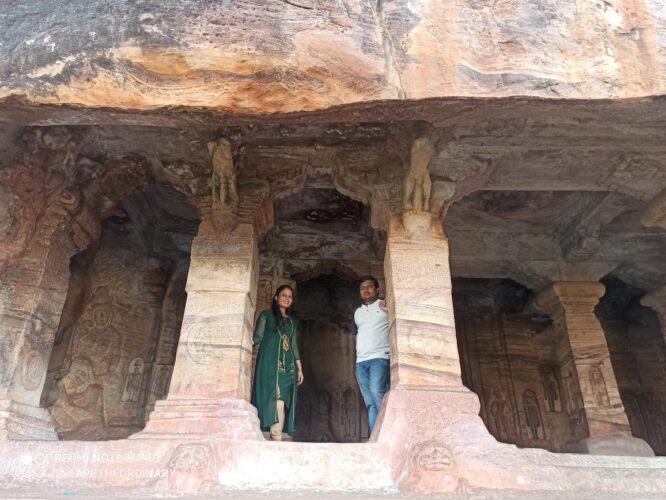
When seen from the far it looks like a big rock. When you go nearer, we can see small temples being carved in the huge rock. As it has 3-4 temples at one place, people call it a temple complex. These temples are rock-cut cave temples, carved in a massive red sandstone. Badami is not the only place where you get to see this type of cave temples. Many are present in Orissa, Madhya Prades, and other parts of India. They show the finest and earliest examples of Hindu cave temple architecture. You can imagine an entire multi-storeyed building carved from a single rock, that is caves temples.
History and Architecture of Badami Caves Temple
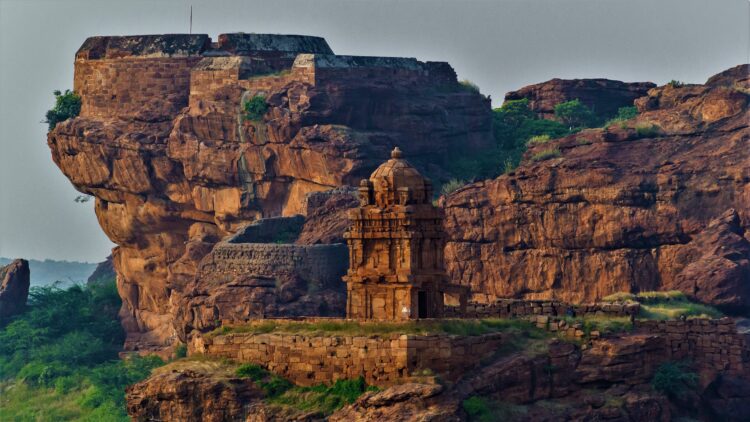
The Badami Cave Temples were built between the 6th and 8th centuries CE during the rule of the Chalukyas. These caves are among the oldest Hindu cave temples in South India. They are also one of the finest examples of Indian rock-cut architecture.
If you are wondering what rock-cut architecture means, it is a style where temples and structures are carved directly out of natural rock. Instead of building with bricks or stones, the entire temple is cut from a single rock hill.
Some other famous examples of rock-cut architecture in India are the Barabar Caves, Udayagiri Caves, and the world-famous Ajanta Caves and Ellora Caves.
Though the exact time of the Badami cave temples is not known, there is an early inscription found in Cave 3 of this cave complex. It says that King Mangalesha built a Vishnu shrine here during 578–579 CE. As per this inscription, historians consider it one of the oldest Hindu cave temples in India. The inscription is written in the early Kannada language, which also helps scholars understand its timeline.
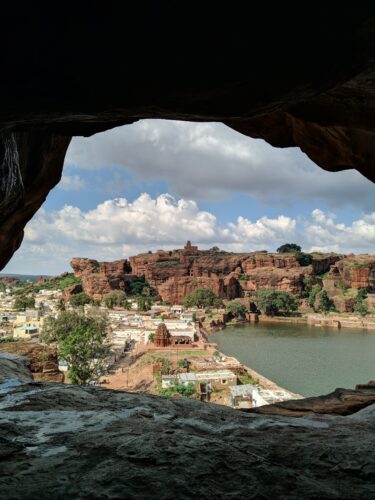
Badami was actually known as Vatapi, and it was the capital of the Chalukyas. Due to its historical importance and unique temple architecture, the Badami cave complex is included in the UNESCO World Heritage Tentative List. It is part of the group called “Evolution of Temple Architecture – Aihole, Badami and Pattadakal” in the Malaprabha river valley. This region is also called the cradle of Indian temple architecture, because many later temple styles were inspired by the experiments done here.
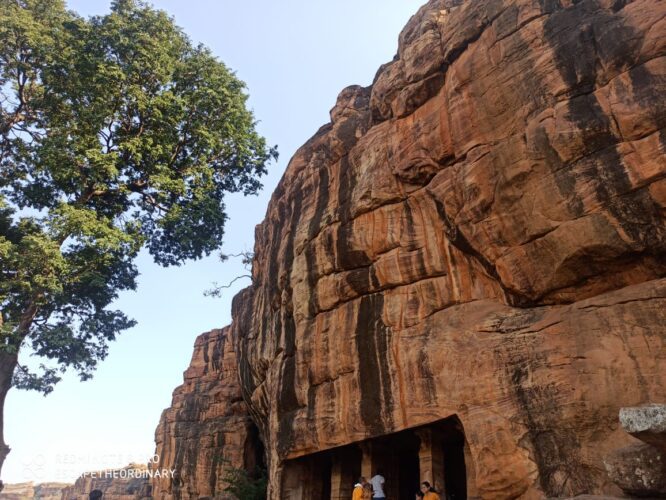
Badami Cave Temples Complex
The Badami Cave Temples consist of four main caves — Cave 1, Cave 2, Cave 3, and Cave 4. These caves are numbered in the order of their creation, from oldest to latest.
Each cave follows a similar layout. First, there is a Mukha Mantapa (verandah) at the entrance. After that comes the Maha Mandapa (main hall) supported by carved pillars and rock brackets. At the end, deep inside the cave, there is a small square sanctum (Garbhagriha) where the main deity is placed.
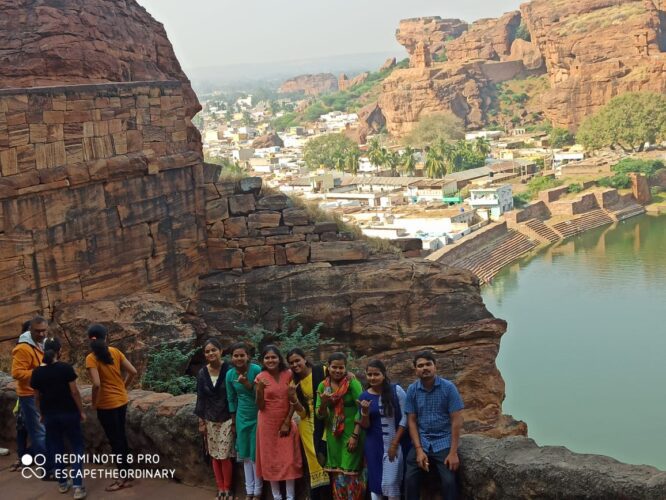
The caves are connected by steep rock-cut steps. As you climb up, you also get beautiful views of Agastya Lake and the town of Badami.
Cave 1 – The Shaivite cave
Cave 1 is dedicated mainly to Lord Shiva. It is the first cave you see while climbing up. The verandah has beautifully carved pillars decorated with flower designs and patterns. It has famous sculptures of 18-armed Nataraja, showing Lord Shiva in different dance poses. This carving is around 5 feet tall.
Another important sculpture here is of Mahishasura Mardini killing the demon Mahishasura. You can also see Harihara (a combined form of Shiva and Vishnu), and Ardhanarishvara (half Shiva, half Parvati).
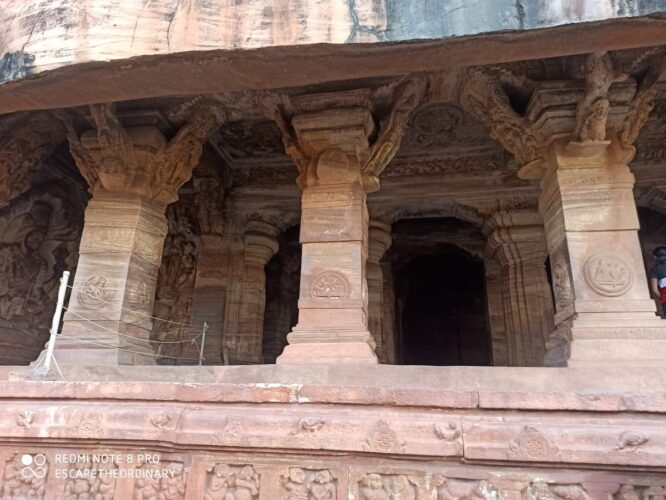
Cave 2 – The Vaishnavite Cave
After climbing around 60–65 steps from Cave 1, you reach Cave 2. This cave is dedicated to Lord Vishnu. The entrance has carved pillars, and you can see Vishnu’s different forms carved beautifully in rock here. The most important carvings includes Trivikrama (Vishnu measuring the universe), and Varaha (Vishnu as the boar lifting the Earth). The ceiling also has carvings of Hindu deities and Ashtadikpalas (guardians of directions).
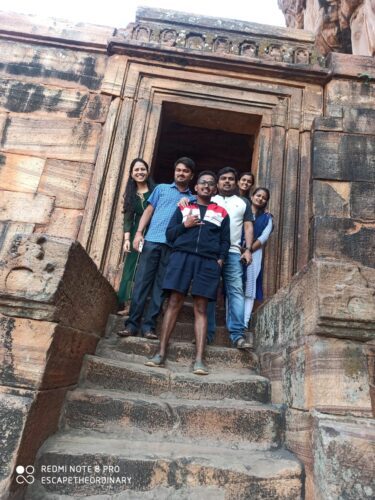
Cave 3 – The Largest and Oldest Cave
Cave 3 is the biggest and most impressive of all four caves. It is also the oldest and most detailed. An inscription found here mentions that King Mangalesha dedicated this cave in 578 CE. Because of this inscription, historians consider it one of the earliest dated Hindu cave temples in India.
The cave contains large and finely carved images of Lord Vishnu in different forms, including Narasimha, Trivikrama, Varaha, Anantasayana (Vishnu reclining on the serpent), and Harihara. The carvings in this cave are more detailed compared to the other caves. The ceiling also once had fresco paintings, though many of them are now faded. These are among the early examples of mural art in India.
Cave 4 – Jainism Dedication
Cave 4 is the smallest and the last cave in the complex. It is dedicated to Jainism. Inside, you can see carvings of Jain Tirthankaras, including Bahubali, Parshvanatha, and Mahavira. These sculptures show the religious harmony that existed during that time.
Apart form this Menabasadi you can also visit other places nearby like,
- Banashankari Amma Temple
- Aihole
- Pattadakal
- Agastya Lake
- Badami Fort
- Bhutanatha Temples
- Archaeological Museum
After visiting these cave temples, I also want you to experience a few more things in Badami. First thing is to take a Tanga ride from Badami to Banashankari. Traditional Tangas (the horse-drawn carriages) are still present in Badami. It is very rare to find these Tanga rides these days.
Banashankari is believed to be the birthplace or homeplace of Banashankari Devi. It is just 2-3 kilometres away from these cave temples. A must-visit place with great legends to hear about Tilakaranya forest, and goddess Banashankari devi. I have already covered this in my other post – Famous Shakthi peetha of North Karnataka.
Nearby, there is also a small museum maintained by the Archaeological Survey of India. It has many sculptures, inscriptions, and temple fragments from the Chalukya period. Another interesting thing about Badami is its red sandstone cliffs. This attracts many rock-climbing enthusiasts.
Awesome
Thank you Shweta.
Very informative !! Excellent coverage . Great work 👍👍👍