
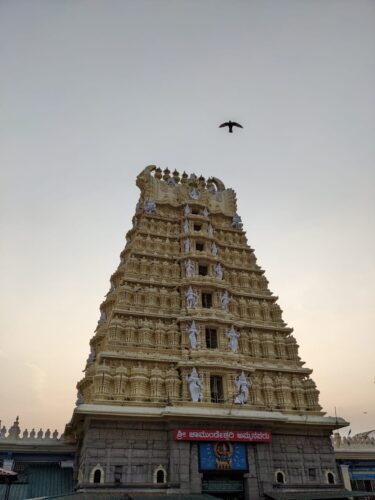
Whenever I take the name Chamundeshwari, my head automatically bows. Not just out of devotion, but because of the deep emotional connection I have with this place. Whenever I go to Mysore for any reason, I never return without visiting Chamundi Betta. Chamundeshwari Amma is the most worshipped goddess here.
I usually go there early in the morning or in the evening by boarding a KSRTC bus. As soon as I reach the temple, my mind automatically begins to pour out all those hidden emotions to Chamundeshwari Amma. I see her, sit there for some time, pray to her, seek her blessings, and then leave with a happy and satisfied soul. That is the bond I share with her.
Most people in Karnataka might have already visited Chamundi Hills. If someone is still waiting to visit, I believe this post will definitely help them plan their visit soon.
Chamundeshwari Temple Mysore – A Shakti Peetha
Chamundeshwari Temple in Mysore is one of the most important Hindu temples in Karnataka. It is located on top of the Chamundi Hills. This temple is dedicated to Chamundeshwari Amma. As far as I know, Chamundi is the fierce and protective form of Goddess Durga. She has been worshipped with deep devotion for generations by the Mysuru Maharajas (Kings).
The city of Mysore, now called Mysuru also has an interesting story behind its name. The city was earlier known as “Mahishuru.” I know what you might be thinking – Mahishasura. Yes, Mysuru is believed to be named after the demon king Mahishasura, who once ruled this region. Mahishasura was an Asura king who caused great trouble to the Devatas.
As per a famous legend, on these hills only Goddess Chamundeshwari destroyed the demon king Mahishasura. Because of this mythological reason, the place got it’s name as Mahishuru. Later, during British rule, the name changed to Mysore. And today it is officially known as Mysuru, the Kannadised form of the name. The people of Karnataka lovingly refer to Devi Chamundeshwari as “Nada Devi,” meaning the State Goddess.
Chamundeshwari Temple is also identified as a Shakti Peetha, one among the 18 Maha Shakti Peethas. During the Puranic period, this region was known as Krouncha Puri. And hence this shrine is called Krouncha Peetha. It is believed that the hair of Goddess Sati fell at this place. The remaining 17 Shakti Peethas are located in different parts of India.
History of Chamundeshwari Temple
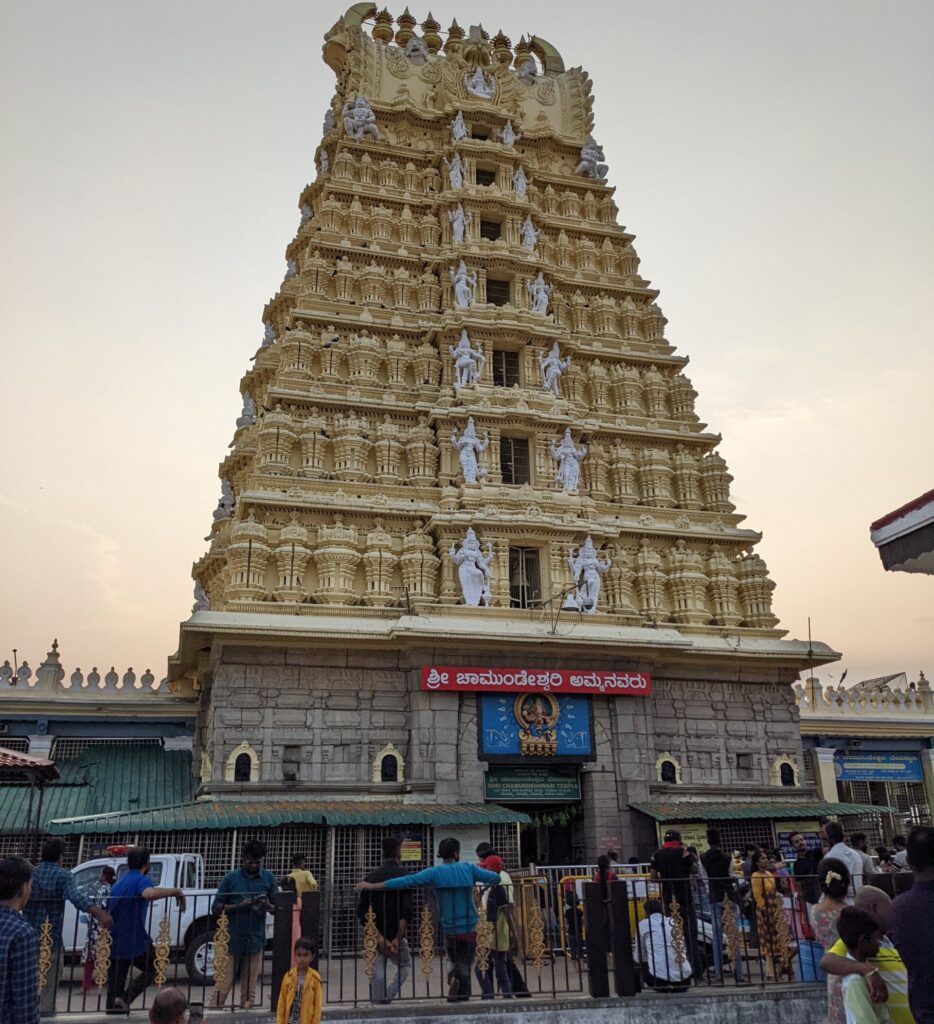
The Chamundeshwari Temple has a history that goes back over a thousand years. It is believed that the shrine began as a simple place of worship. And gradually developed into the grand temple we see today. As devotion to Goddess Chamundeshwari grew, the temple gained wide popularity. Several ruling dynasties, especially the Hoysalas, Vijayanagara rulers, and the Mysore Wodeyars played a major role in this temple’s growth.
The Wodeyar dynasty came to power in Mysore around 1399 CE. After this both the city and the Chamundeshwari Temple gained royal and religious importance. Some historical records suggest that the original shrine was built during the Hoysala period (around the 12th century). Later, during the Vijayanagara period, additions such as temple towers were made. In 1659 CE, a staircase of 1000 steps was constructed to help devotees reach the temple above the hills.
Nandi at Chamundeshwari Temple Mysore
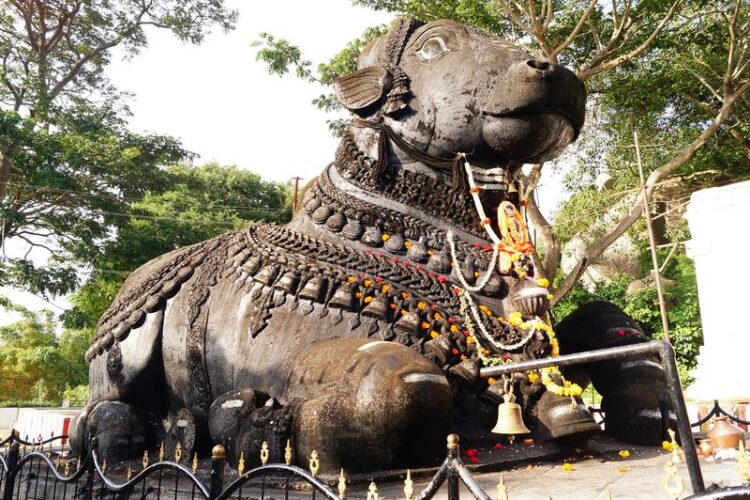
When you enter the Chamundeshwari temple, you get to see several images of Sri Nandi. As we know, Nandi is the sacred bull mount of Lord Shiva. If you take 1000 stairs to Chamundi betta, a big Nandi statue can be seen near the 700th step. This Nandi statue is carved from monolithic granite. And it measures nearly 15 feet in height and 24 feet in length. This Nandi is beautifully adorned with stone-carved bells around its neck. The statue is believed to date back several centuries. It stands facing a small Shiva temple nearby and adds to the spiritual calmness of the place.
The temple is built in a quadrangular (four-sided) shape. It includes the main doorway, entrance, Navaranga hall, Antharala mantapa, sanctum sanctorum, and the prakara. All these parts are built in the Dravidian architectural style.
At the entrance, there is a beautiful seven-tiered gopura. On top of the entrance tower, known as the shikara, you can see seven golden kalashas. A small image of Lord Ganesha is also carved near the entrance doorway. The silver-plated gate shows different forms of the Goddess.
Festivities at Chamundeshwari Temple Mysore
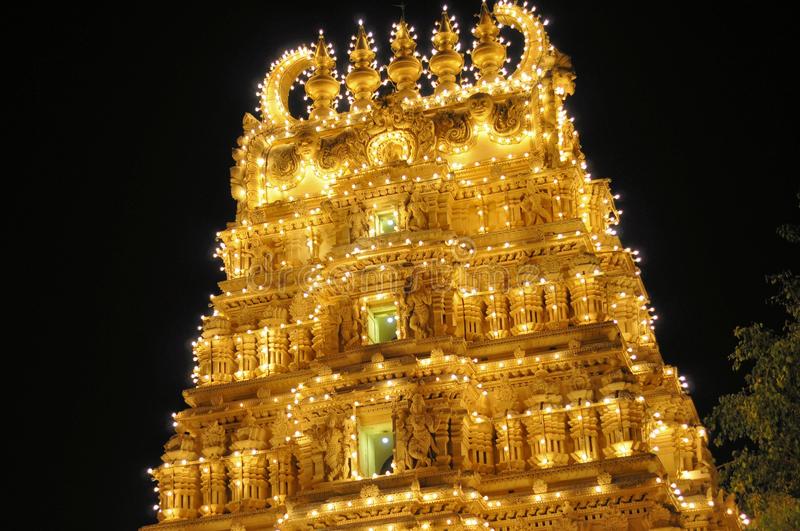
At the Chamundeshwari Temple on Chamundi Hills, a group of priests performs special pujas to Goddess Chamundeshwari every day. Fridays are considered especially auspicious to worship and visit the temple.
The temple is well known for festivals such as Ashada Shukravara, Navaratri, and Ammanavara Vardhanthi. The Fridays in the month of Ashadha are considered very holy. And on these days the temple is filled with thousands of devotees. Chamundi Jayanti is another important festival celebrated during this period. On this special day, the idol of the Goddess is taken in a grand procession around the temple on a golden chariot.
Navaratri Celebration in Chamundeshwari Temple
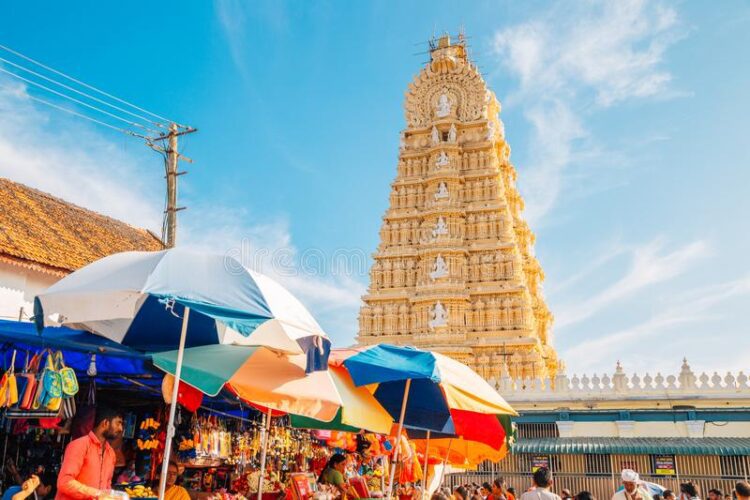
The biggest festival connected with Chamundeshwari Temple is Navaratri, which is part of Mysore Dasara. The state festival of Karnataka celebrated every year in September–October.
During Navaratri, the temple becomes very special. For nine days, Goddess Chamundeshwari is worshipped with great devotion. And decorated in different forms, known as the Navadurgas. On the seventh day, which is dedicated to Kalaratri, valuable jewels donated by the Mysore District Treasury are brought to the temple to decorate the idol of Chamundeshwari.
Every year, Wadeyars (Mysuru King) start the Mysore Dasara celebrations from the Chamundeshwari Temple on Chamundi Hill. On day 1 of the Dasara, Chamundi is worshipped by the King of Mysore. After her blessings only, other festivities starts at the palace. Special rituals and prayers are performed each day of Navaratri. Many devotees visit the temple during these nine days, forming long queues to seek the Goddess’s blessings.
Chamundeshwari Temple Timings:
The Chamundeshwari Temple in Mysore is generally open every day from early morning until late evening. The specific timings for the temple may vary slightly depending on the day of the week and any special events or festivals that may be taking place.
Approximate timings for the Chamundeshwari Temple in Mysore:
- Monday to Sunday: 7:30 AM to 2:00 PM and 3:30 PM to 6:00 PM
- Abhisheka’s timings are from Morning 6 AM till 7.30 AM.
- On Fridays, the Abhisheka timings change slightly – from 5 AM to 6.30 AM.
Best time to visit Chamundeshwari Temple Mysore:
The best time to visit Chamundeshwari temple in Mysore is September to November. Due to the Dasara and Deepawali festivities, the Temple will be specially decorated for the occasion. And you can see the Goddess Chamundeshwari in different avatars of Navaratri.
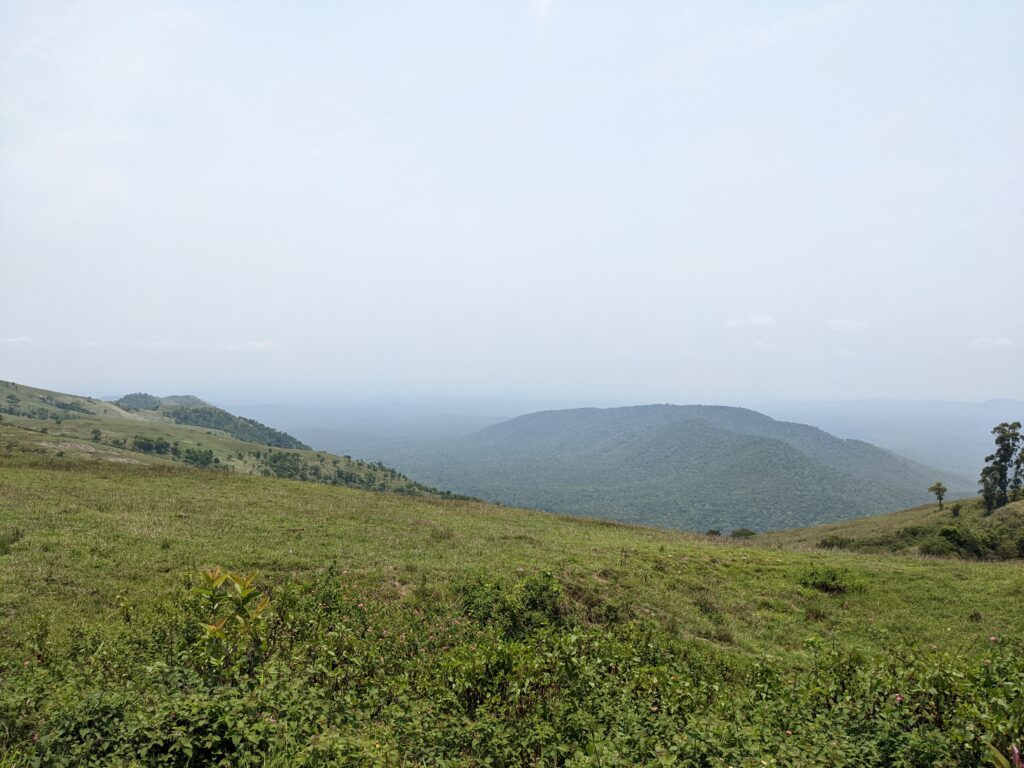
The best time of the day to visit Chamundeshwari temple is dawn/evening. From the top of Chamundi Hills, you can enjoy a beautiful panoramic view of Mysore city, especially when the city lights are on.
How to reach Chamundeshwari Temple Mysore:
Chamundeshwari Temple is located about 13 km from the Mysore city bus stand.
By Bus:
KSRTC city buses run every 20 minutes to Chamundi Hills, including regular and Volvo buses. The journey takes around 30 minutes.
At the bus stand, you will hear conductors calling “Betta, Betta”, which means Hills – those buses go to Chamundi Hills.By Cab or Auto:
Taxis and autos are also easily available from anywhere in Mysore city.
⚠️ Note: Chamundi Hills is a plastic-free zone. Carrying or using plastic bags is strictly prohibited.