
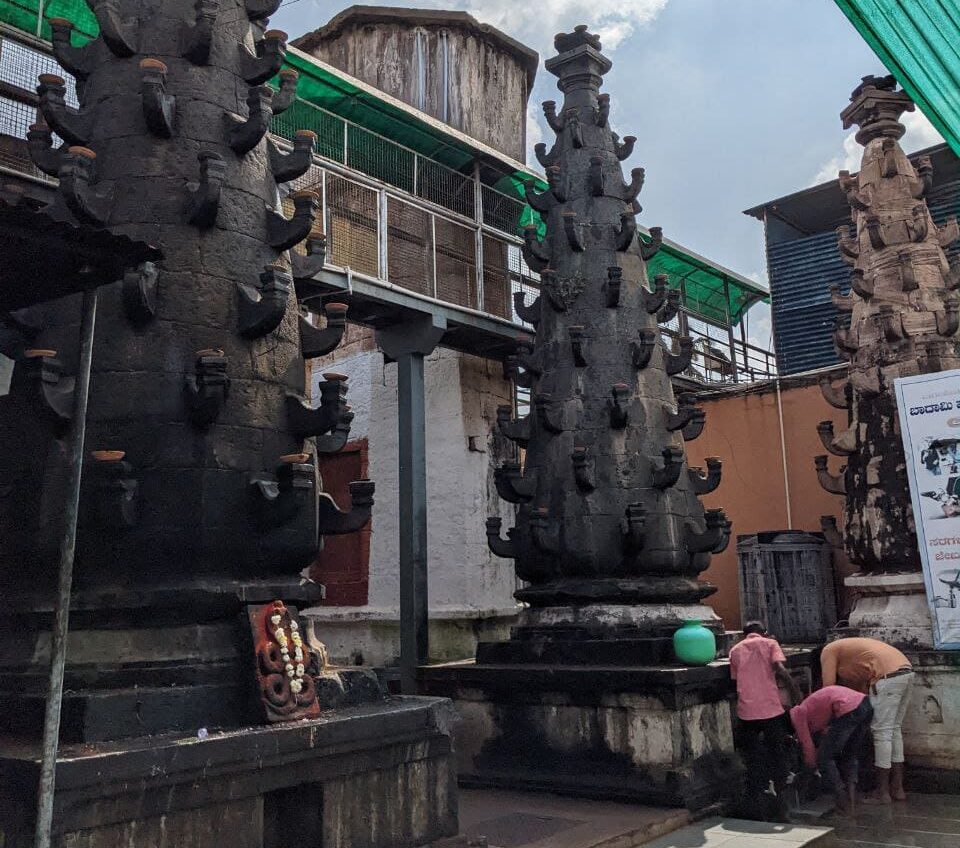
“Badami Banashankari Ninna Padaka Shambooko“
This sacred nara is heard in almost every household of North Karnataka. It means, “Salutations at your feet, Banashankari Amma.” For many families, this line is spoken before starting any good work or auspicious occasion.
I have been visiting Banashankari Temple since I was one year old. For us, Banashankari Amma is not just a goddess — she is part of our life. In North Karnataka, this is the main temple people visit on every important day.
I especially remember going to the temple on Poornima (Hunnime) with my father. The journey, the crowd, the lamps, the temple tank — everything still feels fresh in my memory.
About Banashankari Temple
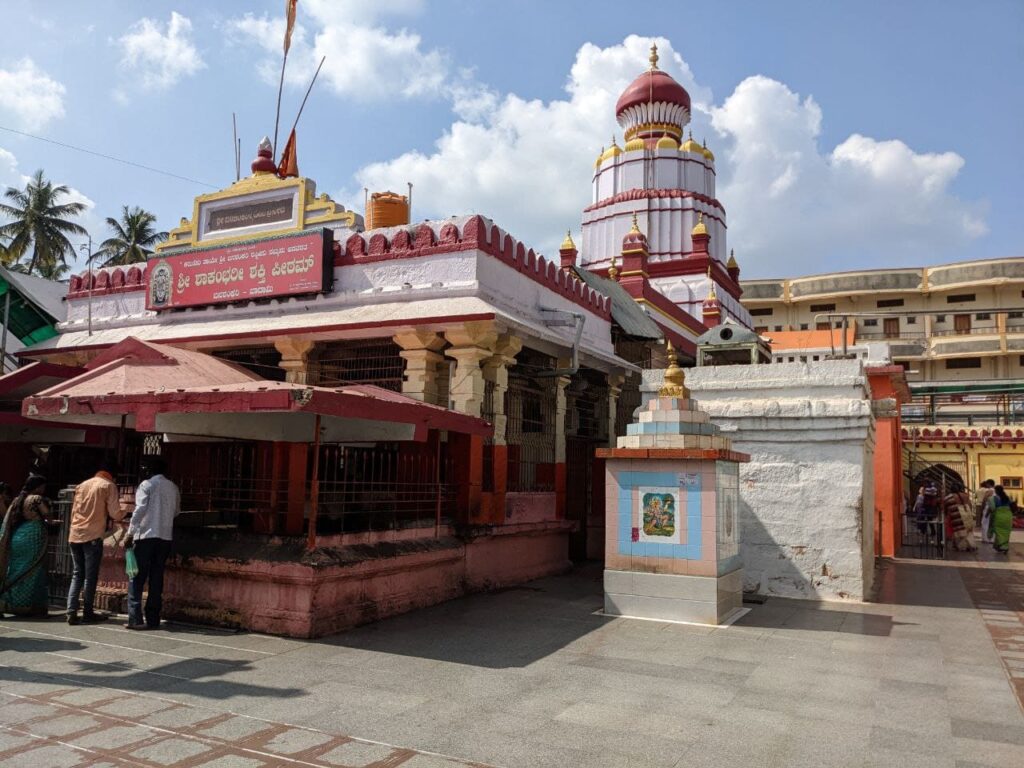
Sri Banashankari Temple has deep historical roots that go back to the Chalukya period, one of the golden eras of Karnataka. This temple is located about 4 km from Badami in Bagalkote district.
Badami, originally known as Vatapi, was the capital of the Early Chalukyas in the 6th–8th centuries. During this time, the region saw remarkable growth in temple architecture, art, and religious development. Banashankari Amma was regarded as the presiding deity of the Chalukyas, especially the Kalyana Chalukyas.
It is believed that King Jagadekamalla III started the construction of the temple in 603 CE. And installed the Banashankari Devi Murti here. This established the temple as an important Shakti center in North Karnataka.
Over time, like many ancient temples, it underwent renovations. In 1750 CE, Marari Dandanayaka, also known as Parasurama Agale, reconstructed and restored the temple structure. The present architecture reflects strong Vijayanagara style influence, although the original foundation belongs to the earlier Dravidian style.
The temple and the goddess are also mentioned in the Skanda Purana, where Banashankari is described as the patron deity of the Chalukyas and neighboring rulers.
Navaratri holds special importance at this temple. Unlike many regions where it is celebrated in Ashwin (September–October), here it is celebrated in the month of Paush.
For nine days, the goddess is adorned with different ornaments and sarees, revealing nine divine swaroops. Banadashtami is considered especially auspicious.
History and Mythological Significance of Badami Banashankari Temple
Sri Banashankari Devi of Badami is one of the most powerful and revered Shakti temples of North Karnataka. She is worshipped as Banashankari, Shakhambari, and Simhavahini — the Mother who protects, nourishes, and destroys evil.
Mythological Origins (Skanda Purana Reference)
The story of Banashankari Devi is mentioned in the ancient Hindu scripture called the Skanda Purana.
Long ago, there was a powerful demon named Durgamasura. He did very hard penance and pleased the gods. As a result of his penance, he received a special blessing (boon) that made him very difficult to defeat.
After getting this power, he became arrogant and started misusing his boon. He stole the Vedas (holy scriptures) and started troubling sages and innocent people living in the forest called Tilakaranya. Because of his actions, prayers stopped, and dharma weakened. It is believed that rains stopped and a severe drought spread across the land. People began to suffer from hunger and fear.
The sages could not bear this suffering. They performed a powerful yagna (holy fire ritual) and prayed to Adi Shakti, the supreme Mother Goddess, to save them.
From the sacred fire of that yagna kunda, Goddess Parvati appeared in a powerful and fierce form. She fought Durgamasura and finally killed him, freeing the world from his cruelty.
Since she appeared in the forest (Bana) and is the Shakti of Lord Shankara (Shiva), she came to be known as Banashankari — which means “Shankari of the Forest.”
Banashakari As Shakhambari – The Mother Who Feeds
Banashankari Devi is also worshipped as Shakhambari. This name also has a beautiful and meaningful story behind it.
Long ago, there was a severe drought. There was no rain for a long time. Crops failed. Rivers dried up. People, animals, and even sages suffered from hunger and thirst. The whole land became dry and lifeless.
It is said that even the gods were worried. Lord Shiva, Lord Brahma, and other deities prayed to the Mother Goddess to save the world. They prayed:
“Without rain, living beings cannot survive. Without water, the world loses life. O Mother, come like rain and protect your children.”
Hearing their prayers and seeing the suffering of her children, the Goddess showed her compassionate form. Out of deep love and kindness, she shed tears. Her tears are believed to have brought rain and filled the land with life again.
She also created vegetables (called Shaka) to feed the hungry people. She nourished the world like a true mother.
Because she provided food during famine, she came to be known as Shakhambari Devi:
- Shaka means vegetables or greens Ambari / Amba means Mother
So Shakhambari means “the Mother who feeds with vegetables” or “the Mother who nourishes the world.”
Around this time, it is believed that she created several sacred water bodies (Tirthas) around the kshetra, including:
- Haridra Tirtha
- Taila Tirtha
- Kshama Tirtha
- Padma Tirtha
- Indriya Nigraha Tirtha
She turned the dry and barren land into a place full of life, almost like a Brindavan.
Even today, this loving and life-giving form of the Goddess is deeply worshipped at Banashankari Temple in Badami.
Mention Of Shakhambari in the Scriptures
The story of Shakhambari Devi is described in the Shakambari Mahatmya section of the Skanda Purana and also in the Devi Bhagavata Purana.
The scriptures say that once there was a terrible drought. There was no rain for many years. Because of this, people, animals, and sages suffered greatly. Crops failed. Hunger spread everywhere.
Seeing the suffering of the world, the Goddess appeared in a compassionate form.
She is described in Sanskrit as:
शाकम्भरीति विख्याता देवी शताक्षीति विश्रुता ।
शाकैः संजीवयामास त्रैलोक्यं सचराचरम् ॥
Meaning:
She became famous as Shakambari and was also known as Shatakshi (the hundred-eyed Goddess).
By producing vegetables and greens, she gave life again to the three worlds — to all living and non-living beings.
Another verse says:
अनावृष्ट्या क्षुधार्तानां लोकानां हितकाम्यया ।
स्वदेहसम्भवैः शाकैः पूरयामास मेदिनीम् ॥
Meaning:
When there was no rain and people were suffering from hunger,
Out of her desire to protect the world, she filled the earth with vegetables that came from her own body.
Because tears flowed from her many eyes like rain, she was called Shatakshi (the Goddess with a hundred eyes).
Because she fed the world with vegetables (Shaka), she was called Shakhambari — the Mother who nourishes.
This is why even today, devotees worship her not only as a powerful destroyer of evil, but also as a compassionate Mother who protects and feeds her children.
Worshipping the Many Forms of the Goddess
Devotees of Banashankari Amma lovingly call her by many names. Each name shows a different form of the same Mother.
She is worshipped as Balavva, Banadavva, Chaudeshwari, Sankavva, Vanadurge, and Vanashankari. In villages across North Karnataka, people call her by these names with deep faith and devotion.
All these names remind us that she is one Goddess, but she protects her children in many forms. She is also known as Simhavahini, which means “the one who rides a lion.” The lion represents courage, strength, and fearlessness. When we see her seated on a lion, it shows that she is powerful and capable of destroying evil.
Banashankari Temple – Simple Beauty and Divine Murti
The Banashankari Temple in Badami is beautiful in its own simple way. The present structure shows elements of the Vijayanagara style, though the temple has older roots.
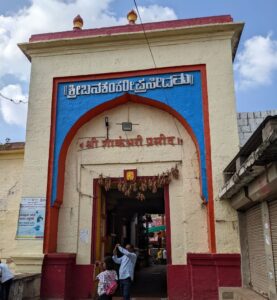
The temple is surrounded by a large wall. When we enter, we see a tall entrance tower called the Gopuram. It has carvings of gods and mythological figures.
Inside, there is a hall where devotees gather and pray. At the center of the temple is the Garbhagudi (sanctum), where Banashankari Amma resides.
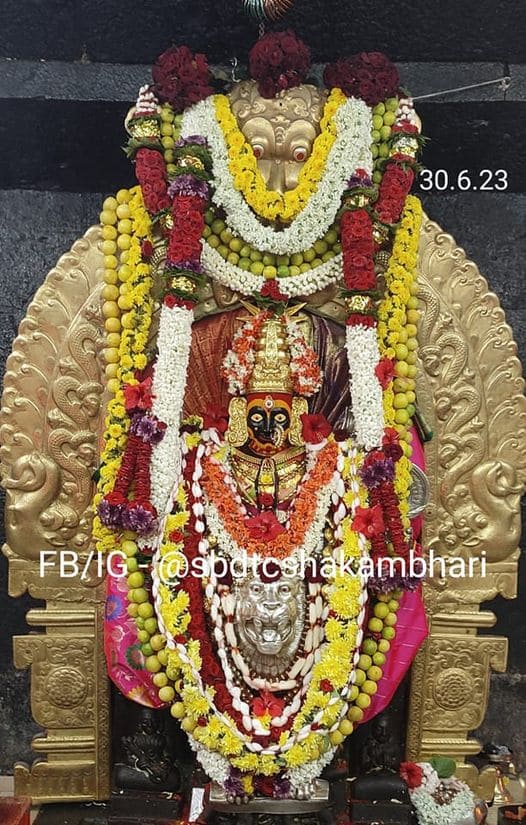
The idol is made of black stone. She is seated on a lion, showing her strength and courage. Beneath her feet is a demon, which shows that good always wins over evil.
She has eight hands. In her hands, she holds weapons like the trident (Trishula), sword, shield, drum (Dhamaru), and other divine symbols. These represent protection, power, and justice.
When you stand before her, you don’t just see a statue — you feel the presence of a powerful and loving Mother.
Festivals and Traditions at Banashankari
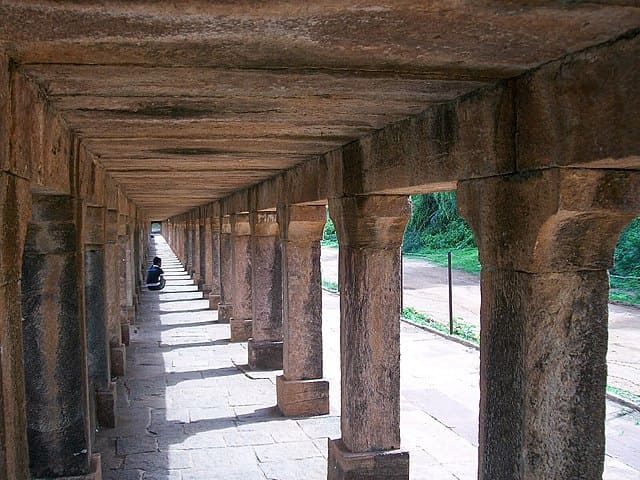
The Banashankari Temple is always lively, especially during festivals.
One special festival here is Palleda Habba (Vegetable Festival). On this day, the Goddess is decorated beautifully with different vegetables. Devotees prepare 108 dishes using various vegetables and offer them to Amma. It shows gratitude to the Mother who once fed the world during drought.
Another important celebration is the annual Banashankari Fair – Banashankari Jatra. It happens every year and ends on the full moon day of Magha month (January–February). Grand Rahotsava of Banashankari Amma (Chariot procession) is held on the Banada Hunnive. During this time, thousands of devotees from across Karnataka visit the temple. The whole area turns festive — small shops, flowers, sweets, bangles, toys — it feels like a village fair with devotion at its heart.
During the Jatra, many people do padayatra. Which means walking to the temple from their village or town. Some walk barefoot. It is their way of showing devotion and faith. The journey may be long, but they walk with belief in their hearts.
Navaratri is also celebrated in a special way. For nine days, Amma is decorated in different forms, and devotees come in large numbers to seek her blessings.
The Taste of North Karnataka
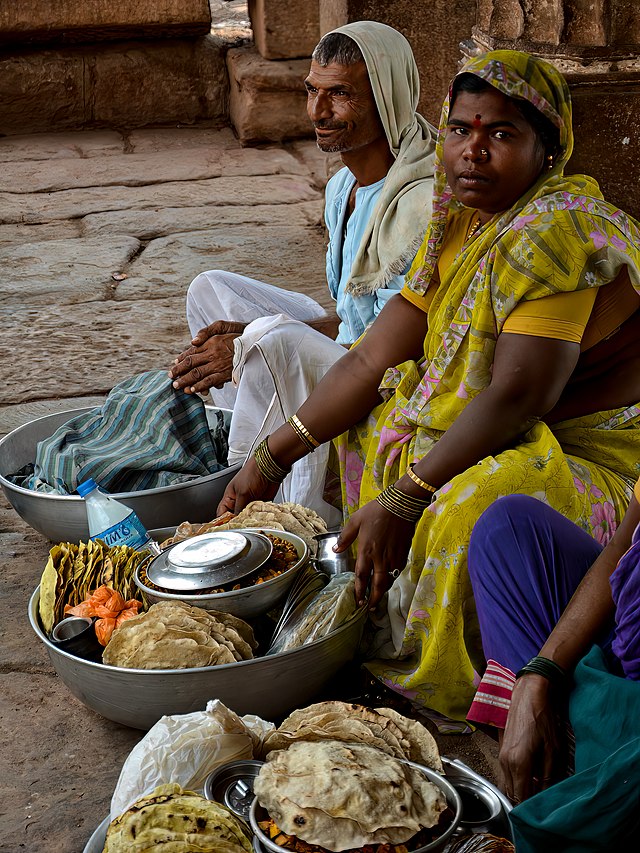
One thing you should not miss when visiting Banashankari is the simple, homemade North Karnataka food served outside the temple. Local women prepare meals like jowar roti, sprout curry, red chutney, karadantu, and other traditional dishes. Just like you see in above picture. And they charge as low as Rs. 50/- per meal. The taste is simple, spicy, and very authentic.
Many devotees feel their visit is incomplete without eating this food. It feels like Amma herself is feeding you.
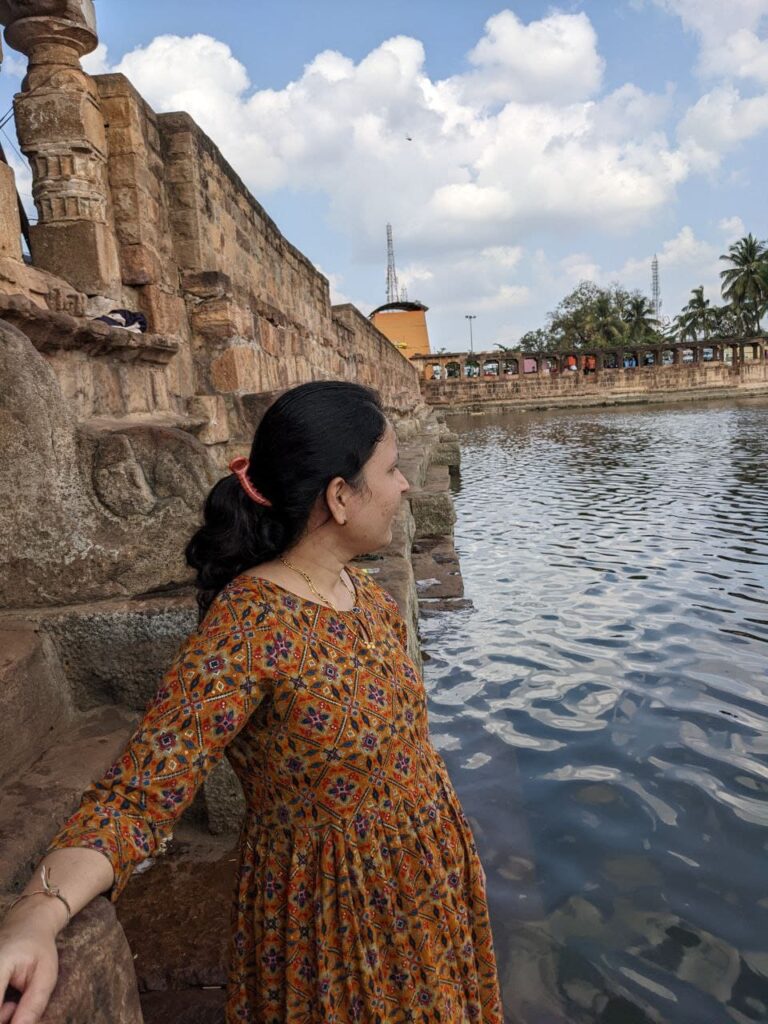
How to Reach Banashankari & Nearby Places to Visit
The Banashankari Temple is located about 4 km from Badami in Karnataka.
You can first reach Badami by road or train, as it is well connected. From Badami town, regular buses, autos, and even local transport are available to reach the temple easily.
The nearest airports are:
- Hubballi (around 110 km)
- Belagavi (around 130 km)
From there, you can travel by road to Badami.
If you are visiting Banashankari, you should also explore the famous historical places nearby. Badami was once the capital of the Chalukyas and is known for its ancient temples and rock-cut monuments.
You can visit:
- Badami Cave Temples
- Aihole
- Pattadakal
These places show the rich history and temple architecture of Karnataka.
So, a visit to Banashankari Amma is not just a spiritual trip. It is also a chance to explore history, culture, and heritage — all in one journey.
Facts On Badami Banashankari Temple
Where is the Badami Banashankari Temple located?
Banashankari Temple is located about 4 km from Badami in Bagalkote district, Karnataka.
When was the Badami Banashankari Temple built?
The temple has roots going back to the Early Chalukya period (7th century). The present structure was renovated in 1750 CE by Marari Dandanayaka (also known as Parashurama Agale).
Who is the presiding deity of the Badami Banashankari Temple?
The presiding deity is Goddess Banashankari, a form of Goddess Parvati. She is also worshipped as Shakhambari and Simhavahini.
What is the best time to visit Banashankari Temple Badami?
The best time to visit Banashankari Temple Badami is during the months of October to March when the weather is pleasant and suitable for exploring the temple and its surroundings. And one can witness the Annual Banashankari Devi fair, which happens in 1st or 2nd week of January.
What is the best time to visit Banashankari Temple?
The best time to visit is from October to March, when the weather is pleasant. Many devotees also visit during the annual Banashankari Jatra held in January–February (Magha month).
Are there any accommodations available near the temple?
Yes, the temple itself has accommodation facilities for the devotees at a very minimal cost. Other than that, people can also stay in Badami, around 2.5 Km from the temple.