
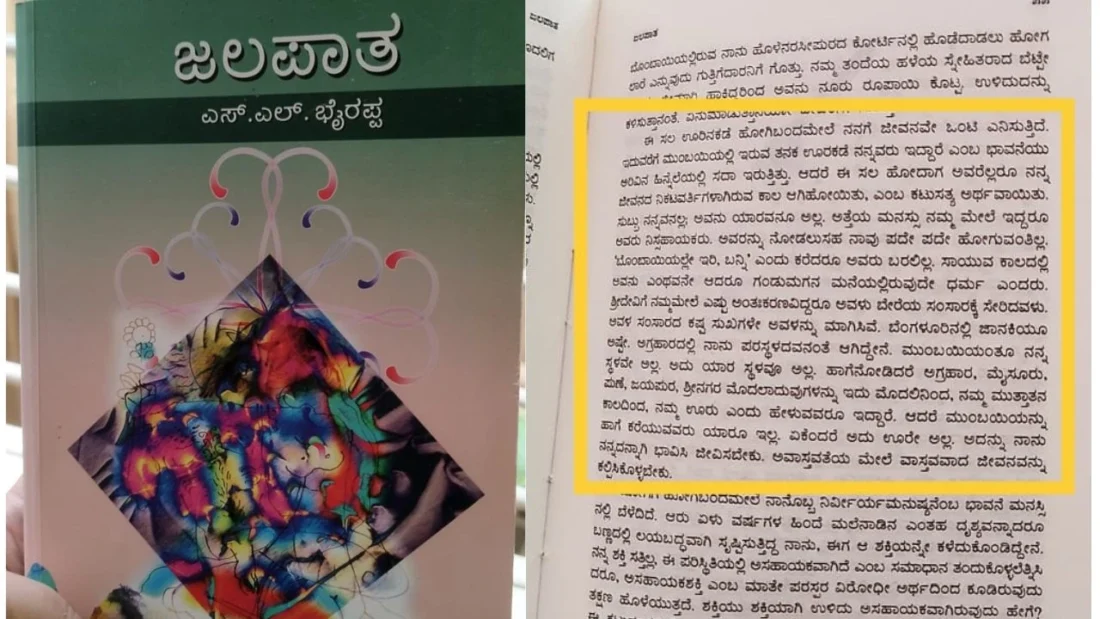
- Book: Jalapatha
- Author: S. L. Bhyrappa
- Language: Kannada
- Genre: Philosophical Fiction
- First Published: 1967
- Pages: ~180
ಈ ಸಲ ಊರಿನಕಡೆ ಹೋಗಿ ಬಂದಮೇಲೆ ನನಗೆ ಜೀವನವೇ ಒಂಟಿ ಎನಿಸುತ್ತಿದೆ. ಇದುವರೆಗೆ ಮುಂಬೈಯಲ್ಲಿ ಇರುವ ತನಕ ಊರಕಡೆ ನನ್ನವರು ಇರುವರು ಎಂಬ ಭಾವನೆಯು ನನ್ನ ಅರಿವಿನಲ್ಲಿ ಸದಾ ಇರುತ್ತಿತ್ತು. ಆದರೆ ಈ ಸಲ ಊರಿಗೆ ಹೋದಾಗ ಅವರೆಲ್ಲರೂ ನನ್ನ ನಿಕಟವರ್ತಿಗಳಾಗಿರುವ ಸಮಯ ಆಗಿಹೋಯಿತು, ಎನ್ನುವ ಕಟುಸತ್ಯ ನನಗೆ ಅರ್ಥವಾಯಿತು.
I picked up Jalapatha simply after watching a few reels on Instagram. I thought it was a small book and I could finish it in a day or two. But I was wrong. As I started turning the pages, it put me into deeper thinking. It is not a book you can rush through.
Even though the novel was written almost five decades ago, it still feels very relevant. The issues discussed in the book still exist today. Time changes, lifestyle changes, cities change — but some questions about marriage, children, responsibility, and personal choices remain the same.
The main character of the novel is Sripathi, who is an artist. He is a middle-class man who moves to Bombay (now Mumbai) with dreams of building a life through his passion. But life does not move according to passion alone. He eventually takes up a job in an advertising company. The job gives him income, but not satisfaction. There is no space for creativity — he simply has to follow his director’s instructions.
Through Sripati’s character, S. L. Bhyrappa neatly explains the constant struggle between dreams and responsibilities. On one side, there is ambition. On the other side, there is family.
His wife, Vasu, who is also a well-educated woman, chooses to be a housewife. Vasu is a strong character in the novel who adjusts, supports, and manages the house. When she becomes pregnant during their financially unstable period, they decide to terminate the pregnancy, as they already have a son, Vishwa. That part felt very real to me. It shows how middle-class decisions are often based not on desire, but on financial circumstances.
Parallel to their story runs another story of Dr. Nadagowda and his wife, Sudha. Dr. Nadagowda is an expert in animal science and believes only the best breeds of animals should reproduce. He wants to apply the same ideology to humans too. According to him, only physically strong and healthy people should have children. Because of his beliefs, he chooses not to have children. But his wife, Sudha, longs deeply for motherhood.
Sudha gradually tries a lot to change her husband’s mind to have a child of their own. But Dr. Nadagowda remains adamant about his extreme ideology and the practicality of the “best breeds.” Unable to bear the childlessness, Sudha ends her life. After a few days, even her husband commits suicide.
Sudha’s character disturbed me the most. Her emotional loneliness feels very heavy. Even after finishing the book, she stayed in my thoughts.
This contrast between Sripati and Nadagowda is what makes the novel powerful. One struggles with financial instability yet chooses parenthood. The other has stability but rejects it due to his ideology. And in between stands Sudha — a woman silently suffering. Naturally, she grows a deeper affection for Vasu’s son, Vishwa.
At the same time, even with strong philosophical thoughts, Sripathi is not shown as a perfect man. He develops closeness with his colleague, Rebello. And that relationship crosses moral boundaries, leading to an extramarital affair. Bhyrappa does not justify Sripathi, but he shows that human beings are weak at times. This makes Sripathi’s character more realistic.
The couple, Sripathi and Vasu, who earlier decided to follow celibacy, break it after some time. As a result, Vasu becomes pregnant for the third time. This time, they decide to keep the child.
During the early months of Vasu’s pregnancy, they decide to go on a picnic. They go to a waterfall. Observing the waterfall — the way it flows, behaves, and does its duty — Sripathi gets lost in thoughts about life, comparing it to that waterfall.
After that, they decide to go on a picnic every month to Lonavala. Sripathi decides to draw a painting every time they visit that place — a painting of his wife Vasu, her changing pregnant body, and the changing nature. The way he observes the changes in her body and compares them with changes in nature is written beautifully.
He paints nature and its transformation. Those portions are not dramatic — they are sensitive and thoughtful. It made me realise how rarely we appreciate pregnancy as something natural and powerful. He says those are the best art pieces of his life made by him, and he will never sell them for money. Vasu and Sripathi are blessed with a baby girl this time.
Later in the story, Sripati returns to his village, thinking life will be easier there. But his struggles continued. He faces financial problems, emotional setbacks, and even lost his daughter, Uma. Life does not spare him.
And that is where the title Jalapatha (Waterfall) makes sense to me.
A waterfall keeps flowing. It falls, hits rocks, changes shape, gathers again, and continues. Life is also like that. For Sripati, financial struggle never fully leaves him. For Sudha, childlessness becomes her pain. For Vasu, motherhood becomes both strength and responsibility. Each character carries their own burden.
Another thing that surprised me is how Bhyrappa discussed topics that were considered bold or even uncomfortable during that time — ideas about reproduction, choices, IVF, sex and the meaning of marriage. Even today, in many families, these discussions are not easy.
What I liked most is that Bhyrappa does not give direct answers. He does not tell us who is right or wrong. He presents situations and leaves us thinking.
After finishing the novel, I was left with more questions than answers. Are sex and marriage two different things? Should one avoid sex in marriage if they do not want to have children? Is marriage complete only if you have kids? Many such questions push the reader to think.
Bhyrappa does not give clear answers. He leaves the reader to think. And for me, that is the real strength of Jalapatha. The philosophical conversation between Sripathi and Vasu is really worth reading.