Welcome to our daily Idiom series, designed to help you sound like a native American English speaker. Today’s idiom is “Piece of Cake.” In this post, you will learn what it means, how to use it in real sentences, and which common mistakes to avoid.
Idiom Piece of Cake Meaning
Here is a little story to get us started. Yesterday, my son came home after his science test. I asked him, “How was your test?” His reply surprised me. He said, “I finished it quickly — it was a piece of cake!” For a moment I thought: was he eating cake during the exam? Of course not. He was using an idiom.
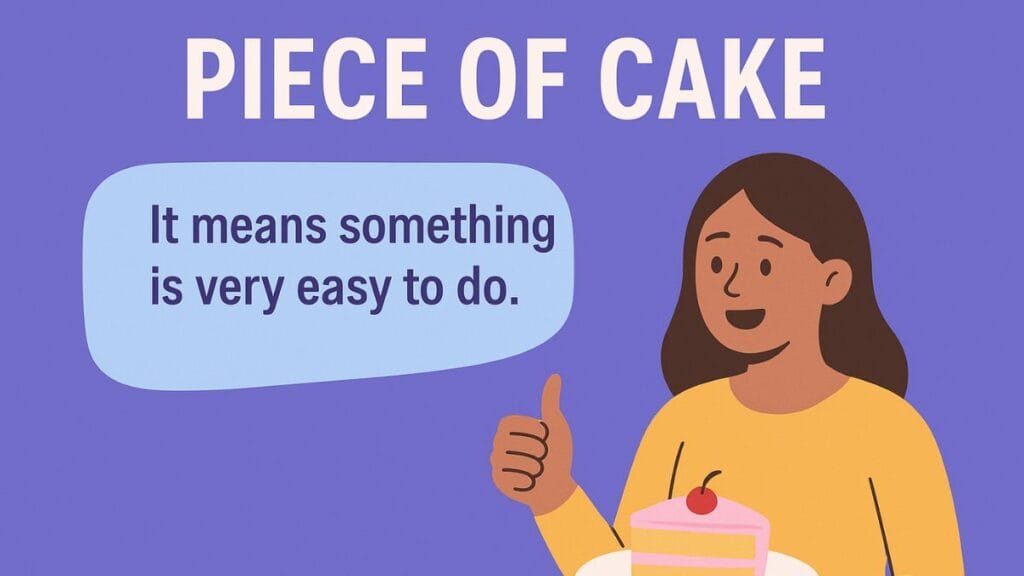
“Piece of cake” does not refer to actual cake. It is an idiom used to describe something that is very easy to do — something that requires little effort and can be completed without much difficulty. Just as eating a slice of cake is simple and enjoyable, a task that is a “piece of cake” requires almost no effort at all.
| Piece of cake = something that is very easy or effortless to do |
For example: for my son, his science test was a piece of cake because he had studied hard and felt fully prepared.
10 Simple Examples of “Piece of Cake”
- Ananya said the English homework was a piece of cake for her.
- For Arjun, driving in heavy city traffic is definitely not a piece of cake.
- Priya cooked biryani and told her mother it was a piece of cake.
- Rahul thought cricket practice would be tough, but it turned out to be a piece of cake.
- Sneha finds speaking Hindi a piece of cake, but English is still a challenge for her.
- The exam was a piece of cake for Karthik because he had studied thoroughly.
- Meera does not think waking up early is a piece of cake.
- For Vikram, repairing his bicycle was a piece of cake.
- Asha said performing in front of her friends was a piece of cake.
- Harish found filling out the online form a piece of cake after watching a tutorial.
Want to learn more idioms easily? Check out our Complete Guide to Everyday American Idioms—you’ll find more simple meanings, fun examples, and real-life practice!
Different Sentence Patterns of “Piece of Cake”
Here are some of the most common ways to use this idiom in a sentence:
- The test was a piece of cake. (simple statement)
- For me, cooking pasta is a piece of cake. (with ‘for me / for her / for him’)
- That job interview? A piece of cake. (short, emphatic)
- I thought it would be hard, but it was a piece of cake. (contrast structure)
- Once you practise enough, it becomes a piece of cake. (talking about future ease)
Notice that the idiom does not change form — it is always “a piece of cake,” never “pieces of cake” or “the piece of cake.”
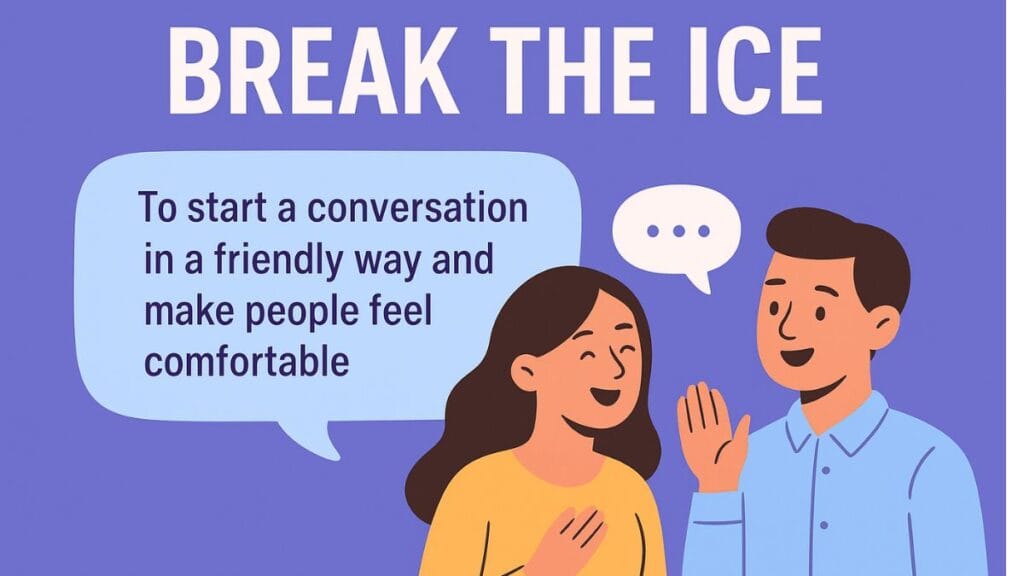
Real-Life Conversation Using “Break the Ice Idiom”
Here is a short conversation between two school friends after a math test. Notice how naturally the idiom fits into the exchange.
| Vikram: | Hey Kiran, was the math test difficult today? |
| Kiran: | Not at all! It was a piece of cake, honestly. |
| Vikram: | Seriously? I found it pretty tricky. |
| Kiran: | The questions were straightforward if you had practised the sample papers. Did you? |
| Vikram: | Not really, I skipped a few. I suppose that is why! I will study properly next time. |
| Kiran: | Trust me — once you cover all the topics, it will be a piece of cake for you too. |
Similar Idioms With Meaning
| Idiom | Meaning |
| Child’s play | A task so simple that even a child could do it. |
| A walk in the park | Very easy and enjoyable to do. |
| As easy as pie | Something that is very easy and quick to complete. |
| A cakewalk | An activity that is simple and effortless. |
Common Mistakes To Avoid
The first and most common mistake is adding the word “very” before the idiom. Many learners say “It was a very piece of cake” — this is grammatically incorrect and sounds unnatural. The idiom already carries the meaning of something being very easy, so adding “very” is both wrong and unnecessary.
| Correct “The test was a piece of cake for me.” |
| Incorrect “The test was a very piece of cake for me.” |
The second mistake is substituting other food words — such as “piece of bread,” “slice of cake,” or “piece of pie.” These all sound wrong because this idiom is fixed. The only correct form is “a piece of cake.”
| Correct “Learning to ride a bicycle was a piece of cake for her.” |
| Incorrect “Learning to ride a bicycle was a slice of cake for her.” |
The third mistake is using this idiom for tasks that are well-known to be extremely difficult. For example, saying “Climbing Mount Everest was a piece of cake” would sound strange and unbelievable to most listeners unless you are being deliberately humorous. Use this idiom for tasks that are genuinely easy or that felt easy because of skill or preparation.
If you want to learn about all the American Idioms, then here is our best curated complete list of A-Z Idioms list in one place.
Practice & Application:Using “Piece of Cake” in Speaking (IELTS & Real Life)
“Piece of cake” is one of the most useful idioms for IELTS Speaking because it comes up naturally when discussing exams, skills, hobbies, or tasks you find easy. Using it confidently signals to the examiner that your vocabulary extends beyond basic words like “easy” or “simple.” It instantly makes your answer sound more fluent and natural.
IELTS Speaking Practice
Part 1 — Short Answer
Question: Do you find exams difficult?
Sample Answer:
It really depends on the subject and how well I have prepared. When I have studied thoroughly and feel confident about the material, the exam feels like a piece of cake. But if I have not revised properly, even a straightforward test can feel quite stressful. So for me, preparation is everything.
Part 2 — Cue Card
Describe a task that you found very easy.
Sample Answer:
I would like to talk about a college presentation I gave last year on a topic I knew extremely well. I had spent a lot of time reading about that subject out of personal interest, long before it was assigned to us. So when the task was announced, I already had most of the knowledge I needed. Preparing the slides took me only a couple of hours, and on the day of the presentation, I spoke confidently without needing to check my notes at all. The whole experience was a piece of cake. I think it was such a smooth experience because passion and prior knowledge together make any task feel effortless. It also reminded me how much easier things become when you genuinely enjoy what you are doing.
Part 3 — Discussion
Question: Why do some people find certain tasks easier than others?
Sample Answer:
People find tasks easier when they already have relevant knowledge, experience, or natural ability in that area. For example, someone who has grown up speaking two languages will find learning a third language far more of a piece of cake than someone starting from scratch. Beyond natural aptitude, consistent practice plays a huge role. The more you repeat a skill, the more automatic it becomes, and eventually what once felt challenging starts to feel effortless.
Question: Do you think practice makes tasks easier over time?
Sample Answer:
Absolutely. Practice builds both skill and confidence, and those two things together are what make a difficult task feel like a piece of cake eventually. Think about learning to drive — the first few lessons feel overwhelming, with so many things to watch and control at the same time. But after months of regular practice, it all becomes second nature. The same principle applies to public speaking, coding, cooking, or almost any other skill. The key is consistent effort over time, not just occasional attempts.
Practice Exercise (Advanced Level)
Rewrite the following sentences using “piece of cake” without changing the meaning:
- The assignment was very easy because I had already studied the topic thoroughly.
- She completed the task quickly and without any difficulty.
- After practising regularly, solving these math problems has become very easy for him.
- The interview felt simple because he was confident and well-prepared.
- Learning basic computer skills was not difficult for her at all.
- Once I understood the concept clearly, the entire chapter became very easy.
- He finished the project effortlessly because of his prior experience.
- The test seemed simple because most of the questions were familiar.
- Cooking this dish is very easy for me since I have made it many times before.
- The training session was easy to follow because the instructor explained everything clearly.
Answer Key
- The assignment was a piece of cake because I had already studied the topic.
- She completed the task — it was a piece of cake.
- After practising regularly, solving these math problems has become a piece of cake for him.
- The interview was a piece of cake because he was confident and well-prepared.
- Learning basic computer skills was a piece of cake for her.
- Once I understood the concept, the entire chapter became a piece of cake.
- He finished the project like a piece of cake, thanks to his prior experience.
- The test was a piece of cake because most of the questions were familiar.
- Cooking this dish is a piece of cake for me since I have made it so many times.
- The training session was a piece of cake because the instructor explained everything clearly.
Try using “piece of cake” the next time someone asks you about a task you found easy. Whether it is a test, a recipe, or a work assignment — using this idiom in real conversation is the fastest way to make it a natural part of your English vocabulary.
FAQs On Piece of Cake
Q: What does “Piece of cake” mean?
It means something is very easy or effortless to do — it requires little effort and can be completed without much difficulty.
Q: How do I use it in a sentence?
Example: “Yesterday’s essay competition was a piece of cake for me — I had practised the topic many times before.”
Q: When should I use this idiom?
Use it whenever you want to describe a task, job, or situation that feels very easy — because of skill, practice, or preparation.
Q: Are there any similar idioms like Piece of cake?
Yes — “child’s play,” “a walk in the park,” “a cakewalk,” “as easy as pie,” and “easy as ABC” all carry a similar meaning.
Q: Can I say “very piece of cake”?
No — this is a common mistake. Never add “very” before the idiom. Just say “a piece of cake.”