
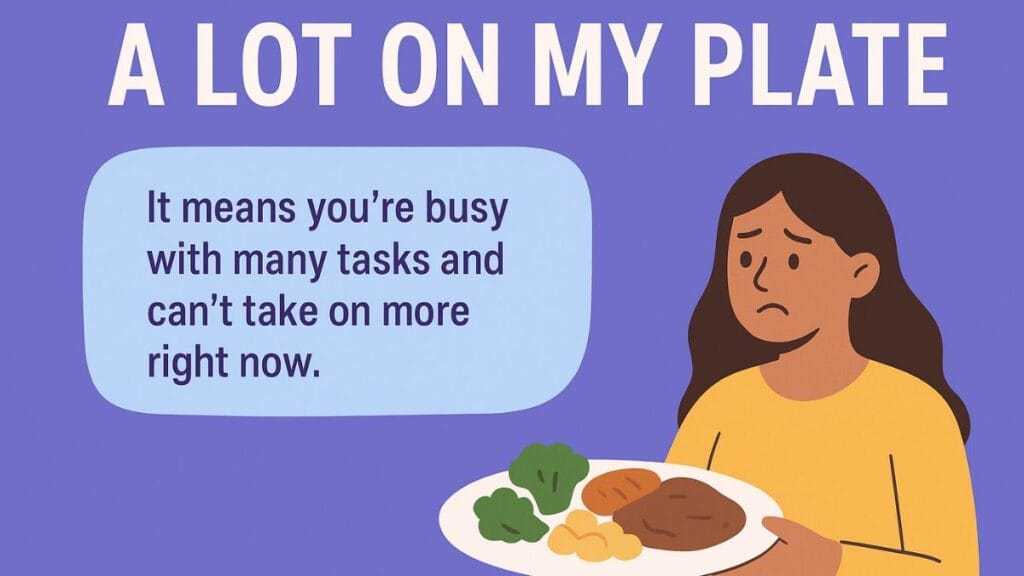
Welcome to our daily Idiom series, designed to help you sound like a native American English speaker. Today’s idiom is “A Lot on My Plate.” In this post, you will learn what it means, how to use it in real sentences, and which common mistakes to avoid.
Idiom A Lot On My Plate meaning
Imagine this situation. You have a project to finish by Friday, a pile of emails to reply to, two meetings to attend, and a friend waiting for your help. You feel stretched in every direction. Instead of simply saying “I’m busy,” there is a more expressive and natural way to describe this feeling in English:
| “I’ve got a lot on my plate right now.” |
The idiom “a lot on my plate” has nothing to do with food. Think of a dinner plate piled so high with food that you cannot possibly finish it all — or add anything more. In the same way, when you have a lot on your plate, you have so many tasks and responsibilities that you feel full up and cannot take on anything extra.
| A lot on my plate = having many tasks, duties, or problems to deal with at the same time |
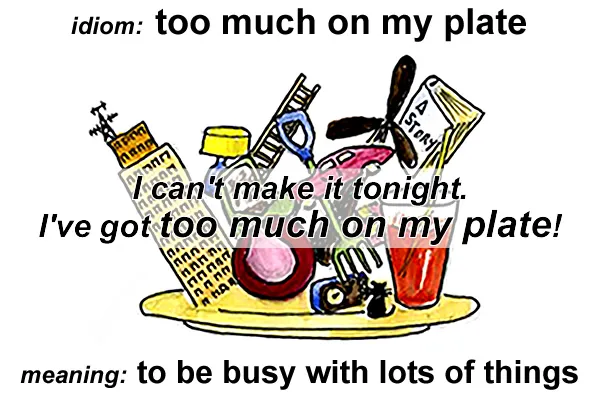
10 Simple Examples of “A Lot On My Plate”
Here are 10 Real-life examples or sentences using the idiom “A lot on my plate.”
- I cannot join the project right now — I already have a lot on my plate.
- She is juggling work, kids, and night school. She really has a lot on her plate.
- Do not worry if he does not reply quickly — he has a lot on his plate this week.
- I had a lot on my plate during finals week, but I managed to get through it.
- They did not take a vacation because they had too much on their plate.
- Managing three events in a single day? That is a lot on anyone’s plate.
- My friend has a lot on his plate with all the wedding planning.
- She apologized for the delay and explained that she had a lot on her plate.
- I would love to help, but I already have a lot on my plate this month.
- After taking a second job, he quickly realized he had too much on his plate.
Want to learn more idioms easily? Check out our Complete Guide to Everyday American Idioms—you’ll find more simple meanings, fun examples, and real-life practice!
Different Sentence Patterns Of A Lot On My Plate Idiom
The idiom can be used in several different structures. Here are the most common ones:
- I have got a lot on my plate right now.
- She has too much on her plate to take on any more work.
- Sorry I am late — there has been a lot on my plate these days.
- He took a break because he had a lot on his plate.
- With the new project and the house move, they have a lot on their plate this month.
Notice that the idiom changes with the subject — my plate, her plate, his plate, their plate. Always match the possessive to the person you are talking about.
Real-Life Conversation Using “A Lot on My Plate”
Here is a short conversation between two colleagues at work. Notice how naturally the idiom fits into everyday speech.
| Deepa: | Hey Arjun, can you help me put together the monthly report this afternoon? |
| Arjun: | I wish I could, but I have a lot on my plate today. I have a client call at two, a team review at four, and I still need to finish the budget summary. |
| Deepa: | No worries — I had no idea you were that busy. I will ask Neha instead. |
| Arjun: | Thanks for understanding. Once things settle down next week, I am happy to help with anything. |
| Deepa: | Of course — sounds good. Take care of yourself too! |
Similar Idioms With Meaning
| Idiom | Meaning |
| Burned out | Tired from doing too much |
| Up to my ears | Extremely busy |
| Snowed under | Overloaded with work |
| Bite off more than you can chew | Take on too much |
| Snowed under | Swamped |
Common Mistakes To Avoid
The most common mistake is changing the word “plate” to something similar — like “table,” “bowl,” or “dish.” These all sound unnatural because the idiom is fixed. It is always plate, never anything else.
| Correct “I have a lot on my plate this semester.” |
| Incorrect “I have a lot on my table this semester.” / “I have a lot in my bowl right now.” |
A second mistake is using this idiom in formal or professional writing. “A lot on my plate” is an informal expression — it sounds natural in a conversation or a casual email to a colleague, but it would sound out of place in a formal report, a job application, or an academic essay. In those contexts, write “I am currently managing several responsibilities” or “I am dealing with a significant workload” instead.
If you want to learn about all the American Idioms, then here is our best curated complete list of A-Z Idioms list in one place.
Practice & Application: “A Lot on My Plate” in Real Situations
“A lot on my plate” is a very useful idiom for IELTS Speaking because it comes up naturally when discussing daily routines, work, studies, or personal responsibilities. Using it confidently shows the examiner that your vocabulary goes beyond basic words like “busy” or “tired.” It also makes your answers sound more fluent and realistic.
IELTS Speaking Practice
Part 1 — Short Answer
Question: Are you usually busy with your daily routine?
Sample Answer:
Yes, most of the time I feel like I have a lot on my plate. Between my studies, assignments, and a few personal responsibilities at home, my days stay quite full. I try to manage everything by planning my schedule the night before, which helps me avoid feeling too overwhelmed.
Part 2 — Cue Card
Describe a time when you were very busy.
Sample Answer:
I would like to talk about a period during my final semester at college. I genuinely had a lot on my plate during those weeks. I had multiple subjects to revise, a major group project to submit, practical exams to prepare for, and on top of all that, I was helping a younger cousin with her school work in the evenings. Everything seemed to demand attention at once. To manage it all, I created a strict daily timetable and cut back on social media almost entirely. It was one of the most stressful periods of my life, but I came out of it feeling proud that I had handled everything without falling apart.
Part 3 — Discussion
Question: Why do people feel stressed when they have too much work?
Sample Answer:
When someone has a lot on their plate, the sheer number of things competing for their attention can become overwhelming. There is constant pressure to meet deadlines, perform well, and not let anyone down — all at the same time. Without a system for managing priorities, people can feel as though they are running in circles without making real progress. Over time, that feeling of being unable to catch up leads to anxiety and burnout.
Question: How can people manage a busy schedule more effectively?
Sample Answer:
The most important thing, in my view, is learning to prioritize. When you have a lot on your plate, not everything on the list is equally urgent. Identifying the two or three tasks that absolutely must be done first — and focusing on those — can make the whole workload feel more manageable. Breaking large tasks into smaller steps also helps, because each small win gives you momentum. And taking short breaks throughout the day actually improves focus rather than wasting time.
Practice Exercise — Advanced Level
Rewrite each sentence below using “a lot on my plate” without changing the meaning.
- I am currently handling multiple work deadlines while also preparing for an important exam next week.
- She is managing her college assignments, a part-time job, and family responsibilities all at the same time.
- He is extremely busy this month because he is working on several projects while attending training sessions.
- I cannot accept any additional tasks right now because I am already dealing with too many responsibilities.
- They are under pressure because they have to organize an event, manage guests, and handle logistics all at once.
- She feels mentally exhausted from balancing work pressure and personal commitments for a long time.
- I have several important things to finish before the deadline, including reports, presentations, and meetings.
- He is finding it difficult to manage both his professional work and personal life due to his packed schedule.
- At the moment I am focused on multiple priorities, so it is hard for me to take a break.
- The manager is handling team issues, client meetings, and project deadlines simultaneously, which keeps him very occupied.
Answer Key
- I have a lot on my plate right now with work deadlines and exam preparation.
- She has a lot on her plate managing her studies, work, and family responsibilities.
- He has a lot on his plate this month with several projects and training sessions.
- I cannot take on more tasks because I already have a lot on my plate.
- They have a lot on their plate organizing the event and managing all the logistics.
- She feels exhausted because she has had a lot on her plate with work and personal commitments.
- I have a lot on my plate before the deadline with reports, presentations, and meetings to finish.
- He has a lot on his plate trying to balance his professional and personal life.
- I have a lot on my plate at the moment, so it is hard to take a break.
- The manager has a lot on his plate handling team issues, client meetings, and project deadlines.
The best way to make any idiom stick is to use it in real life. The next time someone asks you to take on a new task and you are already overwhelmed, try saying: “I would love to help, but I have a lot on my plate right now.” You will be surprised how naturally it comes out after just a few tries.
FAQs On A Lot On My Plate Idiom
Q: What does “a lot on my plate” mean?
It means you are busy with many tasks or responsibilities at the same time and cannot take on anything more right now.
Q: How do I use it in a sentence?
Example: “I cannot go out tonight — I have got a lot on my plate with work and family this week.”
Q: When should I use this idiom?
Use it in casual, informal conversations when you want to explain that you are juggling several responsibilities or feeling overwhelmed. Avoid it in formal writing.
Q: Are there any similar idioms?
Yes — “snowed under,” “swamped,” and “up to my ears” all carry a similar meaning of being very busy or overwhelmed.