Welcome to our daily Idiom series, designed to help you sound like a native American English speaker. Today’s idiom is “On Cloud Nine.” In this post, you will learn what it means, where it comes from, how to use it in real sentences, and which common mistakes to avoid.
Meaning of “On Cloud Nine”
Have you ever felt so happy that it seemed like you were floating above everything — weightless, carefree, and completely at peace with the world? That is exactly the feeling this idiom describes.
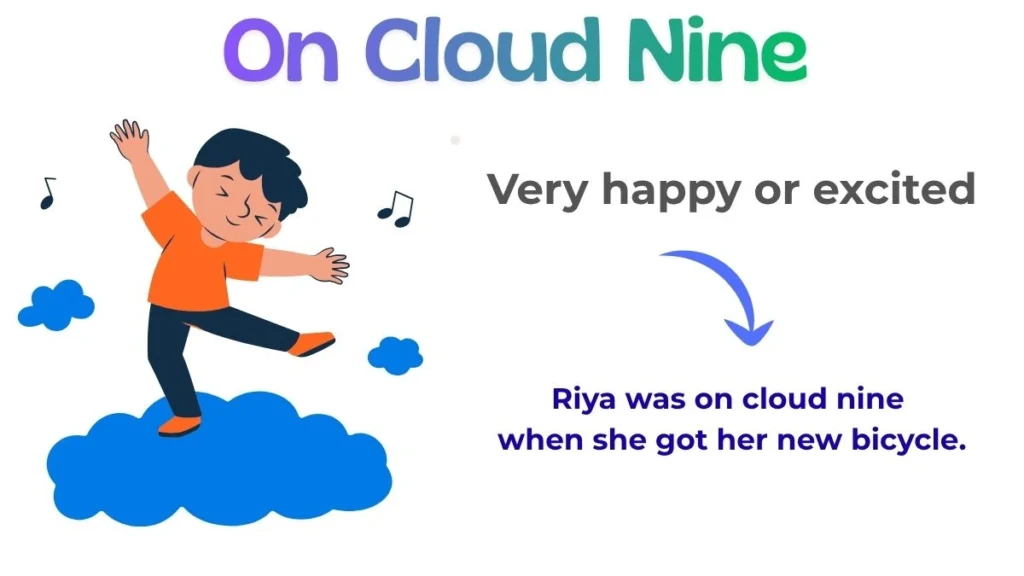
“On cloud nine” is used to express a state of extreme happiness or joy. It is an informal expression, most commonly heard in everyday conversation, text messages, and social media captions. You will often see posts that say “I am on cloud nine right now!” — usually followed by some wonderful news.
| On cloud nine = feeling extremely happy, joyful, or overjoyed |
Simple Examples of “On Cloud Nine Idiom”
Personal happiness:
- “I was on cloud nine when I finally received my first job offer.”
- “She has been on cloud nine since hearing the good news about her exam results.”
- “They have been on cloud nine ever since they got engaged last week.”
Small joys and achievements:
- “I was on cloud nine when my favourite team won the championship.”
- “She was on cloud nine because her painting was selected for the art gallery exhibition.”
- “He was on cloud nine when his friends threw him a surprise birthday party.”
Want to learn more idioms easily? Check out our Complete Guide to Everyday American Idioms — you will find simple meanings, fun examples, and real-life practice.
Different Sentence Patterns of “On Cloud Nine”
Here are the most common ways to use this idiom in a sentence:
- I am on cloud nine right now. (present — currently feeling this way)
- She was on cloud nine after getting the promotion. (past — the feeling has passed)
- He will be on cloud nine when he hears the news. (future — predicting someone’s reaction)
- Getting that scholarship put me on cloud nine for the rest of the week. (what caused the feeling)
- I have been on cloud nine since this morning. (present perfect — started in the past, still ongoing)
Notice that the idiom stays fixed — it is always “on cloud nine,” never “on cloud ten” or “on the ninth cloud.” Only the verb and tense change around it.
Real-Life Conversation Using “On Cloud Nine”
Here is a short conversation between two college friends. Notice how naturally the idiom fits into everyday speech.
| Nisha: | You look different today — what happened? You are practically glowing! |
| Pooja: | I just found out I got selected for the national dance competition. I am literally on cloud nine right now. |
| Nisha: | Are you serious?! That is incredible — you have worked so hard for this. |
| Pooja: | I know! When I read the email, I just froze. I could not believe it. I called my mum immediately and she was on cloud nine too. |
| Nisha: | You absolutely deserve this. Go celebrate — you have earned it! |
Similar Idioms to On Cloud Nine
If you want to expand your vocabulary, here are some phrases similar to “on cloud nine.”
| Idiom | Meaning | Example |
| Over the moon | Extremely happy | “She was over the moon when she got accepted into college.” |
| Walking on air | Feeling light and very happy | “He was walking on air after crossing the marathon finish line.” |
| In seventh heaven | Extremely happy or pleased | “They were in seventh heaven on their wedding day.” |
| Thrilled to bits | Very excited or delighted | “I was thrilled to bits when I met my favourite author.” |
| On top of the world | Feeling wonderful and successful | “After winning the award, she felt on top of the world.” |
| In high spirits | In a cheerful, happy mood | “The whole team was in high spirits after the victory.” |
Want to learn more idioms easily? Check out our Complete Guide to Everyday American Idioms—you’ll find more simple meanings, fun examples, and real-life practice!
Learning idioms like this not only improves your vocabulary but also makes conversations more fun and expressive. Keep practicing them in real-life situations, and soon you’ll be able to use them effortlessly.
Common Mistakes To Avoid
The most common mistake is changing the preposition. Learners often say “in cloud nine” instead of “on cloud nine.” The correct preposition is always on — you are sitting on top of the cloud, not inside it.
| Correct “I was on cloud nine when I heard the news.” |
| Incorrect “I was in cloud nine when I heard the news.” |
The second mistake is adding an article: “on a cloud nine.” There is no “a” in this idiom. It is always “on cloud nine” — no article, no variation.
| Correct “She has been on cloud nine all day.” |
| Incorrect “She has been on a cloud nine all day.” |
The third mistake is using this idiom in formal or academic writing. “On cloud nine” is an informal expression. In a formal report, a job application, or an academic essay, use “extremely happy,” “overjoyed,” or “elated” instead.
If you want to learn more American idioms, check out our complete A-Z idioms list, carefully curated in one place.
Practice & Application: Using “On Cloud Nine” in Speaking (IELTS & Real Life)
“On cloud nine” is a natural fit for IELTS Speaking, particularly in Part 1 when talking about happy memories or personal achievements, and in Part 2 when describing a specific event. It signals to the examiner that you can use idiomatic language fluently and in context — which is one of the key criteria for a high Lexical Resource score.
IELTS Speaking Practice
Part 1 — Short Answer
Question: Can you describe a time when you felt really happy?
Sample Answer:
Absolutely. When I received my university acceptance letter last year, I was completely on cloud nine. I had worked very hard throughout school and had really wanted to get into that particular programme. Reading that email for the first time — I must have re-read it four or five times just to make sure it was real. That entire evening felt magical.
Part 2 — Cue Card
Describe a moment when you felt extremely happy.
Sample Answer:
I would like to talk about the day I found out I had passed my final board examinations with distinction. I had studied for months, often late into the night, and there were many moments when I doubted whether all the effort was worth it. When the results came out and I saw my name on the merit list, I was completely on cloud nine. I called my parents immediately, and my mother burst into tears of joy. My friends came over that evening and we celebrated together. What made it even more special was not just the result itself, but knowing that the people I loved most were sharing that happiness with me. I think the reason that moment felt so powerful was because it was the outcome of genuine hard work — it was not luck. That made the joy feel earned, and therefore even more meaningful.
Part 3 — Discussion
Question: Do you think people today have enough reasons to feel happy?
Sample Answer:
I think happiness is very personal and depends far less on external circumstances than people assume. Some individuals are on cloud nine over small wins — a kind message from a friend, a good meal, finishing a book they loved. Others struggle to feel content even when life looks perfect from the outside. In today’s world, I think the bigger challenge is that social media constantly shows us highlight reels of other people’s happiest moments, which can make our own ordinary days feel insufficient. Learning to find genuine joy in small, everyday things is probably one of the most valuable skills a person can develop.
Question: Are there cultural differences in how people express happiness?
Sample Answer:
Definitely. In some cultures, expressing strong emotions publicly — like saying you are on cloud nine — is completely normal and even encouraged. People hug, shout, and celebrate openly. In other cultures, happiness is expressed more quietly and privately, through a smile or a calm sense of satisfaction. Neither approach is better than the other — they are simply different ways of experiencing and sharing the same universal feeling. What matters is that the happiness itself is genuine.
Practice Exercise — Advanced Level
Rewrite each sentence below using “on cloud nine” without changing the meaning.
- Ananya felt extremely happy when she received her scholarship letter.
- He was overjoyed after his band performed live for the first time.
- The whole family was thrilled when the new baby arrived safely.
- She could not stop smiling after her boss praised her work in front of everyone.
- Vikram felt wonderful when his startup received its first investment.
- After years of trying, they were absolutely delighted to finally buy their own home.
- The students were filled with joy when the school announced a surprise holiday.
- I felt incredibly happy the moment my best friend said yes to being my business partner.
Answer Key
- Ananya was on cloud nine when she received her scholarship letter.
- He was on cloud nine after his band performed live for the first time.
- The whole family was on cloud nine when the new baby arrived safely.
- She was on cloud nine after her boss praised her work in front of everyone.
- Vikram was on cloud nine when his startup received its first investment.
- After years of trying, they were on cloud nine when they finally bought their own home.
- The students were on cloud nine when the school announced a surprise holiday.
- I was on cloud nine the moment my best friend said yes to being my business partner.
The next time something wonderful happens to you — a piece of good news, a small victory, a moment of pure joy — try saying “I am on cloud nine” instead of just “I am happy.” You will be surprised how much more alive the sentence feels.
FAQs On ‘On Cloud Nine‘ Idiom
Q: What does “On cloud nine” mean?
It means feeling extremely happy, joyful, or overjoyed — so happy that it feels like you are floating above everything.
Q: How do I use it in a sentence?
Example: “She was on cloud nine after hearing the good news about her promotion.”
Q: When should I use this idiom?
Use it in casual, everyday conversations when you want to express great happiness or joy. Avoid it in formal writing — use ‘overjoyed’ or ‘elated’ instead.
Q: Are there any similar idioms?
Yes — ‘over the moon,’ ‘walking on air,’ ‘in seventh heaven,’ ‘on top of the world,’ and ‘in high spirits’ all describe a similar feeling of happiness.
Q: Can I say “in cloud nine”?
No — this is the most common mistake. The correct preposition is always ‘on,’ not ‘in.’ Always say ‘on cloud nine.’