Welcome to our daily Idiom series, designed to help you sound like a native American English speaker. Today’s idiom is “Hit the Books.” In this post, you will learn what it means, how to use it in real sentences, and which common mistakes to avoid.
Idiom Hit the Book Meaning
Picture this situation. You have a big exam tomorrow. All week, you have been busy with sports practice, watching your favourite web series, and hanging out with friends. But now, the fun is over. You go to your room, open your books, and start studying seriously. That moment — when you finally sit down and study with full focus — is what we call “hitting the books.”
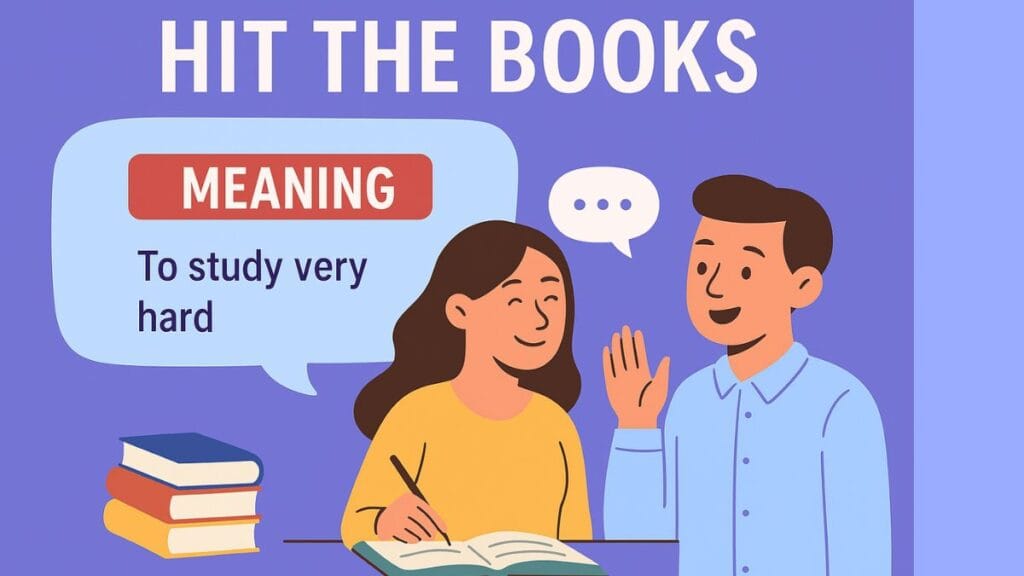
“Hit the books” does not mean you are physically hitting your books with your hand. It is an idiom, which means the phrase carries a special meaning that is different from the individual words. The meaning is simple:
To hit the books = to study seriously or with full focus
For example, you can say: “I need to hit the books to pass my final exams.”
10 Simple Examples of “Hit the Books”
- Riya has a big math exam tomorrow, so she is going to hit the books tonight.
- After the holidays, Raj hit the books to catch up on the lessons he had missed.
- My brother hits the books every evening to prepare for his entrance exam.
- We have a surprise test in English tomorrow, so it is time to hit the books.
- Anjali stopped playing video games and hit the books before her final exams.
- If you want good marks, you need to hit the books regularly.
- Before the science quiz, Arjun hit the books for three hours straight.
- Mom told me to hit the books instead of watching TV all day.
- Kavita hits the books after dinner every night without fail.
- During exam season, most students stay home and hit the books.
Want to learn more idioms easily? Check out our Complete Guide to Everyday American Idioms—you’ll find more simple meanings, fun examples, and real-life practice!
Different Sentence Patterns of “Hit the Books”
- It’s already 9 PM — I really need to hit the books.
- She hit the books all weekend and felt confident going into the exam.
- If you keep putting it off, you will have no time to hit the books before the test.
- The best students hit the books consistently, not just the night before an exam.
Real-Life Conversation Using “Hit the Books”
Here is a simple conversation between two college friends. It shows how this idiom sounds in a natural, everyday situation.
| Vikram: | Hey, are you coming to the cricket match this evening? |
| Simran: | I wish I could, but I have to hit the books tonight. Our chemistry exam is on Friday. |
| Vikram: | Already? I had no idea it was so soon. |
| Simran: | Yeah, I have been procrastinating all week. Time to get serious. |
| Vikram: | Good luck! I should probably hit the books too, honestly. |
Similar Idioms With Meaning
| Idiom | Meaning |
| Burn the midnight oil | To study or work late into the night |
| Crack the books | To begin studying seriously |
| Brush up on | To review or refresh your knowledge about a subject |
| Learn by heart | To memorize something completely |
| Pull an all-nighter | To stay awake all night to study or work |
Common Mistakes To Avoid
Some learners use the idiom in the wrong form. The two most common errors are writing “hit books” (missing “the”) or “hit with the books.” Both are incorrect. The only correct form is “hit the books” — all three words are required.
| Correct “I need to hit the books before the test.” |
| Incorrect “I need to hit books before the test.” / “I need to hit with the books.” |
One more important point: this is a casual idiom. Use it only in informal, everyday conversations — for example, when talking with friends, classmates, or family. Avoid using it in academic writing, formal emails, or professional settings. In those contexts, say “study” or “prepare” instead.
If you want to learn about all the American Idioms, then here is our best curated complete list of A-Z Idioms list in one place.
Practice & Application: “Hit the Books” in Real Situations
Using “Hit the Books” in Speaking (IELTS & Real Life)
“Hit the books” is a great idiom to use in IELTS Speaking, especially in Part 1 or Part 2 when talking about studying, exams, or daily routines. Using it naturally shows the examiner that your vocabulary is not limited to textbook phrases. Just remember to use it only in the informal, conversational tone that the IELTS Speaking test allows.
IELTS Speaking Practice
Part 1 — Short Answer
Question: How do you usually prepare for exams?
Sample Answer:
Honestly, I tend to leave things a little late. But once I realize the exam is close, I really hit the books — usually for a few hours each evening. I find it helpful to review my notes first and then practice past questions. That combination works well for me.
Part 2 — Cue Card
Describe a time when you studied very hard for something.
Sample Answer:
I would like to talk about the time I prepared for my final year college exams. The syllabus was very wide, and I had fallen behind during the semester because of various activities. About three weeks before the exams, I decided to hit the books seriously. I created a timetable, switched off social media, and studied for six to eight hours every day. It was exhausting, but it paid off. I ended up scoring much better than I had expected, and looking back, that period taught me the value of focused, disciplined study.
Part 3 — Discussion
Question: Do you think students today study as hard as previous generations?
Sample Answer:
That is an interesting question. I think students today face more distractions than previous generations did — social media, streaming platforms, and smartphones can all pull attention away from studying. However, when the pressure of an exam arrives, most students still find the motivation to hit the books. The challenge is building the habit of studying consistently, rather than waiting until the last moment. Schools and parents can play a big role in helping young people develop that discipline early.
Question: What are some effective ways to make studying more productive?
Sample Answer:
In my view, the most effective approach is to study in shorter, focused sessions rather than sitting for many hours at a stretch. When you hit the books for 45 minutes with no distractions and then take a short break, you retain information far better than if you study for four hours while constantly checking your phone. Setting a clear goal for each session — such as completing a specific chapter or solving a set of problems — also helps a great deal.
Practice Exercise — Advanced Level
Rewrite each sentence below using “hit the books” without changing the meaning.
- Deepa decided to study seriously after wasting the whole afternoon.
- The students started preparing hard as soon as they heard about the exam.
- He stayed in his room all evening and studied with full concentration.
- My sister told me she was going to study non-stop until midnight.
- After dinner, the whole family went quiet because everyone was studying.
- The coach told the players to focus on their studies during the off-season.
- She turned off her phone and began studying as soon as she got home.
- To get into a good university, you have to study seriously from an early age.
Answer Key
- Deepa decided to hit the books after wasting the whole afternoon.
- The students hit the books as soon as they heard about the exam.
- He hit the books in his room all evening with full concentration.
- My sister told me she was going to hit the books until midnight.
- After dinner, the whole family went quiet because everyone was hitting the books.
- The coach told the players to hit the books during the off-season.
- She turned off her phone and hit the books as soon as she got home.
- To get into a good university, you have to hit the books from an early age.
The more you practise using an idiom in different contexts, the more natural it will feel. Try saying “hit the books” out loud in a sentence today — and then use it again tomorrow in a different situation.
FAQs On Hit the Books Idiom
Q: What does “Hit the books” mean?
It means to study seriously or with complete focus — for example, when preparing for an important exam or test.
Q: How do I use it in a sentence?
Q: When should I use this idiom?
Use it only in casual, informal conversations — such as when chatting with friends or classmates about studying. Avoid it in formal writing or professional emails.
Q: Are there any similar idioms?
Yes — “burn the midnight oil,” “brush up on,” and “crack the books” are all similar in meaning.