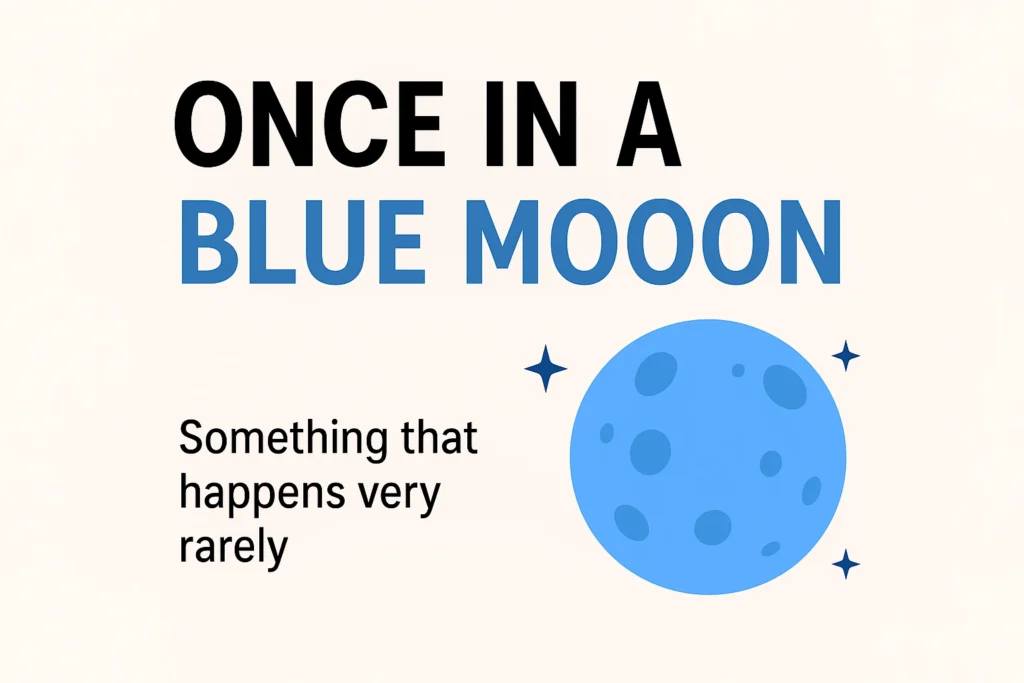
Welcome to our daily Idiom series, designed to help you sound like a native American English speaker. Today’s idiom is “Once in a Blue Moon.” In this post, you will learn what it means, where it comes from, how to use it in real sentences, and which common mistakes to avoid.
Quick Summary
Idiom: Once in a Blue Moon
Meaning: Something that happens very rarely or almost never
Example: I eat junk food once in a blue moon — I try to keep a healthy diet.
Once in a Blue Moon — Meaning
Have you ever had a friend who barely visits — maybe once a year, or even less? Or perhaps there is a dish you love but only allow yourself very occasionally? When something happens so rarely that it almost feels like a special event, English speakers describe it as happening “once in a blue moon.”
| Once in a blue moon = something that happens very rarely, hardly ever, or almost never |
The phrase is used to describe any event, habit, or situation that occurs infrequently. It carries a gentle, slightly wistful tone — not dramatic, just matter-of-fact. For example, if a friend who rarely visits finally comes to see you, you might say: “You come to see me once in a blue moon!” — and everyone will understand exactly what you mean.
10 Simple Examples of Once in a Blue Moon Idiom
- I eat pizza once in a blue moon because I am trying to keep a healthy diet.
- Our family goes on a holiday together once in a blue moon.
- She meets her school friends once in a blue moon — everyone lives so far apart now.
- He cleans his room once in a blue moon, and it shows!
- I watch television once in a blue moon since I am usually too busy.
- They visit their grandparents once in a blue moon, which is a shame.
- Our teacher gives the class a free period once in a blue moon.
- He buys new clothes once in a blue moon — he prefers saving money.
- I go to the cinema once in a blue moon, but when I do, I make the most of it.
- We get snowfall here once in a blue moon — it causes great excitement when it happens.
Want to learn more idioms easily? Check out our Complete Guide to Everyday American Idioms—you’ll find more simple meanings, fun examples, and real-life practice!
Different Sentence Patterns of “Once in a Blue Moon”
This idiom is flexible and works easily in many sentence structures:
- I eat out once in a blue moon. (simple statement about a personal habit)
- Once in a blue moon, she calls to check how I am doing. (placed at the start for emphasis)
- It is a restaurant we visit once in a blue moon, but it is always worth it. (relative clause)
- If he turns up once in a blue moon, at least make him feel welcome. (conditional)
- Events like this happen once in a blue moon — treasure them. (dramatic emphasis)
Note that the idiom is almost always used with the present simple or past simple tense. Using it with future tenses sounds slightly unnatural — instead of “I will eat pizza once in a blue moon,” it is more natural to say “I rarely eat pizza” or simply use the present: “I eat pizza once in a blue moon.”
Real-Life Conversation Using “Once in a Blue Moon”
Here is a short conversation between two old friends catching up after a long time apart. Notice how naturally the idiom fits into the exchange.
| Tanya: | Oh my goodness, Deepak! I feel like I never see you anymore. Where have you been hiding? |
| Deepak: | I know, I know! Work has been absolutely crazy. I come to this part of town once in a blue moon these days. |
| Tanya: | Well, you should come more often! We used to meet up every week. Now it feels like once in a blue moon is an exaggeration — more like once in a blue year! |
| Deepak: | Ha! Fair point. Honestly, I miss it. Let us actually plan something for next weekend — no excuses. |
| Tanya: | Deal. And I am holding you to that — no waiting for another blue moon! |
Similar Idioms
| Idiom | Meaning | Example |
| Once in a lifetime | Happens very rarely or only once ever | “Seeing the Northern Lights was a once-in-a-lifetime experience.” |
| Hardly ever | Almost never | “She hardly ever eats meat — she prefers vegetables.” |
| Few and far between | Not very common; rare occurrences | “Good opportunities like this are few and far between.” |
| Rare as hen’s teeth | Extremely rare (hens have no teeth) | “Affordable housing in that city is rare as hen’s teeth.” |
| Scarcely ever | Very rarely, almost never | “He scarcely ever raises his voice, so when he did, we all noticed.” |
| On rare occasions | Sometimes, but not often (slightly more formal) | “On rare occasions, the committee meets outside the office.” |
Tip: “Once in a blue moon” and “once in a lifetime” are not the same. “Once in a blue moon” means rarely but repeatedly possible. “Once in a lifetime” means something so rare it will probably never happen again.
If you want to learn about all the American Idioms, then here is our best curated complete list of A-Z Idioms list in one place.
Common Mistakes to Avoid
The first mistake is using this idiom to describe something that is genuinely impossible or has never happened. “Once in a blue moon” means rarely — it still implies the thing does actually happen, just not often. For something that never happens at all, use “never” or “not once.”
| Correct “I go to the gym once in a blue moon — maybe three or four times a year.” |
| Incorrect “I have won the lottery once in a blue moon.” (if you have never won, this does not fit) |
The second mistake is changing the wording of the idiom. Common errors include “once in the blue moon” (adding “the”), “once under a blue moon,” or “once at a blue moon.” The correct form is always “once in a blue moon” — no variations.
| Correct “We eat out together as a family once in a blue moon.” |
| Incorrect “We eat out once in the blue moon.” / “We eat out once under a blue moon.” |
The third mistake is using this idiom in formal writing. It is an informal, conversational expression. In a formal report, academic essay, or professional email, use “infrequently,” “on rare occasions,” or “seldom” instead.
If you want to learn all American idioms in one place, check out our complete A-to-Z Idioms list.
Practice & Application: Using “Once in a Blue Moon” in Speaking (IELTS & Real Life)
“Once in a blue moon” is a great idiom for IELTS Speaking because frequency and routine are common topics in Part 1. It also fits naturally in Part 2 when describing a memorable or unusual experience. Using it confidently signals to the examiner that your vocabulary includes natural, idiomatic English — one of the key factors for a high Lexical Resource score.
IELTS Speaking Practice
Part 1 — Short Answer
Question: Do you ever eat at restaurants?
Sample Answer:
Honestly, only once in a blue moon. I enjoy cooking at home, and eating out regularly can be quite expensive. But when a special occasion comes up — a birthday, an anniversary, or a reunion with old friends — I do like to go somewhere nice. It feels like a treat precisely because it does not happen all the time.
Part 2 — Cue Card
Describe something you do very rarely but enjoy when you do it.
Sample Answer:
I would like to talk about going to live music concerts. It is something I do once in a blue moon — perhaps once a year if I am lucky — but every single time, it is an experience I remember for months afterward. I love music and I listen to it every day, but there is something completely different about watching a performance live. The energy in the room, the way the crowd moves together, the fact that every note is slightly different from the recorded version — it all combines to create something quite magical. The reason it happens so rarely is partly the cost and partly finding the right event at the right time. But that rarity actually makes it more special. If I went to concerts every week, I think I would take it for granted. Going once in a blue moon means I am fully present and genuinely appreciating every moment.
Part 3 — Discussion
Question: Do you think people today spend time on hobbies as regularly as they used to?
Sample Answer:
I think many people have hobbies that they pursue only once in a blue moon rather than consistently, and modern life is largely to blame. Busy work schedules, long commutes, and the passive pull of screens — social media, streaming platforms, short video apps — all compete for the time that might otherwise go towards a meaningful hobby. It is ironic, because people often cite hobbies as things they value highly, yet in practice they rarely make time for them. I believe regular engagement with something creative or physical is important for mental wellbeing, and it is something more of us should actively protect time for.
Question: Are there cultural events or traditions in your country that happen very rarely?
Sample Answer:
Yes, definitely. In India, certain festivals and traditions come around once in a blue moon in the sense that they are tied to very specific astronomical or cultural events that do not align often. The Kumbh Mela, for instance, occurs in its largest form — the Maha Kumbh — only once every twelve years. When events like that do happen, millions of people travel from across the country to be part of them, precisely because the opportunity is so rare. It gives the gathering an intensity and meaning that a regular annual event might not carry.
Practice Exercise — Advanced Level
Rewrite each sentence below using “once in a blue moon” without changing the meaning.
- He almost never cooks at home — he orders food delivery nearly every night.
- She visits her relatives in another city very rarely, maybe once a year.
- The two friends hardly ever see each other since they moved to different countries.
- My grandfather rarely uses his smartphone — only when absolutely necessary.
- They take a long holiday together perhaps once every two or three years.
- She hardly ever wears traditional clothes — only at weddings or festivals.
- I buy myself something expensive very infrequently — only on special occasions.
- The whole extended family gets together only on rare occasions.
Answer Key
- He cooks at home once in a blue moon — he orders food delivery nearly every night.
- She visits her relatives in another city once in a blue moon — maybe once a year.
- The two friends see each other once in a blue moon since they moved to different countries.
- My grandfather uses his smartphone once in a blue moon — only when absolutely necessary.
- They take a long holiday together once in a blue moon — perhaps every two or three years.
- She wears traditional clothes once in a blue moon — only at weddings or festivals.
- I buy myself something expensive once in a blue moon — only on very special occasions.
- The whole extended family gets together once in a blue moon.
This idiom is one of the most versatile in everyday English because almost everyone can relate to the feeling of something happening far less often than they would like. Try using it the next time you describe a rare habit, a long-overdue meeting with a friend, or an occasion you only experience occasionally.
Frequently Asked Questions
What does “once in a blue moon” mean?
It means something happens very rarely — only occasionally, after a long gap, or almost never. It is used for things that do happen, just not very often.
How do I use it in a sentence?
Example: “He comes to visit once in a blue moon — I was delighted to see him after so long.”
When should I use this idiom?
Use it in casual, everyday conversations when you want to describe something that happens very infrequently. Avoid it in formal writing — use ‘seldom’ or ‘on rare occasions’ instead.
Can I say “once in the blue moon”?
No — this is a very common mistake. There is no ‘the’ in this idiom. The correct form is always ‘once in a blue moon.’