Welcome to our daily Idiom series, designed to help you sound like a native American English speaker. Today’s idiom is “Kick the Bucket.” In this post, you will learn what it means, where it comes from, how to use it correctly, and — importantly — when NOT to use it.
Quick Summary
Idiom: Kick the Bucket
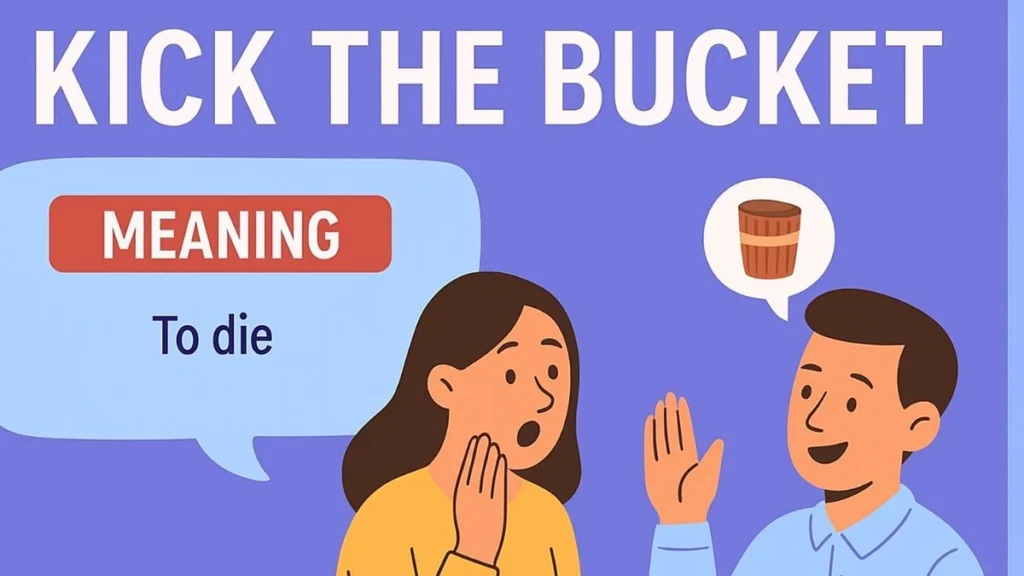
Meaning: To die (used in an informal, dark-humour, or light-hearted way), Can also refer to a machine or object that stops working permanently.
Example: “My grandfather always joked about everything he wanted to do before he kicked the bucket”
“Kick the bucket” is an informal idiom that means to die. It is most often used in a light-hearted or humorous context — in a film, a joke, a casual conversation between friends, or when someone is talking about their own mortality in a self-aware way. You would not use it at a funeral or when offering condolences.
| Kick the bucket = to die (informal, often humorous or casual in tone) |
The idiom can also be used, more loosely, to describe a machine, gadget, or object that has finally stopped working for good — and this extended use is very common in everyday speech. For example: “My old laptop finally kicked the bucket” simply means the laptop stopped working permanently.
Kick the Bucket Idiom Examples
- My grandfather used to joke about all the places he wanted to visit before he kicked the bucket.
- In the film, the hero’s beloved old dog kicked the bucket after a long and happy life.
- He made a long list of experiences he wanted to have before he kicked the bucket.
- The villagers said the old landlord kicked the bucket peacefully in his sleep.
- I want to see the Northern Lights before I kick the bucket — it is at the top of my list.
- The character in the novel kicked the bucket in a dramatic final chapter.
- When the beloved actor kicked the bucket, fans around the world paid tribute.
- Ramesh keeps joking that he will donate everything to charity after he kicks the bucket.
- My old phone finally kicked the bucket — I dropped it one too many times. (used for objects)
- The ancient family car kicked the bucket on the motorway — it was well overdue. (used for objects)
Want to learn more idioms easily? Check out our Complete Guide to Everyday American Idioms—you’ll find more simple meanings, fun examples, and real-life practice!
Different Sentence Patterns of “Kick the Bucket”
Here are the most common ways to use this idiom in a sentence:
- He kicked the bucket last year. (past tense — he has already died)
- She wants to travel the world before she kicks the bucket. (future intention)
- I hope I do not kick the bucket before finishing my book! (humorous, self-referential)
- When my old computer kicked the bucket, I finally bought a new one. (for objects)
- He was 97 when he kicked the bucket — he had a remarkable life. (past, with context)
Important: The idiom always refers to a complete and permanent end — either death or total, irreparable failure of an object. You cannot use it for temporary illness or a device that just needs charging.
Real-Life Conversation Using “Kick the Bucket”
Here is a short, light-hearted conversation between two friends. This shows how the idiom is used in casual speech — with humour, not disrespect.
| Arun: | Did you see that article about people making bucket lists in their 30s? |
| Meera: | Ha! Bucket lists — as in, things to do before you kick the bucket? Yes, I read it. Honestly, it made me think. |
| Arun: | What would be on yours? |
| Meera: | Road trip across Rajasthan, learn to scuba dive, and eat my way through Japan. You? |
| Arun: | Write a novel. I have been saying it for years. At this rate, I will kick the bucket before I finish chapter one! |
| Meera: | Then stop talking about it and start writing! You have time. |
Similar Idioms and Their Meanings
English has several ways to talk about death — some gentle and respectful, others blunt or humorous. Here is how they compare:
| Idiom | Tone | Meaning / Example |
| Pass away | Gentle, respectful | The most polite way to say someone died. “His grandmother passed away peacefully last night.” |
| Give up the ghost | Casual, slightly old-fashioned | To die, or for a machine to stop working. “The printer gave up the ghost right before the deadline.” |
| Bite the dust | Informal, dramatic | To die or fail completely. “Three of our competitors bit the dust during the recession.” |
| Meet one’s maker | Somewhat solemn or ironic | To die — implies facing judgment. “He finally met his maker at the age of 91.” |
| Go to a better place | Comforting, religious | Used to comfort someone who is grieving. “We believe she has gone to a better place.” |
| Kick the bucket | Humorous, irreverent | Casual or dark-humour context only. Never use with someone who is grieving. |
Tip: When someone close to you has lost a person they love, always use ‘pass away’ or ‘go to a better place’ — never ‘kick the bucket.’ Context and tone matter enormously with idioms related to death.
Common Mistakes to Avoid
The most important mistake to avoid is using this idiom in the wrong context. “Kick the bucket” is humorous and irreverent. Using it when speaking to someone who has just lost a family member, at a funeral, or in any situation involving real grief would be deeply inappropriate and hurtful.
| Correct context “He made a joke about kicking the bucket before finishing his bucket list.” (light-hearted, about himself) |
| Wrong context “Sorry to hear your father kicked the bucket.” (never say this to someone who is grieving — use ‘passed away’) |
The second mistake is using it for temporary situations. This idiom only works for permanent, irreversible endings — death or total failure. It cannot be used for something that might recover.
| Correct “My ten-year-old laptop finally kicked the bucket — it will not even turn on.” |
| Incorrect “My phone kicked the bucket — the battery is low.” (not permanent — just needs charging) |
The third mistake is changing the idiom’s form. “Kicked the pail,” “kick the can,” or “kick a bucket” are all wrong. The fixed expression is always “kick the bucket.”
If you want to learn about all the American Idioms, then here is our best curated complete list of A-Z Idioms list in one place.
Practice & Application: Using “Kick the Bucket” in Speaking (IELTS & Real Life)
“Kick the bucket” can appear in IELTS Speaking, particularly in Part 1 or Part 2 when discussing life goals, future plans, or memorable film and book characters. Using it shows the examiner that you understand idiomatic tone and register — which is an advanced skill. However, be mindful of when it is appropriate. In IELTS, if the topic involves someone’s real death or grief, choose ‘passed away’ instead.
IELTS Speaking Practice
Part 1 — Short Answer
Question: Do you have any big dreams or goals you want to achieve in your life?
Sample Answer:
Quite a few, actually. I have a sort of informal bucket list in my head — things I want to experience before I kick the bucket. Seeing the Aurora Borealis is one. Writing something that actually gets published is another. And I have always wanted to learn classical guitar properly, not just the basic chords. Life gets busy, but I think it is important to keep working towards those personal goals alongside the everyday responsibilities.
Part 2 — Cue Card
Describe a film or book character who had an interesting approach to life or death.
Sample Answer:
I would like to talk about the film ‘The Bucket List,’ which I watched a couple of years ago. It features two older men who are both seriously ill and decide to make a list of everything they want to experience before they kick the bucket. What I found compelling about the film was not the grand adventures they went on, but the conversations they had along the way — about regret, about what it means to have lived well, and about finding connection with another person even late in life. The phrase ‘bucket list’ itself has become part of everyday English because of stories like this one. It made me think seriously about my own priorities. The lesson I took from it was simple: do not wait until you are facing the end to start living intentionally. That is a message that resonates regardless of age or culture.
Part 3 — Discussion
Question: Why do you think people make bucket lists?
Sample Answer:
I think bucket lists exist because most people have a gap between the life they are living and the life they imagine for themselves. Day-to-day routine takes over, and aspirations get postponed indefinitely. Writing down what you want to do before you kick the bucket forces you to confront that gap honestly. It also gives people a framework for making decisions — if something aligns with your list, it is worth prioritising. If it does not, perhaps less so. There is also a psychological benefit: having goals, even loosely defined ones, gives people a sense of direction and purpose, which researchers consistently link to greater life satisfaction.
Question: Is it morbid to think about death, or is it healthy?
Sample Answer:
I think it depends on how you engage with the subject. Being obsessively fearful about death is not healthy. But thinking about it calmly — acknowledging that life is finite and using that awareness as motivation — can be genuinely positive. Many philosophical traditions, from Stoicism to Buddhism, actually encourage contemplating mortality as a way to appreciate the present more fully. The fact that we will all eventually kick the bucket is not a depressing thought if it helps us ask: am I spending my time on things that actually matter to me? That is a useful question at any age.
Practice Exercise — Advanced Level
Rewrite each sentence below using “kick the bucket” without changing the meaning. Pay attention to whether the idiom is being used for a person or an object.
- The old cat finally died after seventeen years of being part of the family.
- She has a long list of countries she wants to visit before she dies.
- The ancient washing machine stopped working completely last Tuesday.
- He joked that he would keep working until the day he died.
- When the beloved author died, the literary world mourned the loss.
- My first bicycle finally fell apart beyond repair after twenty years.
- He said he would never retire — they would have to carry him out of the office after he died.
- The ancient generator at the campsite gave out permanently during the storm.
Answer Key
- The old cat finally kicked the bucket after seventeen years of being part of the family.
- She has a long list of countries she wants to visit before she kicks the bucket.
- The ancient washing machine kicked the bucket last Tuesday.
- He joked that he would keep working until the day he kicked the bucket.
- When the beloved author kicked the bucket, the literary world mourned the loss.
- My first bicycle finally kicked the bucket after twenty years.
- He said he would never retire — they would have to carry him out of the office after he kicked the bucket.
- The ancient generator at the campsite kicked the bucket during the storm.
Notice how examples 3, 6, and 8 use the idiom for objects rather than people. This extended, humorous use is very common in everyday English and is perfectly natural to use — as long as the failure is total and permanent, not temporary.
Frequently Asked Questions
Q: What does “kick the bucket” mean?
It means to die — used informally, often with humour. It can also be used for machines or objects that stop working permanently.
Q: How do I use it in a sentence?
Example: “He had a whole list of adventures he wanted to complete before he kicked the bucket.”
Q: When should I NOT use this idiom?
Never use it when speaking to or about someone who is genuinely grieving. It is humorous and irreverent — in those situations, always say ‘passed away’ instead.
Q: Can I use it for objects?
Yes — this is common and natural. ‘My old laptop kicked the bucket’ means it stopped working permanently. It should only be used for total, irreversible failure, not temporary problems.