Welcome to our daily Idiom series, designed to help you sound like a native American English speaker. Today’s idiom is “The Ball is in Your Court.” In this post, you will learn what it means, where it comes from, how to use it correctly, and — importantly — when NOT to use it.
Quick Summary:
| Idiom | The Ball is in Your Court |
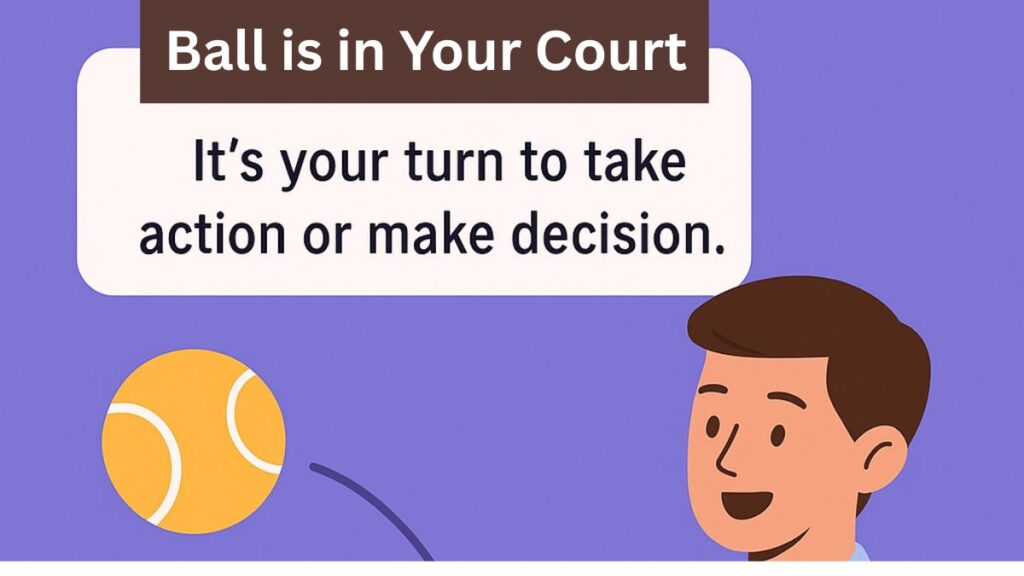
| Meaning | It is your turn to take action or make a decision — the responsibility has passed to you |
| Extended use | Also used to signal the end of one person’s effort in a negotiation, argument, or relationship — the next move belongs to the other person |
| Example | “I have done everything I can. Now the ball is in your court.” |
| Register | Informal to semi-formal — natural in casual conversation, workplace discussions, and negotiations. Avoid in very formal written documents. |
Want to learn more idioms easily? Check out our Complete Guide to Everyday American Idioms—you’ll find more simple meanings, fun examples, and real-life practice!
The Ball is in Your Court — Meaning
“The ball is in your court” is an idiom that means it is now your turn to act, decide, or respond. One person has done their part — made an offer, sent information, taken a first step — and now the responsibility for what happens next lies with the other person. It is one of the most widely used idioms in professional and everyday English, and it sounds completely natural in both spoken and written communication.
The ball is in your court = it is your turn to act or decide (informal, widely used in conversation and professional settings)
The idiom works in a wide range of contexts — personal relationships, business negotiations, job applications, legal matters, and everyday decisions. Whenever one party has done what they can and is now waiting on another to make the next move, this phrase fits perfectly.
It is also commonly used to politely but firmly signal that you are done waiting — that you have fulfilled your responsibility and the other person must now respond. This makes it particularly useful in professional emails and workplace conversations, where directness and politeness must be balanced carefully.
The Ball is in Your Court — Idiom Examples
- I have already sent you all the details about the project. Now the ball is in your court, Riya.
- After explaining everything to my parents, I told them the ball is in their court to decide about the trip.
- We have done all we can to fix the issue, Mr. Verma. The ball is in your court now to approve the final plan.
- When Maya confessed her feelings to Raj, she smiled and said, “Now the ball is in your court.”
- The teacher gave us the topic and guidelines — the ball is in our court to complete the presentation.
- I have made my apology. Now the ball is in her court if she wants to forgive me.
- The lawyer confirmed he had submitted all the documents. The ball was now in the judge’s court.
- The company has made their offer — the ball is in your court if you want to accept or negotiate.
- I have done my part of the house chores, so the ball is in your court to do the dishes!
- After weeks of preparation, the manager told his team, “We have done everything — the ball is in the client’s court now.”
Want to learn more idioms easily? Check out our Complete Guide to Everyday American Idioms — you will find simple meanings, fun examples, and real-life practice.
Different Sentence Patterns of “The Ball is in Your Court”
Here are the most common ways to use this idiom in a sentence:
- “The ball is in your court.” (direct — telling someone it is their turn to act)
- “The ball was in his court.” (past tense — describing a situation where someone had to decide)
- “I have done my part — now the ball is in your court.” (explaining that your effort is complete)
- “The ball is now in their court.” (reporting to a third party that someone else must act)
- “At this point, the ball is entirely in your court.” (adding emphasis — the responsibility is fully theirs)
| Important: The idiom can refer to a single person (“the ball is in your court”) or a group (“the ball is in their court”). The subject changes but the structure of the phrase stays fixed. Never say “the ball is at your court” or “the ball is on your side” — the correct preposition is always “in.” |
Real-Life Conversation Using “The Ball is in Your Court”
Here is a short, natural conversation between two colleagues discussing a business deal. This shows how the idiom fits into professional and casual speech alike.
| Speaker | Dialogue |
| Arun: | I finally sent the revised proposal to the client this morning — all updated figures, the new timeline, everything they asked for. |
| Meera: | Good. That has been hanging over us for two weeks. How did they respond? |
| Arun: | Nothing yet. I sent it at nine and it is nearly four now. |
| Meera: | Well, the ball is in their court now. You have done everything right — the proposal is solid. |
| Arun: | I know. I just hate the waiting. What if they come back and ask for more changes? |
| Meera: | Then you deal with it. But until they respond, there is nothing more you can do. Stop worrying and let them make their move. |
| Arun: | You are right. The ball is in their court. I need to let it go for now. |
| Meera: | Exactly. And if they have not replied by Friday, then you follow up. That is when the ball comes back to you. |
Similar Idioms and Their Meanings
English has several ways to express that responsibility or a decision belongs to someone else. Here is how they compare:
| Idiom | Tone | Meaning / Example |
| The ball is in your court | Neutral, versatile | “We have submitted the bid. Now the ball is in their court.” |
| Your move | Casual, direct | It is your turn to act — often used in a competitive or playful context. “I have made my offer. Your move.” |
| Up to you | Casual, simple | The decision is yours to make. “I have given you all the information — it is up to you now.” |
| Make the call | Direct, decisive | Take the final decision. “Someone has to make the call — it should be you.” |
| In your hands | Neutral, slightly formal | The outcome depends on you. “The future of this project is now in your hands.” |
| Hold the reins | Formal, authoritative | Be in charge and direct what happens next. “With the new promotion, she now holds the reins.” |
| Tip: “The ball is in your court” is the most neutral and professional of these options — it works in both spoken conversation and semi-formal writing such as emails. “Your move” is more competitive and playful. “Up to you” is the most casual and simple. Choose based on the formality of the situation. |
Common Mistakes to Avoid
The most common mistake is using the idiom when both parties are still actively working on something. “The ball is in your court” means one person has finished their part — the handoff is complete. It does not mean “we are both still figuring this out.”
Correct context
“I have sent the signed contract. The ball is in your court to countersign and return it.” (one side has acted — now the other must respond)
Wrong context
“We are both still researching the options. The ball is in your court.” (incorrect — if both sides are still working, use “we are still figuring it out” instead)
The second mistake is changing the preposition. “The ball is at your court,” “on your court,” or “by your court” are all wrong. The correct and fixed phrase always uses “in” — the ball is in your court.
Correct
“The ball is in your court — let me know your decision.”
Incorrect
“The ball is at your court now.” (always use “in” — never “at,” “on,” or “by”)
The third mistake is using the phrase aggressively. While the idiom is direct, its natural tone is calm and matter-of-fact — not accusatory. Avoid saying it in a way that sounds like you are blaming or pressuring someone. In professional contexts especially, pairing it with a supportive phrase softens it: “I have done my part — the ball is in your court whenever you are ready.”
If you want to learn all American idioms in one place, check out our complete A-to-Z Idioms list.
Practice & Application: Using “The Ball is in Your Court” in Speaking (IELTS & Real Life)
“The ball is in your court” can appear in IELTS Speaking in Part 1 when discussing decision-making or responsibility, in Part 2 when describing a negotiation, a workplace situation, or a moment when you had to wait for someone else to act, and in Part 3 when discussing leadership, teamwork, or conflict resolution. It also works naturally in semi-formal writing — such as a follow-up email — without sounding too casual.
IELTS Speaking Practice
Part 1 — Short Answer
Question: Do you find it easy to make decisions?
Sample Answer:
It depends on the type of decision. For small, everyday things — what to eat, which route to take — I decide quickly and move on. But for decisions that affect other people, I prefer to gather as much information as possible before committing. I think the hardest situations are the ones where you have done everything you can and then you have to wait — when the ball is in someone else’s court and there is nothing more you can do. That kind of waiting is more uncomfortable for me than the decision itself.
Part 2 — Cue Card
Describe a situation where you had to wait for someone else to make an important decision.
Sample Answer:
I would like to talk about a job application I made about two years ago. It was a position I really wanted — a role at a media company in Bangalore that I had been keeping an eye on for months. I spent weeks preparing my portfolio, writing and rewriting my cover letter, and rehearsing for the interview. By the time the final interview was done, I felt I had given everything I had. And then came the hardest part — the waiting. My friend told me, “You have done your bit. The ball is in their court now.” That helped, actually. It reminded me that I had no more control over the outcome and that all I could do was wait and prepare for whatever came next. They took ten days to respond, which felt like forever. But when they did come back, it was with an offer. I think that experience taught me something important: once you have genuinely done your best, the ability to let go and wait calmly is itself a skill worth developing.
Part 3 — Discussion
Question: In group work or team projects, how should responsibility be divided?
Sample Answer:
I think the most effective teams are ones where responsibility is clearly handed off rather than shared vaguely. When everyone is responsible for everything, often no one takes real ownership of anything. It helps to have clear moments of handoff — where one person finishes their part, says “the ball is in your court,” and the next person knows exactly what they need to do. This kind of structured passing of responsibility keeps projects moving and prevents the situation where tasks get stuck because two people each assumed the other was handling it. Good communication about who is responsible at each stage is, in my experience, what separates teams that deliver from teams that do not.
Question: Do you think people avoid making decisions? Why?
Sample Answer:
Yes, I think many people do — and I understand why. Making a decision means accepting responsibility for the outcome, and that can feel risky, especially if the stakes are high or the situation is uncertain. It is much more comfortable to keep the ball in someone else’s court — to delay, to ask for more information, to wait for consensus. But this avoidance has real costs. In business, delayed decisions can mean missed opportunities. In relationships, unresolved choices create tension and uncertainty for everyone involved. I think the ability to make a clear decision — even an imperfect one — and communicate it calmly is one of the most underrated skills in both personal and professional life.
Practice Exercise — Advanced Level
Rewrite each sentence below using “the ball is in your court” or “the ball is in their court” without changing the meaning. Think about who has acted and who now needs to respond.
- I have sent the report — now it is up to the manager to review and approve it.
- She told him how she felt. Now it is his turn to decide what to do.
- The client has received our revised quote. It is their turn to respond.
- I have apologised twice. Whether we move forward is now his decision.
- The university received all my documents. Now I just have to wait for their decision.
- We have made our final offer. They need to decide if they want to accept it.
- The doctor has given him all the options. It is now up to him to decide on treatment.
- I have done my part of the group project. The rest is up to my teammates.
Answer Key
- I have sent the report — the ball is now in the manager’s court to review and approve it.
- She told him how she felt. Now the ball is in his court to decide what to do.
- The client has received our revised quote. The ball is in their court to respond.
- I have apologised twice. The ball is in his court — whether we move forward is his decision now.
- The university has received all my documents. The ball is in their court.
- We have made our final offer. The ball is in their court to decide whether to accept it.
- The doctor has given him all the options. The ball is in his court to decide on treatment.
- I have done my part of the group project. The ball is in my teammates’ court now.
| Notice: how the subject of the idiom always refers to the person who must act next. Once you identify who is responsible for the next move, simply say “the ball is in [their] court.” The structure never changes — only the person changes. |
If you want to learn about all the American Idioms, then here is our best curated complete list of A-Z Idioms list in one place.
Frequently Asked Questions
What does “the ball is in your court” mean?
It means it is your turn to act, respond, or make a decision. One person has done their part and is now waiting for the other to take the next step.
How do I use it in a sentence?
“I have sent the proposal — the ball is in your court now.” Or: “She made her feelings clear. The ball is in his court.”