Welcome to our daily Idiom series, designed to help you sound like a native American English speaker. Today’s idiom is “Hit the Sack.” In this post, you will learn what it means, where it comes from, how to use it correctly, and — importantly — when NOT to use it.
Quick Summary
| Idiom | Hit the Sack |
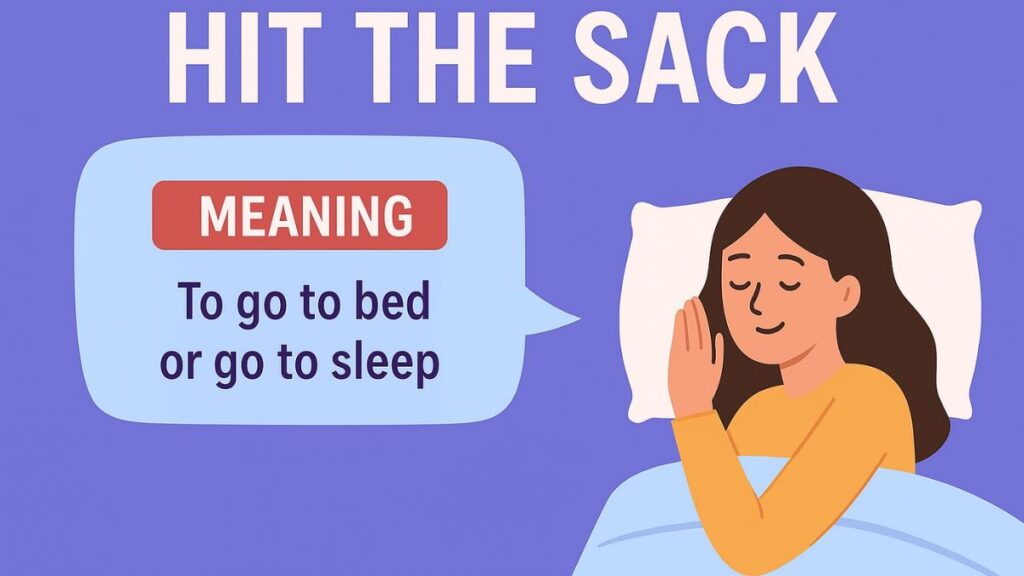
| Meaning | To go to bed — used in a casual, informal, everyday way |
| Extended use | Can also express extreme tiredness or the desire to sleep — not just the physical act of going to bed |
| Example | “It is already midnight — I am going to hit the sack.” |
| Register | Informal — suitable for casual conversation between friends, family, or colleagues. Not appropriate in formal written communication. |
“Hit the sack” is an informal idiom that means to go to bed. It is one of the most common and widely understood idioms in everyday American English, used freely among friends, family members, and in casual workplace settings. It carries a sense of tiredness and readiness for sleep — the kind of natural, end-of-day feeling that needs no explanation.
Hit the sack = to go to bed (informal, casual, and very common)
The idiom can also be used more loosely to express the strong desire or intention to sleep, not just the act of physically going to bed. Saying “I need to hit the sack” communicates both tiredness and the decision to rest. It is often said at the end of an evening — after a long day, a party, a late dinner, or a long journey — as a friendly and natural way of excusing oneself.
Unlike some idioms, “hit the sack” is never used sarcastically or in a dark-humour context. It is always light, casual, and warm — simply a colloquial way of saying goodnight and heading to bed.
Where Does “Hit the Sack” Come From?
The origin of this idiom is straightforward and rooted in history. Before modern mattresses became widely available, many ordinary people — particularly workers, travellers, and soldiers — slept on large cloth sacks or bags stuffed with straw, hay, or other material. These were simple, practical sleeping surfaces, and “hitting” (lying down on) the sack meant going to sleep.
The phrase became especially common in American English during the nineteenth and early twentieth centuries, when such sleeping arrangements were still widely used — in military camps, on cattle drives, in frontier settlements, and in labourers’ lodgings. Soldiers, cowboys, and working men would “hit the sack” at the end of an exhausting day.
A closely related expression, “hit the hay,” comes from exactly the same origin — hay being another common filling for sleeping sacks. Both expressions mean exactly the same thing and are equally common in modern American English.
By the mid-twentieth century, the idiom was firmly established in everyday American speech. It has since spread widely and is now understood throughout the English-speaking world, from the United States and Canada to Australia and the United Kingdom.
Hit the Sack Idiom Examples
- “It is nearly midnight — I think I am going to hit the sack.”
- After the long flight, all Priya wanted to do was hit the sack.
- “I am exhausted. I am going to hit the sack as soon as I get home.”
- The children hit the sack early after a full day at the beach.
- “We have an early start tomorrow, so let’s hit the sack soon.”
- Raj said goodnight to everyone and hit the sack at half past ten.
- “I cannot keep my eyes open — I need to hit the sack right now.”
- After the party wound down, the guests thanked the host and hit the sack.
- “You look exhausted. Why don’t you hit the sack and we can talk tomorrow?”
- “I usually hit the sack around eleven, but last night it was well past one.”
Want to learn more idioms easily? Check out our Complete Guide to Everyday American Idioms — you will find simple meanings, fun examples, and real-life practice.
Different Sentence Patterns of “Hit the Sack”
Here are the most common ways to use this idiom in a sentence:
- “I am going to hit the sack.” (present — expressing immediate intention)
- “She hit the sack at nine.” (past tense — she went to bed at nine)
- “We should hit the sack soon.” (suggestion — recommending sleep)
- “I need to hit the sack — I am completely drained.” (expressing strong tiredness)
- “He usually hits the sack around ten.” (habitual — his regular bedtime)
| Important: “Hit the sack” always refers to going to bed to sleep — it cannot be used for a short nap or a rest on the sofa. For a brief daytime sleep, use “take a nap” instead. The idiom also only describes going to bed, not waking up — you would never say “I hit the sack at 7 a.m.” |
Real-Life Conversation Using “Hit the Sack”
Here is a short, natural conversation between two friends at the end of a long evening. This shows how the idiom fits into casual speech — easy, relaxed, and completely natural.
| Speaker | Dialogue |
| Arun: | Right, I think that is me done for the night. I am absolutely shattered. |
| Meera: | Already? It is only half ten! |
| Arun: | I know, but I was up at five this morning for that meeting. I have been running on coffee since noon. |
| Meera: | Fair enough. Go on, hit the sack. You look like you need it. |
| Arun: | Ha — I really do. I think I will be asleep before my head hits the pillow. |
| Meera: | Same, honestly. I should hit the sack too. Big day tomorrow. |
| Arun: | Then let’s both call it a night. Good night! |
| Meera: | Night! Sleep well. |
Similar Idioms and Their Meanings
English has several casual ways to talk about going to sleep. Here is how they compare:
| Idiom | Tone | Meaning / Example |
| Hit the sack | Casual, friendly | “I am exhausted — time to hit the sack.” |
| Hit the hay | Casual, slightly rustic | Same meaning as hit the sack — equally common. “It is late. I am going to hit the hay.” |
| Call it a night | Casual, social | End the evening — used in social settings. “I think I am ready to call it a night.” |
| Turn in | Mild, slightly formal | Go to bed — slightly more formal than hit the sack. “I think I will turn in early tonight.” |
| Catch some Z’s | Very casual, American | Get some sleep — playful and informal. “I am going to catch some Z’s before the drive.” |
| Go to bed | Neutral, standard | The plain, non-idiomatic version — suitable in all contexts. “What time did you go to bed?” |
| Tip: “Hit the sack” and “hit the hay” are completely interchangeable in meaning and tone. Both are casual and warm. If you are not sure which to use, either will always work. For more formal situations — a written message to a senior colleague, for example — use “turn in” or simply “go to bed.” |
Common Mistakes to Avoid
The most common mistake is using “hit the sack” in a formal or written context where it sounds too casual.
Correct context
“It is late — I am going to hit the sack. See you tomorrow.” (casual spoken conversation — perfectly natural)
Wrong context
“Dear Mr. Sharma, I will now hit the sack and respond to your email in the morning.” (never use this in formal written communication — write “I will respond in the morning” instead)
The second mistake is using it for a daytime rest. “Hit the sack” specifically means going to bed at night for a full sleep — not a short nap or lying down on the sofa.
Correct
“I am worn out. I am going to hit the sack early tonight.”
Incorrect
“I hit the sack for twenty minutes after lunch.” (use “take a nap” for a short daytime rest — not “hit the sack”)
The third mistake is changing the wording. “Hit the bed,” “strike the sack,” or “punch the sack” are all incorrect. The fixed expression is always “hit the sack.”
If you want to learn all American idioms in one place, check out our complete A-to-Z Idioms list.
Practice & Application: Using “Hit the Sack” in Speaking (IELTS & Real Life)
“Hit the sack” can appear in IELTS Speaking, particularly in Part 1 when discussing daily routines, sleep habits, or lifestyle, and in Part 2 when describing a memorable day or an experience involving travel and exhaustion. Using it naturally signals to the examiner that you understand informal register — an advanced skill. Keep it in spoken answers; never use it in Writing Task 1 or Task 2.
IELTS Speaking Practice
Part 1 — Short Answer
Question: What time do you usually go to sleep?
Sample Answer:
On weekdays I try to hit the sack by around eleven — I find that if I go much later than that, I struggle to focus the next morning. But honestly, during exam season or when a deadline is coming up, it is often closer to one or two in the morning. I have noticed that my mood and concentration are noticeably better when I get a full seven hours, so I try to be disciplined about it. I am not always successful, but it is something I am working on.
Part 2 — Cue Card
Describe a time when you were extremely tired.
Sample Answer:
I would like to talk about a trip I took with my family last year — we travelled from Bangalore to London, which involved an overnight flight, a long layover, and then another connection. By the time we arrived at our hotel, we had been travelling for nearly twenty-two hours. I remember walking into the room, putting my bag down, and sitting on the edge of the bed — and then suddenly it was morning. I had hit the sack without even meaning to. I did not change my clothes, I did not set an alarm, I just fell asleep sitting there. My mother found it hilarious. But I genuinely cannot remember ever being that tired before or since. The strange thing is, I woke up feeling completely fine — the body is remarkable in how it can recover with just one good night of sleep.
Part 3 — Discussion
Question: Do you think people today get enough sleep? Why or why not?
Sample Answer:
Honestly, I do not think most people do — at least not in urban environments. There is a kind of cultural pressure, especially among younger people and professionals, to stay productive for as long as possible and to treat sleep as something you fit in around everything else rather than as something essential. People feel guilty for wanting to hit the sack at a reasonable hour when there are still messages to reply to or work to finish. But the research is very clear: chronic sleep deprivation affects memory, decision-making, mood, and long-term physical health in serious ways. I think the attitude towards sleep is slowly changing — there is more awareness now than there was ten years ago — but the behaviour has not caught up with the knowledge yet.
Question: How has technology affected people’s sleep habits?
Sample Answer:
Enormously, and mostly negatively. The main issue is that screens — phones, tablets, laptops — emit blue light that interferes with the body’s natural sleep signals, making it harder to feel sleepy even when you are genuinely tired. Beyond the physical effect, there is also the psychological pull of social media and streaming platforms, which are specifically designed to keep you engaged for one more minute, one more episode, one more scroll. People who would otherwise hit the sack at a sensible hour find themselves awake at two in the morning without quite knowing how it happened. That said, technology has also produced some helpful tools — sleep tracking apps, white noise machines, and digital alarm systems that wake you at the lightest stage of your sleep cycle. So it is a complicated picture, but on balance I think the negative effects outweigh the positive ones for most people.
Practice Exercise — Advanced Level
Rewrite each sentence below using “hit the sack” without changing the meaning. Pay attention to the tense and the context.
- She went to bed very early because she had an important exam the next morning.
- After the long drive, he went straight to bed without even unpacking.
- I am planning to go to bed early tonight — I have barely slept all week.
- The children were so tired after the school trip that they went to bed before seven.
- We had such a long day at the conference that everyone went to bed as soon as they got back to the hotel.
- He told me he usually goes to bed around midnight on weekends.
- “You look completely exhausted — why don’t you go to bed?”
- After the party finally ended, we all went to bed and slept until noon.
Answer Key
- She hit the sack very early because she had an important exam the next morning.
- After the long drive, he hit the sack without even unpacking.
- I am planning to hit the sack early tonight — I have barely slept all week.
- The children were so tired after the school trip that they hit the sack before seven.
- We had such a long day at the conference that everyone hit the sack as soon as they got back to the hotel.
- He told me he usually hits the sack around midnight on weekends.
- “You look completely exhausted — why don’t you hit the sack?”
- After the party finally ended, we all hit the sack and slept until noon.
| Notice: how the idiom works naturally in all tenses — past, present, and future intention. The only constant is that it always refers to going to bed for a proper sleep, never a short rest. |
Want to learn more idioms easily? Check out our Complete Guide to Everyday American Idioms—you’ll find more simple meanings, fun examples, and real-life practice!
What does “hit the sack” mean?
It means to go to bed. It is an informal, casual expression used to describe going to sleep — usually at night, at the end of the day.
How do I use it in a sentence?
“It is nearly midnight and I have an early start — I am going to hit the sack.” Or: “She hit the sack as soon as she got home.”
Is “hit the sack” the same as “hit the hay”?
Yes — they mean exactly the same thing and are equally common in American English. Both come from the same historical origin of sleeping on straw-filled sacks. Use whichever feels natural.