If you’ve ever worked with an Indian colleague, had an Indian friend, or even watched an Indian YouTube video — you’ve probably heard it.
“Do one thing…”
And then they gave you three things to do.
Wait. What?
The Most Confusing Phrase in Indian English
Here’s how it usually goes:
You ask someone for help. Maybe you’re lost. Maybe you need directions. Maybe you’re at a shop trying to return something.
And the person looks at you, thinks for a second, and says —
“Do one thing. Go to the second floor, ask for the manager, and tell him Ravi sent you.”
Three steps. One thing. Classic.
If you’re not Indian, your brain probably short-circuited a little. You’re standing there thinking — that was definitely not one thing.
But if you grew up in India? You didn’t even notice. Because “do one thing” doesn’t actually mean one thing.
So What Does It Actually Mean?
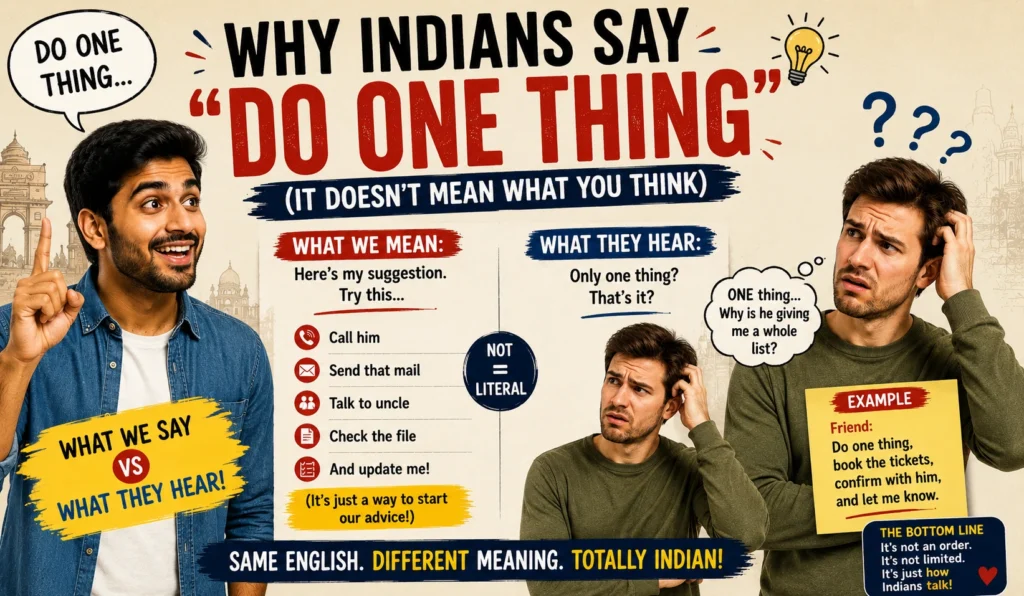
“Do one thing” is basically an Indian way of saying:
“Okay, listen. Here’s what you should do.”
It’s a conversation starter. A way to say — I have a solution for you, pay attention.
It signals that advice is coming. Something helpful is about to follow. Think of it like saying “here’s the deal” or “okay so” — just with a very literal translation from Indian languages underneath it.
Where Did It Come From?
This one has roots in Hindi and several other Indian languages.
In Hindi, people say “Ek kaam karo” — which directly translates to “do one thing.” It’s used the same way — to introduce a suggestion or a solution.
When Indians started speaking English, this phrase came along for the ride. Word for word. Straight translation, no adjustments made.
And honestly? It stuck. Because it works. It gets attention. It tells the other person — stop, listen, I’ve got something useful to say.
You’ll Hear It Everywhere
This phrase shows up in every corner of Indian life:
- At the office: “Do one thing — send me the report first and we’ll discuss in the meeting.”
- At home: “Do one thing, just call your aunt and wish her. She’ll be happy.”
- At a restaurant: “Do one thing — try the butter chicken. You won’t regret it.”
- From your mom: “Do one thing. Study. That’s it. Just study.” (okay that one actually is one thing)
It’s warm. It’s direct. It’s very, very Indian.
Why Foreigners Find It So Confusing
The confusion is totally understandable.
In most parts of the world, if someone says “do one thing” — they mean exactly that. One task. One action. One step.
So when an Indian person says it and follows up with a five-step plan, foreigners genuinely don’t know what happened.
Some think they misheard. Some think it’s a joke. Some just nod politely and hope for the best.
The funniest reactions usually come in Indian offices with international teams. The foreign colleague hears “do one thing” and waits for one simple instruction — and then gets an entire workflow handed to them.
It’s Not Wrong. It’s Just Ours.
Here’s the thing about Indian English — it’s not broken English. It’s not bad English.
It’s its own version of English. Shaped by Indian languages, Indian culture, and the way Indians naturally think and talk.
“Do one thing” makes perfect sense once you understand it. It’s efficient, it’s friendly, and honestly — it’s a great way to get someone’s attention before giving advice.
Languages borrow from each other all the time. Indian English just does it in a very open, unapologetic way. And that’s what makes it so interesting.
One More Thing Before You Go
If you’re ever in India and someone says “do one thing” to you — just smile and listen carefully.
Because whatever comes next? It’s probably solid advice.
Even if it involves four steps.
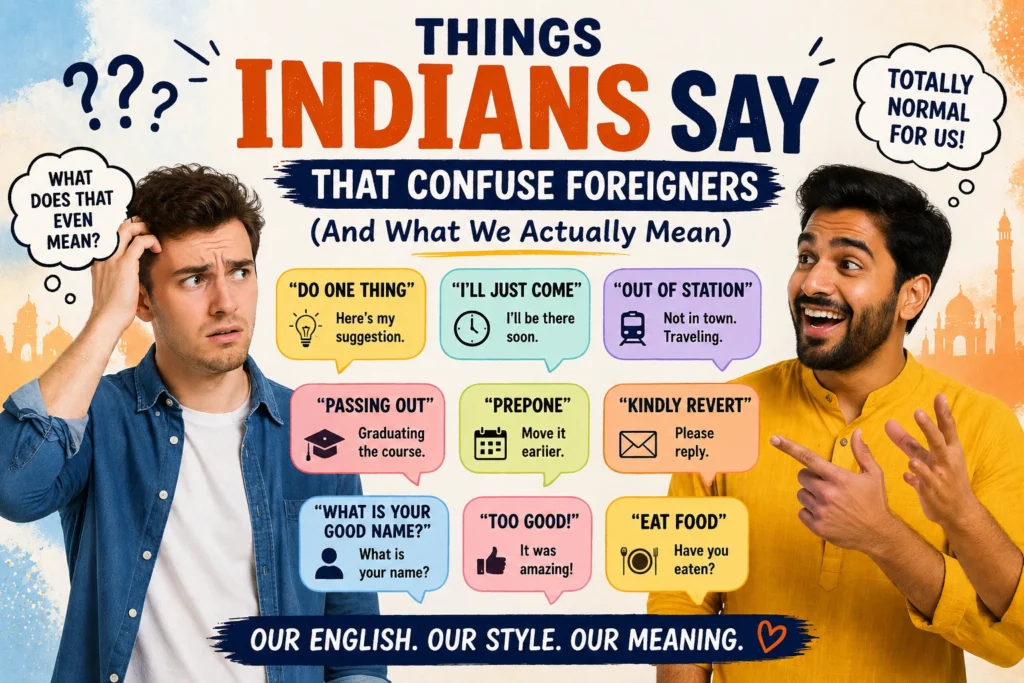
Enjoyed this? Read our full guide on Things Indians Say That Confuse Foreigners (And What We Actually Mean) — you’ll never mishear Indian English the same way again.
Similar Posts: Why Indians Say “Prepone” and What It Actually means?