Imagine hearing English for the first time.
Someone wishes you good luck by saying “break a leg.” A friend describes betrayal as “a stab in the back.” Your colleague says someone “kicked the bucket” — and nobody calls the police.
If you grew up speaking English, none of this sounds strange. But stop for a second and actually read these phrases.
They sound absolutely terrifying.
And yet — we say them every single day without thinking twice.
Here are 6 English idioms that sound violent, dangerous, or even deadly — but are completely normal to use in conversation.
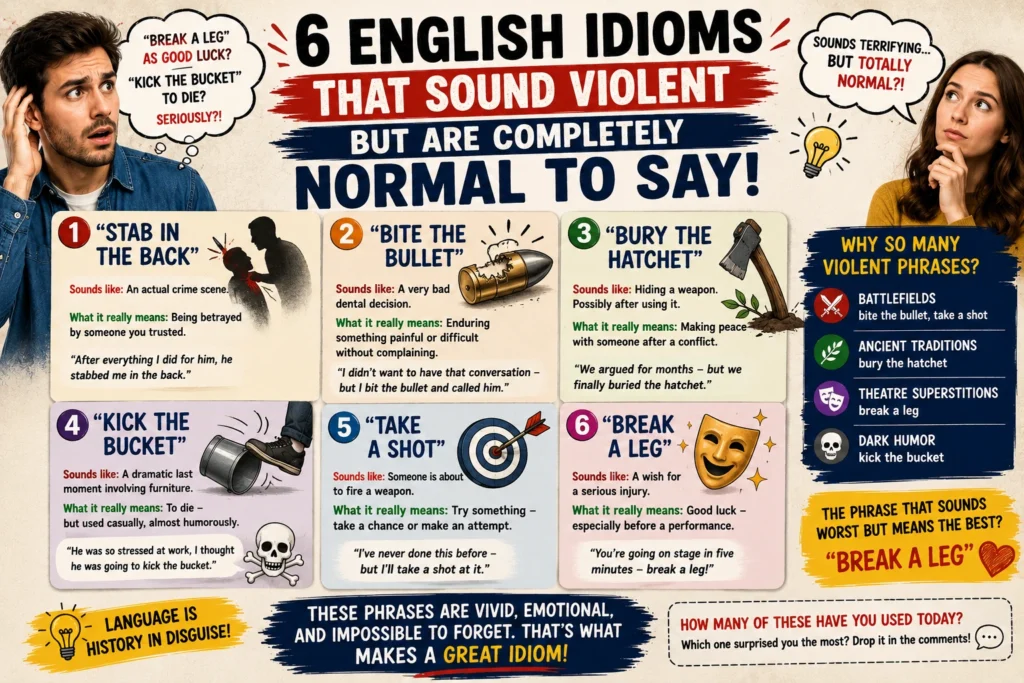
6 English Idioms That Sound Violent But Are Completely Normal to Say
1. “Stab in the Back”
Sounds like: An actual crime scene.
What it really means: Being betrayed by someone you trusted.
“After everything I did for him, he stabbed me in the back.”
Nobody got hurt. No knives were involved. But the feeling behind it? Very real.
This idiom works because betrayal genuinely feels like being stabbed — sharp, sudden, and coming from behind when you weren’t looking. The violence in the phrase is emotional, not physical.
You’ll hear this in offices, friendships, and family drama all over the world.
2. “Bite the Bullet”
Sounds like: A very bad dental decision.
What it really means: Enduring something painful or difficult without complaining.
“I didn’t want to have that conversation — but I bit the bullet and called him.”
The origin of this one is actually fascinating. Before modern anaesthesia, soldiers undergoing surgery were literally given a bullet to bite down on to endure the pain.
Today nobody is biting anything. It just means — stop avoiding it, take the discomfort, and get it done.
3. “Bury the Hatchet”
Sounds like: Hiding a weapon. Possibly after using it.
What it really means: Making peace with someone after a conflict.
“We argued for months — but we finally buried the hatchet.”
This one actually comes from a Native American peace tradition where rival tribes would literally bury their weapons as a symbol of ending conflict.
The weapon became a metaphor. Today burying the hatchet just means two people decided to stop fighting and move on — no digging required.
4. “Kick the Bucket”
Sounds like: A dramatic last moment involving furniture.
What it really means: To die — but used casually, almost humorously.
“He was so stressed at work, I thought he was going to kick the bucket.”
Nobody knows exactly where this one came from — there are several theories, none confirmed. But somehow “kick the bucket” became the most casual, almost affectionate way to talk about death in English.
You’d never say it at a funeral. But you’d absolutely say it about your old car, your dying phone battery, or a plant you forgot to water.
5. “Take a Shot”
Sounds like: Someone is about to fire a weapon.
What it really means: Try something — take a chance or make an attempt.
“I’ve never done this before — but I’ll take a shot at it.”
Depending on context, “take a shot” can also mean having a drink — which is equally harmless (mostly).
The “shot” here comes from the idea of aiming and firing — but at an opportunity, not a target. It’s one of the most versatile idioms in English. You take a shot at a job interview, a new recipe, a difficult conversation, or a basketball hoop.
6. “Break a Leg”
Sounds like: A wish for a serious injury.
What it really means: Good luck — especially before a performance.
“You’re going on stage in five minutes — break a leg!”
This is probably the most confusing idiom for non-native English speakers. Why would you wish someone a broken leg before their big moment?
The most popular theory is that it comes from theatre superstition — saying “good luck” directly was considered bad luck backstage. So performers started saying the opposite as a charm.
Today it’s used before presentations, performances, exams, and interviews. Nobody’s legs are in danger.
Why Does English Have So Many Violent-Sounding Idioms?
Because most idioms weren’t invented in a boardroom.
They came from:
- Battlefields — bite the bullet, take a shot
- Ancient traditions — bury the hatchet
- Theatre superstitions — break a leg
- Dark humor — kick the bucket
Language absorbs history. And history has always been a little violent.
The phrases stuck because they’re vivid, emotional, and impossible to forget. That’s exactly what makes a great idiom.
The Phrase That Sounds Worst But Means the Best
Out of all six — “break a leg” wins.
You’re telling someone you care about them enough to wish them well. You’re just doing it in the most alarming way possible.
And somehow that’s very English.
How Many of These Have You Used Today?
Chances are you’ve said at least one of these without thinking twice. Which one surprised you the most? Drop it in the comments.
And if you want to explore more idioms that use the human body in unexpected ways — check out our complete guide to Body Idioms in American English.