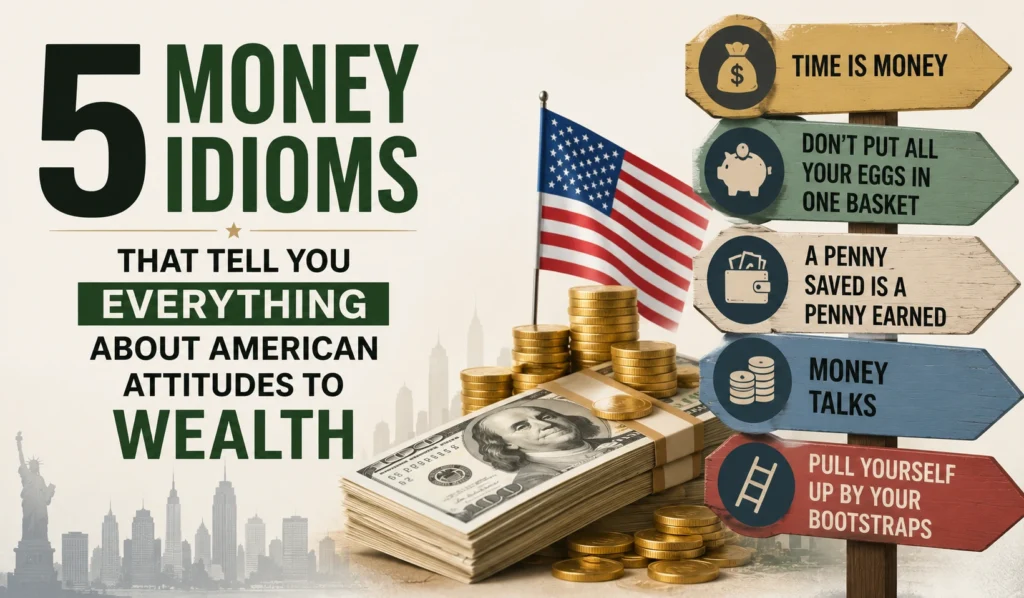
Americans have a complicated relationship with money.
They work hard for it. They talk about it constantly. They feel guilty about it. They dream about it. And somewhere in the middle of all that — they built a whole set of idioms around it.
Idioms are interesting because they don’t just describe things. They reveal how a culture thinks about things. And these five money idioms? They say more about America than any economics textbook ever could.
1. “It Cost an Arm and a Leg”
What it means: Something was extremely expensive.
“Have you seen the rent in New York? It costs an arm and a leg just to get a closet.”
This one is dramatic on purpose. You’re not just saying something was pricey — you’re saying it took a physical toll. A sacrifice. Something irreplaceable.
And that’s very American. The idea that expensive things don’t just empty your wallet — they take something out of you.
Nobody actually knows where this phrase started. Some say it came from portrait painters who charged more depending on how many body parts they had to paint. Others trace it back to war — the idea that the ultimate price a soldier pays is literally a limb.
Either way, the message is the same: this wasn’t just money. This hurt.
2. “Born With a Silver Spoon”
What it means: Someone who grew up rich and privileged — without earning it.
“He’s never worked a day in his life. Born with a silver spoon, that one.”
This idiom has a bit of an edge to it. It’s not just describing wealth — it’s judging it.
In America, there’s a cultural tension that never really goes away. On one hand, people admire success. On the other hand, they respect earned success. Old money — wealth that was inherited, not built — makes Americans slightly uncomfortable.
The silver spoon comes from old European tradition, where wealthy families would literally give their babies silver spoons to eat with, believing silver had health benefits. But in modern American English, calling someone “born with a silver spoon” isn’t really a compliment. It’s a quiet accusation.
It means: you didn’t build this. You just showed up to it.
3. “Golden Handshake”
What it means: A large, generous payout given to a senior executive when they leave a company — sometimes even when they’re being fired.
“The CEO ran the company into the ground and still walked away with a golden handshake. Only in corporate America.”
This one is fascinating because it shows two sides of American wealth culture at once.
On one side — the celebration of success. Gold is the color of achievement. A handshake is respectful, professional, civilized.
On the other side — the frustration that the rules seem different at the top. Regular employees get laid off with two weeks’ notice. Executives get millions.
The word “golden” shows up a lot in American money idioms — golden opportunity, golden parachute, the golden rule. Gold means the best. The most valuable. The kind reserved for people who’ve made it.
A golden handshake is what happens when you reach the top of the ladder — even if you knocked a few people off on the way up.
4. “Foot the Bill”
What it means: To pay for something, usually on behalf of others.
“We had a team lunch and somehow I ended up footing the bill for twelve people.”
Nobody is totally sure where “foot” came from here. The most popular theory is that it refers to the bottom — or “foot” — of a bill, where the total is written. To foot the bill is to look at that number at the bottom and sign your name next to it.
What’s interesting about this phrase is the feeling attached to it. Nobody says “I got to foot the bill.” They say “I had to foot the bill” or “I ended up footing the bill.” There’s always a slight sense of burden — of being the one left holding the check.
It reflects something real about American social dynamics around money. Who pays? Who’s expected to pay? Who always ends up paying? These are loaded questions — at dinner tables, in boardrooms, and in politics.
Footing the bill is generous. But it rarely feels entirely voluntary.
5. “Hand Over Fist”
What it means: Making or losing money very fast, in large amounts.
“That street food cart on 5th Avenue is making money hand over fist every weekend.”
This one originally came from sailors. Climbing a rope hand over fist — one hand then the other, fast and continuous — was a sign of speed and momentum. At some point, it moved from ropes to money.
And it fits perfectly. Because “hand over fist” isn’t just about having money. It’s about the pace of it. The relentlessness. The never-stopping flow.
That’s very American. The ideal isn’t just to be wealthy — it’s to be building wealth. Constantly. Quickly. More this quarter than last. More this year than before.
Hand over fist captures the hustle. The momentum. The idea that money is not a destination but a moving thing — and the goal is to keep it moving in your direction.
What These Idioms Tell Us
Put these five phrases together and you get a pretty clear picture.
Americans believe that expensive things cost more than money — they cost you (arm and a leg). They’re suspicious of wealth that wasn’t earned (silver spoon). They know the rules are different at the top (golden handshake). They feel the weight of who pays (foot the bill). And they measure success not just by how much you have, but how fast you’re getting it (hand over fist).
Idioms don’t lie. They’re what a culture reaches for when it’s trying to describe something it feels deeply but can’t quite explain directly.
And money? Americans feel that very deeply.
Love digging into idioms? Read our guide on Body Idioms That Will Change How You Speak English and Color Idioms and What They Really Mean — two more rabbit holes worth going down.