Welcome to our daily Idiom series, designed to help you sound like a native American English speaker. Today’s idiom is “Bite the Bullet.” In this post, you will learn what it means, where it comes from, how to use it correctly, and — importantly — when NOT to use it.
Quick Summary:
| Idiom | Bite the Bullet |
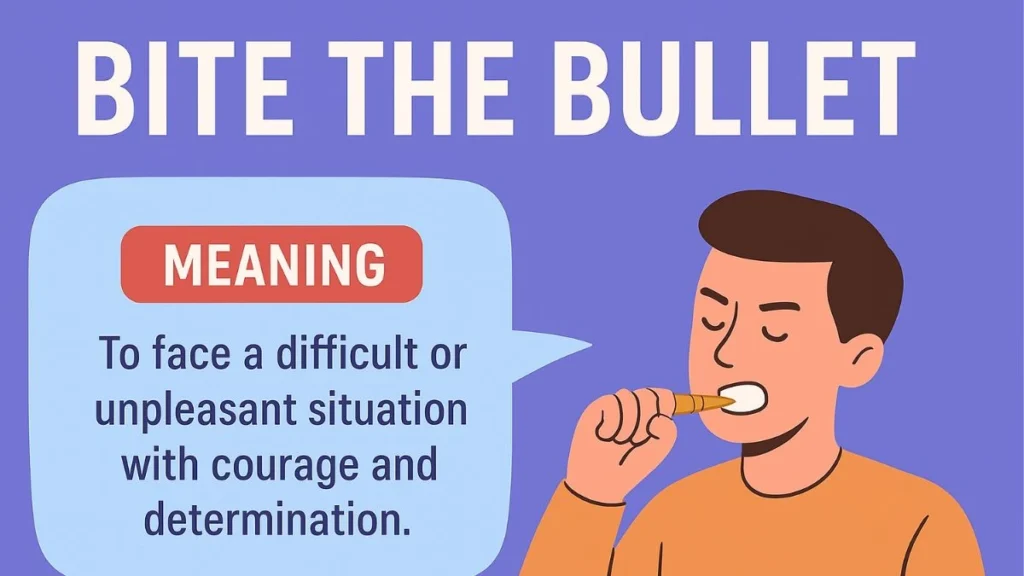
| Meaning | To endure a painful, difficult, or unpleasant situation with courage — to face something hard and get on with it |
| Extended use | Also used when someone finally accepts an unavoidable situation and stops delaying — even if the decision or experience is uncomfortable |
| Example | “The surgery was scary, but I bit the bullet and went through with it.” |
| Register | Informal — natural in casual conversation and everyday workplace speech. Can also appear in semi-formal writing when the tone is direct and personal. |
Bite the Bullet — Meaning
“Bite the bullet” means to face a difficult or painful situation bravely and get through it. Even when every instinct says to avoid it, delay it, or run from it. It describes the act of pushing past discomfort, fear, or reluctance and doing something hard because it needs to be done.
Bite the bullet = endure something painful or difficult with courage, and stop putting it off
The idiom captures a very specific and very human experience — the moment when you stop avoiding something unpleasant and simply do it. It might be a difficult conversation you have been putting off, an expensive but necessary repair, a painful medical procedure, or a hard professional decision. In all of these cases, “biting the bullet” means accepting the discomfort and moving forward anyway.
The phrase is always used admiringly or self-awarely — it implies courage, not recklessness. When someone says they “bit the bullet,” they are acknowledging that something was genuinely hard, and that they faced it anyway. It is never used for small or trivial situations — reserve it for moments of real difficulty or genuine reluctance.
Bite the Bullet — Idiom Examples
- “I have been avoiding the dentist for two years, but I finally bit the bullet and made an appointment.”
- The company knew the restructuring would be painful, but they bit the bullet and made the necessary changes.
- “I did not want to have that conversation with my manager, but I bit the bullet and asked for the raise.”
- She had been putting off the surgery for months. She finally bit the bullet and scheduled it.
- “The repair costs were higher than I expected, but I bit the bullet and got the car fixed properly.”
- After years of unhappiness in the role, he finally bit the bullet and handed in his resignation.
- “I know the gym membership is expensive, but just bite the bullet — your health is worth it.”
- The team bit the bullet and worked through the weekend to meet the deadline.
- “It was an uncomfortable apology to make, but I bit the bullet and said what needed to be said.”
- She bit the bullet and told her family the truth, even though she knew it would upset them.
Want to learn more idioms easily? Check out our Complete Guide to Everyday American Idioms — you will find simple meanings, fun examples, and real-life practice.
Different Sentence Patterns of “Bite the Bullet”
Here are the most common ways to use this idiom in a sentence:
- “I bit the bullet and told him the truth.” (past tense — you faced something difficult and did it)
- “You just have to bite the bullet and get it done.” (advice — encouraging someone to stop avoiding something)
- “She finally bit the bullet and went to the doctor.” (past — “finally” emphasises the reluctance before acting)
- “Sometimes you just have to bite the bullet.” (general truth — a philosophical statement about endurance)
- “We bit the bullet and invested in the new system.” (group — a collective decision to do something costly or difficult)
| Important: “Bite the bullet” always implies that something was genuinely difficult, painful, or costly — either emotionally, physically, or financially. Do not use it for minor inconveniences. Saying “I bit the bullet and ordered a coffee” would sound absurd. Save it for situations that involve real reluctance, real cost, or real courage. |
Real-Life Conversation Using “Bite the Bullet”
Here is a short, natural conversation between two friends. One has been avoiding a difficult decision for months — the other encourages them to act. This shows how the idiom fits into everyday spoken English.
| Speaker | Dialogue |
| Arun: | I have been putting off going to the dentist for almost a year now. I know something is wrong with my back tooth but I just cannot bring myself to go. |
| Meera: | Arun, you have been saying this since last January. At some point you just have to bite the bullet. |
| Arun: | I know, I know. I just really hate the whole thing. The sounds, the waiting room, all of it. |
| Meera: | I get it, but avoiding it is only making it worse. The longer you wait, the more likely it becomes something serious and expensive. |
| Arun: | You are probably right. My jaw has been aching on and off for weeks now. |
| Meera: | Then that is your sign. Bite the bullet, book the appointment this evening, and it will be done. The anticipation is always worse than the actual thing. |
| Arun: | Fine. You are right. I will book it tonight. |
| Meera: | Good. And once you have done it, you will wonder why you waited so long — they all do. |
Similar Idioms and Their Meanings
English has several ways to describe facing something difficult with courage or acceptance. Here is how they compare:
| Idiom | Tone | Meaning / Example |
| Bite the bullet | Informal, courageous | “She bit the bullet and had the difficult conversation with her boss.” |
| Face the music | Informal, accountable | Accept the consequences of your actions. “He made the mistake and had to face the music.” |
| Take the plunge | Casual, decisive | Do something bold or risky after hesitating. “She finally took the plunge and started her own business.” |
| Grin and bear it | Resigned, enduring | Endure something unpleasant without complaining. “The commute is awful, but I just grin and bear it.” |
| Tough it out | Casual, determined | Push through a hard situation with persistence. “It was a gruelling training programme, but he toughed it out.” |
| Swallow the pill | Neutral, resigned | Accept something unpleasant that cannot be avoided. “The pay cut was hard to swallow, but she accepted it.” |
| Tip: “Bite the bullet” implies active courage — you push through something despite fear or reluctance. “Grin and bear it” is more passive — you endure something with no way out, simply tolerating it. “Face the music” specifically involves accepting consequences for your own actions. Choose based on the situation: courage → bite the bullet; consequences → face the music; simple endurance → grin and bear it. |
Common Mistakes to Avoid
The most important mistake is using “bite the bullet” for situations that are too trivial. The idiom carries the weight of real difficulty — physical pain, emotional hardship, financial sacrifice, or a long-delayed decision. Using it casually for minor inconveniences makes it lose its meaning.
Correct context
“The treatment was expensive and painful, but I bit the bullet and went through with it.” (real difficulty — financial cost and physical pain — exactly the right context)
Wrong context
“I bit the bullet and chose the salad instead of the chips.” (too trivial — this is not a moment of real difficulty or courage; use “I opted for” or “I chose” instead)
The second mistake is confusing it with “dodge a bullet,” which means the opposite — narrowly avoiding something bad. “Biting” the bullet means facing it; “dodging” it means escaping it.
Correct
“I bit the bullet and had the operation.” (I faced it and went through with it.)
Incorrect — confused with dodge a bullet
“I bit the bullet — the deal fell through just before it went wrong.” (wrong — if you escaped something bad, say “I dodged a bullet,” not “bit” one)
The third mistake is altering the fixed form. “Chew the bullet,” “swallow the bullet,” or “take the bullet” all have different meanings or simply do not exist as idioms. The correct and only form is “bite the bullet.”
If you want to learn all American idioms in one place, check out our complete A-to-Z Idioms list.
Practice & Application: Using “Bite the Bullet” in Speaking (IELTS & Real Life)
“Bite the bullet” is an excellent idiom for IELTS Speaking because it fits naturally into a wide range of topics — health, work, decision-making, challenges, and personal growth. It works well in Part 1 short answers, Part 2 personal narratives, and Part 3 discussions about courage, resilience, and difficult choices. It is informal enough to sound natural but not so slangy that it sounds unprofessional.
IELTS Speaking Practice
Part 1 — Short Answer
Question: Is there something you have been putting off that you know you should do?
Sample Answer:
Honestly, yes — I have been putting off a proper health check-up for about two years now. I am not particularly worried about anything specific, but I keep finding reasons to delay it — I am too busy, I will do it next month, and so on. My mother keeps telling me to just bite the bullet and book the appointment, and she is right. The funny thing is that I know the longer I delay, the more anxious I become about what they might find — even though going is the only way to stop worrying. I think I will try to book it this week, actually. Saying it out loud makes the delay feel even more unreasonable.
Part 2 — Cue Card
Describe a time when you had to do something difficult or unpleasant that you had been avoiding.
Sample Answer:
I would like to talk about a conversation I had with a close friend about two years ago — a conversation I had been avoiding for months. We had been close friends since school, but over the previous year or so I had noticed that the friendship had become quite one-sided. I was always the one reaching out, always the one making plans, and I often felt unappreciated. It bothered me deeply, but every time I thought about raising it, I backed away. I was afraid of damaging the friendship, afraid of being seen as needy, and honestly, afraid of the awkwardness.
Eventually, I realised that saying nothing was damaging things far more than an honest conversation ever could. So I bit the bullet. I asked my friend if we could talk, sat down with them over coffee, and calmly explained how I had been feeling. It was uncomfortable — genuinely uncomfortable — and there were a few moments where I wished I had stayed quiet. But by the end of the conversation, something had shifted. My friend had not been aware of how their behaviour had been coming across, and they were genuinely sorry. The friendship recovered and actually became stronger after that.
That experience taught me that the conversations we avoid are almost always the ones most worth having. Biting the bullet — facing an uncomfortable truth directly — is rarely as bad as the anticipation suggests.
Part 3 — Discussion
Question: Why do people tend to avoid difficult decisions or situations?
Sample Answer:
I think avoidance is one of the most deeply human instincts there is. Difficult decisions involve uncertainty, and uncertainty is uncomfortable — our minds naturally prefer the familiar, even when the familiar is not good for us. There is also the question of loss aversion: research in psychology consistently shows that people feel the pain of a potential loss far more strongly than the pleasure of a potential gain. So when a difficult choice involves any possibility of losing something — money, a relationship, status, comfort — the temptation to delay is enormous.
The problem, of course, is that avoidance rarely makes things easier. Usually it makes them worse. A difficult conversation becomes a broken relationship. An ignored symptom becomes a serious illness. An avoided financial decision becomes a crisis. The people who learn to bite the bullet — to act decisively in the face of discomfort — tend to navigate life more successfully, not because they feel less fear, but because they have learned not to be paralysed by it.
Question: Do you think resilience is something people are born with, or can it be developed?
Sample Answer:
I believe strongly that resilience is built, not born. Some people may have temperamental advantages — a naturally calmer nervous system, a more optimistic outlook — but the core ability to bite the bullet, to face hardship without being destroyed by it, is something that develops through experience. Every time you face something difficult and survive it, you build evidence that you can face the next difficult thing. The opposite is also true: every time you avoid something hard, you reinforce the belief that you cannot handle it. This is why small acts of courage matter — not just the dramatic ones, but the everyday decisions to have the uncomfortable conversation, to do the thing you have been putting off, to act despite the fear. Those small decisions, repeated over time, are what resilience is actually made of.
Practice Exercise — Advanced Level
Rewrite each sentence below using “bite the bullet” without changing the meaning. Think carefully about the tense and who is doing the action.
- She finally went to the doctor after ignoring the pain for three months.
- He knew the conversation with his boss would be awkward, but he had it anyway.
- The company made the difficult decision to cut costs, even though it affected many employees.
- “You have been avoiding that apology for weeks — just do it and move on.”
- After years of delay, they finally spent the money and renovated the kitchen.
- I did not want to give the presentation, but I agreed to do it anyway.
- The athlete pushed through the pain and completed the final kilometre of the race.
- She accepted the difficult feedback from her mentor, even though it was hard to hear.
Answer Key
- She finally bit the bullet and went to the doctor after ignoring the pain for three months.
- He knew the conversation with his boss would be awkward, but he bit the bullet and had it anyway.
- The company bit the bullet and made the difficult decision to cut costs, even though it affected many employees.
- “You have been avoiding that apology for weeks — just bite the bullet and move on.”
- After years of delay, they finally bit the bullet and spent the money on renovating the kitchen.
- I did not want to give the presentation, but I bit the bullet and agreed to do it anyway.
- The athlete bit the bullet and pushed through the pain to complete the final kilometre of the race.
- She bit the bullet and accepted the difficult feedback from her mentor, even though it was hard to hear.
| Notice: how “bite the bullet” almost always works best in the past tense — it describes something that was hard and has now been done. The word “finally” often appears alongside it, because the idiom naturally implies that there was a period of reluctance or delay before the action was taken. |