Welcome to our daily Idiom series, designed to help you sound like a native American English speaker. Today’s idiom is “Under the Weather.” In this post, you will learn what it means, where it comes from, how to use it in real sentences, and which common mistakes to avoid.
Idiom Under the Weather Meaning
Let me share a little story. A few months ago, I was really looking forward to my best friend’s wedding. I had bought a new dress, planned my hairstyle, and picked out the perfect shoes. But just two days before the big day, I caught a bad cold. My nose was blocked, my head felt heavy, and I had absolutely no energy. When my friend called to check on me, I said: “I am feeling a bit under the weather.”
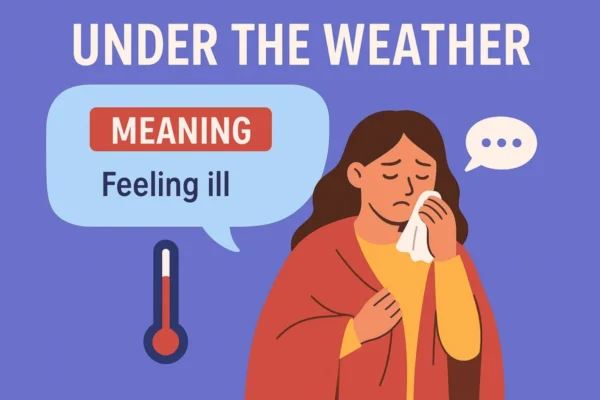
Of course, I was not standing outside in the rain. The phrase “under the weather” simply means feeling sick, unwell, or not quite yourself. It is a softer, more natural way to say you are ill — and native English speakers use it all the time.
| Under the weather = feeling sick, unwell, or physically low |
So the next time you are not feeling well, instead of just saying “I am sick,” try saying “I am feeling a bit under the weather.” It sounds more natural and is far more commonly used in everyday American and British English.
10 Simple Examples of Under the Weather Idiom
- Riya was feeling under the weather, so she decided to take a day off from the office.
- Arjun looked under the weather after spending the afternoon in the heavy rain.
- Meena was a bit under the weather, so she did not join her friends for the film.
- Rahul felt under the weather after eating too much street food the night before.
- Anjali seemed under the weather during class and kept resting her head on the desk.
- Kavita stayed home because she was under the weather with a mild fever.
- Suresh felt under the weather after working late nights for an entire week.
- Priya was under the weather, so her mother asked her to rest and take a nap.
- Amit looked a bit under the weather, but still managed to attend the morning meeting.
- Neha felt under the weather, so she cancelled her shopping plans with friends.
Want to learn more idioms easily? Check out our Complete Guide to Everyday American Idioms—you’ll find more simple meanings, fun examples, and real-life practice!
Different Sentence Patterns of “Under the Weather”
Here are the most natural ways to use this idiom in everyday conversation:
- I am feeling a bit under the weather today. (present — mild, polite way to say you are unwell)
- She was under the weather all of last week. (past — describes a period of illness)
- He looks under the weather — do you think he is okay? (observation about someone else)
- I might be under the weather — I have had a headache since this morning. (uncertain, early signs)
- If you are feeling under the weather, please rest at home and do not come in. (advice or instruction)
Note that “a bit under the weather” and “feeling under the weather” are the two most natural phrasings. Adding “a bit” makes it sound milder and more polite — useful when you do not want to make a fuss.
Real-Life Conversation Using “Under the Weather”
Here is a short conversation between two colleagues at work. Notice how the idiom fits naturally into an everyday workplace exchange.
| Rahul: | Hey Pooja, you missed the team call this morning. Everything okay? |
| Pooja: | Sorry about that. I have been feeling a bit under the weather since yesterday — sore throat, blocked nose, the usual. |
| Rahul: | Oh no, I am sorry to hear that. Are you resting properly? |
| Pooja: | Trying to. I think I just need a day or two and I will be fine. Can you share the notes from the call? |
| Rahul: | Of course — will send them right now. Take care of yourself. No need to push through if you are still under the weather tomorrow. |
Similar Idioms with Meaning
| Idiom | Meaning | Example |
| Feeling blue | Feeling sad or low in mood | “She has been feeling blue ever since her dog fell ill.” |
| Down in the dumps | Feeling depressed or gloomy | “He has been down in the dumps since he lost the competition.” |
| Off-colour | Feeling unwell or slightly ill | “You look a bit off-colour today — are you sure you are okay?” |
| A bit off | Feeling slightly unwell or not quite right | “I feel a bit off this morning — I might skip breakfast.” |
| Sick as a dog | Extremely sick (stronger and more dramatic) | “After that meal, I was sick as a dog all night.” |
| Not feeling oneself | Feeling different from normal, usually unwell | “I am just not feeling myself today — I think I need rest.” |
Tip: “Under the weather” and “off-colour” are both mild ways to say you are unwell. “Sick as a dog” is much stronger — use it when someone is seriously ill.
Common Mistakes to Avoid
The first mistake is using this idiom for situations that are not related to health. “Under the weather” is only used to describe illness or physical unwellness. It cannot be used for nervousness, lack of preparation, or bad mood.
| Correct “She was under the weather and could not attend the meeting.” |
| Incorrect “She was under the weather during her exam because she had not studied.” (not health-related) |
The second mistake is connecting the idiom to actual weather. Just because the word “weather” appears in the phrase does not mean it describes rain or storms. The idiom is entirely about health, not climate.
| Correct “I stayed indoors because I was feeling under the weather.” |
| Incorrect “It rained all day, so I was under the weather.” (this confuses the idiom with literal weather) |
The third mistake is altering the wording. Common errors include “below the weather,” “under weather” (missing “the”), and “under the weathers” (wrong plural). The phrase is fixed — it is always “under the weather,” exactly as written.
| Correct “I am feeling a bit under the weather today.” |
| Incorrect “I am feeling below the weather.” / “I am feeling under weather.” |
If you want to learn all American idioms in one place, check out our complete A-to-Z Idioms list.
If you want to learn about all the American Idioms, then here is our best curated complete list of A-Z Idioms list in one place.
Practice & Application: Using “Under the Weather” in Speaking (IELTS & Real Life)
“Under the weather” is one of the most practical idioms for IELTS Speaking because health and daily routine are very common topics in Part 1. It also works naturally in Part 2 when describing a time you had to cancel plans or deal with illness. Using it confidently and correctly shows the examiner that your English vocabulary is natural and not just textbook-perfect.
IELTS Speaking Practice
Part 1 — Short Answer
Question: Have you ever had to cancel plans because you were not feeling well?
Sample Answer:
Yes, quite recently actually. I had been looking forward to a cousin’s birthday dinner for weeks, but on the day itself I woke up feeling under the weather — sore throat, mild fever, and no energy at all. I had to call and apologise, which I felt terrible about. My family was understanding, but it was still disappointing. I ended up resting the whole day and thankfully recovered quickly.
Part 2 — Cue Card
Describe a time when you were ill and had to miss something important.
Sample Answer:
I would like to talk about a time I was under the weather right before an important college presentation. My group and I had been preparing for weeks, and we were all quite nervous but also excited. Then, two days before the presentation, I came down with a severe cold. I was completely under the weather — runny nose, constant sneezing, and a headache that made it hard to concentrate. I still attended the presentation because I did not want to let my group down, but it was one of the hardest things I have done. I could barely speak clearly, and I had to pause several times. Looking back, I think I should have rested more in the days leading up to it rather than pushing through the late nights. The experience taught me that taking care of your health is not a luxury — it is what allows you to perform well in everything else.
Part 3 — Discussion
Question: Why do some people continue working even when they are ill?
Sample Answer:
There are several reasons. In many work cultures, especially competitive ones, people feel a pressure to show that they are dedicated — taking a sick day might be seen as weakness or laziness, even when someone is genuinely under the weather. There is also the practical concern of deadlines and responsibilities. If you are part of a team, falling ill at a critical moment can feel like letting others down. However, I think this attitude is slowly changing. More employers now understand that a person who forces themselves to work while unwell tends to be less productive and takes longer to recover, which costs more in the long run.
Question: How important is it to rest when you are feeling unwell?
Sample Answer:
It is extremely important, and I think it is something many people underestimate. When you are under the weather, your body is working hard to fight off whatever is making you ill. Pushing through without adequate rest is essentially taking energy away from that recovery process. Short-term rest almost always leads to faster recovery than trying to carry on as usual. Beyond the physical benefits, rest also protects the people around you — if you are contagious and you go to work or school, you risk spreading the illness to others. I believe resting when ill is not just self-care but also a form of consideration for others.
Practice Exercise — Advanced Level
Rewrite each sentence below using “under the weather” without changing the meaning.
- Deepa was not feeling well yesterday, so she did not come to work.
- He stayed at home all day because he had a cold and a mild fever.
- My mother has been unwell for the past two days and is resting in bed.
- She skipped the class trip because she was not in good health.
- He looked pale and tired during the team meeting this afternoon.
- After working without a break for ten days, she finally fell ill.
- I cancelled the dinner reservation because I started feeling sick after lunch.
- He told his manager he was not well and needed to take a day off.
Answer Key
- Deepa was feeling under the weather yesterday, so she did not come to work.
- He stayed at home all day because he was under the weather with a cold and mild fever.
- My mother has been under the weather for the past two days and is resting in bed.
- She skipped the class trip because she was feeling under the weather.
- He looked under the weather during the team meeting this afternoon.
- After working without a break for ten days, she finally fell under the weather.
- I cancelled the dinner reservation because I started feeling under the weather after lunch.
- He told his manager he was under the weather and needed to take a day off.
The idiom “under the weather” is especially useful because it is gentle and polite. It lets you explain your situation without going into unnecessary detail about your symptoms. Try using it the next time you need to cancel plans or explain an absence — people will immediately understand, and your English will sound completely natural.
FAQs On Under the Weather Idiom
Q: What does “Under the weather” mean?
It means feeling sick, unwell, or physically low — not at your best. It is a polite, natural way to say you are ill.
Q: How do I use it in a sentence?
Example: “I did not attend the meeting today because I was feeling a bit under the weather.”
Q: Are there any similar idioms?
Yes — ‘feeling blue,’ ‘down in the dumps,’ ‘off-colour,’ ‘a bit off,’ and ‘sick as a dog’ are all related, though some describe mood rather than physical health.
Q: When should I use this idiom?
Use it in casual, everyday conversations when you want to describe feeling ill or unwell. It works in spoken English, informal emails, and text messages.
Q: Can I use it for bad moods or nervousness?
No — this is a common mistake. ‘Under the weather’ is only used for physical illness or poor health. For sadness or low mood, use ‘feeling blue’ or ‘down in the dumps’ instead.