
Here’s a situation most English learners know well: you’re watching an American TV show, following every word, feeling confident — and then someone says “the ball is in your court” or “don’t rock the boat” and suddenly you’re three sentences behind, trying to figure out if there’s an actual boat involved.
There isn’t. There’s never a boat.
American English is loaded with idioms — short, punchy phrases whose meaning has nothing to do with the individual words that make them up. Native speakers use them constantly, often without realizing it. They show up in job interviews, first dates, sports broadcasts, political speeches, text messages, and office small talk. If you don’t know them, you’re not just missing vocabulary — you’re missing the entire layer of meaning underneath the conversation.
This guide is built differently from most idiom lists. Instead of dumping 50 phrases in a table and calling it done, we’ve organized 100+ of the most commonly used and most frequently misunderstood American idioms by the situations where you’ll actually encounter them. Each one includes a real-world example that puts it in context, not a textbook sentence.
At the bottom, you’ll find the complete master reference table — every idiom in one place, sortable by category, for quick lookup.
Let’s get into it.
Why American Idioms Are Particularly Hard to Learn
Every language has idioms. But American English has a few features that make its idioms especially challenging for outsiders:
They’re borrowed from everywhere. American idioms come from baseball, horse racing, military slang, seafaring, farming, gambling, card games, and immigrant cultures from dozens of countries. There’s no single logic system — you have to learn each one on its own terms.
They evolve fast. British English idioms tend to be more stable. American ones shift, get repurposed, and pick up new meanings within a generation. Something from a 1990s film can sound dated today; something from a 2015 meme can be completely standard by 2025.
Context changes everything. “Break a leg” sounds like a threat. “Kick the bucket” sounds clumsy. “Burning the midnight oil” could be about candles. Without cultural context, the literal words point you in completely the wrong direction.
Americans use them without noticing. Unlike some formal expressions, idioms slip out naturally. A native speaker won’t pause and say “I’m about to use an idiom.” They’ll just say “we’re in the same boat” and keep moving.
The fastest way to close that gap is exactly what this guide offers: learn idioms in the situations where you’ll actually encounter them.
Section 1: Work & Professional Life Idioms
The American workplace has its own dialect, and idioms are a huge part of it. In meetings, emails, and hallway conversations, these phrases carry real professional weight. Misunderstanding them in a business context can lead to genuine confusion — or worse, coming across as out of touch.
Hit the Ground Running
Meaning: To begin a new job, project, or role immediately and with full energy — no warm-up period needed.
This one comes from military parachute drops, where soldiers had to start moving the instant their feet touched the ground. In American workplace culture, it’s one of the highest compliments a manager can pay a new employee.
Real example: “She started on Monday and by Wednesday had already reorganized the client onboarding process. She hit the ground running and hasn’t slowed down.”
Drop the Ball
Meaning: To make a mistake, fail to follow through on a responsibility, or let someone down by not doing what was expected.
From American football — literally fumbling or failing to catch a crucial pass. In professional life, dropping the ball means missing the moment when your team needed you to deliver.
Real example: “I dropped the ball on the Henderson account — I missed the renewal deadline and now they’re talking to competitors. I own that completely.”
On the Same Page
Meaning: In agreement; sharing the same understanding of a situation, plan, or goal.
Real example: “Before we go into the client meeting, I want to make sure we’re all on the same page about the pricing structure. Last time there was confusion and it cost us the deal.”
Go Back to the Drawing Board
Meaning: To abandon a plan that hasn’t worked and start the planning process over from the beginning.
The “drawing board” is a literal architect’s or designer’s drafting table — the place where plans originate. Going back to it means the plan has failed badly enough that you can’t salvage it.
Real example: “The user testing results were brutal. People couldn’t figure out the navigation at all. We’re going back to the drawing board on the entire interface.”
Cut Corners
Meaning: To do something in a cheaper, faster, or lazier way than it should be done — usually at the expense of quality, safety, or ethics.
Real example: “The contractor cut corners on the electrical work to finish under budget. Three months later, the inspection failed and the repairs cost twice what they saved.”
Touch Base
Meaning: To make brief contact with someone to share updates, check in, or stay connected. One of the most commonly used phrases in American professional communication.
Real example: “I’ll touch base with the Chicago team before the presentation so we’re not blindsided by anything on their end.”
In the Loop / Out of the Loop
Meaning: Informed about what’s happening (in the loop) or not informed (out of the loop). The “loop” is the circle of people who are kept updated.
Real example: “Keep me in the loop on how the negotiation develops — I don’t need every detail, just the major pivots.”
“She’d been out sick for two weeks and came back completely out of the loop. It took three hours of catch-up meetings to get her current.”
Bite the Bullet
Meaning: To endure a painful, unpleasant, or difficult experience with stoic acceptance — doing something hard because it needs to be done.
The origin is genuinely historical: before modern anesthesia, soldiers about to undergo surgery were sometimes given a bullet to bite down on during the pain. Today it applies to any unpleasant-but-necessary decision or action.
Real example: “The rebrand is going to be expensive and disruptive and nobody wants to go through it. But we need to bite the bullet — the current brand is actively hurting us in the 25–34 demographic.”
Pass the Buck
Meaning: To shift responsibility for something onto someone else; to avoid accountability by making it someone else’s problem.
From poker: a “buck” (a marker, often a knife with a buckhorn handle) was passed to whoever was responsible for dealing next. Harry Truman’s famous desk sign read “The Buck Stops Here” — meaning he accepted final responsibility.
Real example: “Every time there’s a complaint, the customer service team passes the buck to billing, billing passes it to tech support, and the customer ends up calling back four times. It’s a systemic failure.”
By the Book
Meaning: Following rules, procedures, or regulations exactly as written — no improvisation, no shortcuts.
Real example: “The compliance officer does everything strictly by the book. Which is occasionally frustrating but has kept us out of regulatory trouble for eleven years.”
The Bottom Line
Meaning: The most important fact or the final conclusion — the thing that matters most after everything else is considered. Also literally means net profit or loss on a financial statement.
Real example: “I know there are a lot of moving parts to this decision. But the bottom line is: can we deliver it on time, or can’t we?”
Ahead of the Curve
Meaning: More advanced than others; already doing or knowing something before it becomes mainstream or before others catch up.
Real example: “They adopted remote-first work policies in 2018. When 2020 happened, they were so far ahead of the curve it actually became a recruiting advantage.”
A Ballpark Figure
Meaning: A rough, approximate estimate — not exact, but in the general range of accuracy. From baseball: the ballpark is large enough that a rough estimate of crowd size is called a “ballpark figure.”
Real example: “I don’t need the final budget yet — just give me a ballpark figure so I know whether this is a $50,000 project or a $500,000 project.”
Pull Strings
Meaning: To use personal connections or influence behind the scenes to get something done — often implying favoritism or bypassing normal processes.
Real example: “He didn’t get that contract on merit. Someone pulled strings. You can tell because the RFP was published on a Friday afternoon with a Monday deadline — that’s not accidental.”
Think Outside the Box
Meaning: To approach a problem creatively; to consider solutions beyond the usual or expected approaches.
Yes, it’s become a cliché — but it’s still used constantly in American workplaces, which is exactly why you need to know it.
Real example: “The traditional marketing playbook isn’t working for this audience. We need to think outside the box — and I mean actually outside it, not just repackaging what we always do.”
Section 2: Money & Financial Idioms
Americans talk about money constantly — and they often talk around it, using idioms that convey financial situations without stating numbers. These are essential for everyday life and especially for workplace and business conversations.
Cost an Arm and a Leg
Meaning: To be extremely expensive — outrageously so.
Real example: “Parking downtown costs an arm and a leg during event nights. We always take the train.”
In the Red / In the Black
Meaning: In the red = operating at a financial loss or in debt. In the black = profitable or financially solvent. (From accounting: red ink for losses, black ink for profits.)
Real example: “The restaurant was in the red for eighteen months before it turned a corner. Now it’s comfortably in the black — but those were a brutal eighteen months.”
Tighten Your Belt
Meaning: To spend less money; to cut back on expenses because of financial constraints.
Real example: “With inflation hitting everything from groceries to utilities, most middle-income households have had to tighten their belts significantly.”
Break the Bank
Meaning: To cost so much that it exhausts your financial resources; to be prohibitively expensive.
Real example: “You don’t have to break the bank to take a good vacation. A road trip through national parks can be stunning and genuinely affordable.”
Put All Your Eggs in One Basket
Meaning: To risk everything on a single option, strategy, or investment — dangerously concentrated risk.
Real example: “His entire portfolio was in one stock. His financial advisor had warned him not to put all his eggs in one basket. Then the company missed earnings by 40 percent.”
Penny-Wise, Pound-Foolish
Meaning: Careful about small amounts of money while being careless or wasteful about larger amounts — saving in the wrong places.
Real example: “They skipped the $500 maintenance visit and ended up with a $6,000 repair six months later. Classic penny-wise, pound-foolish thinking.”
A Dime a Dozen
Meaning: Extremely common and therefore not particularly valuable or impressive.
Real example: “Generic productivity apps are a dime a dozen. What makes yours different is the only question that matters in that pitch.”
Rake It In
Meaning: To earn a large amount of money, especially quickly or easily.
Real example: “After the product went viral, they were raking it in — orders were coming in faster than they could fulfill them.”
Nickel and Dime Someone
Meaning: To charge many small fees that add up to a significant amount; to repeatedly ask for small amounts of money in a way that feels petty or excessive.
Real example: “The airline’s base fare looked reasonable until the fees hit — seat selection, carry-on, checked bag. They nickel and dime you into paying twice what you expected.”
Foot the Bill
Meaning: To pay for something — usually something expensive or something you weren’t necessarily planning to pay for.
Real example: “The contractor’s error caused the water damage. The contractor footed the bill for the repairs. That’s what contracts are for.”
Section 3: Relationships & Social Life Idioms
These are the idioms that show up in conversations about friendships, family, dating, and social dynamics. They’re everywhere in American casual conversation.
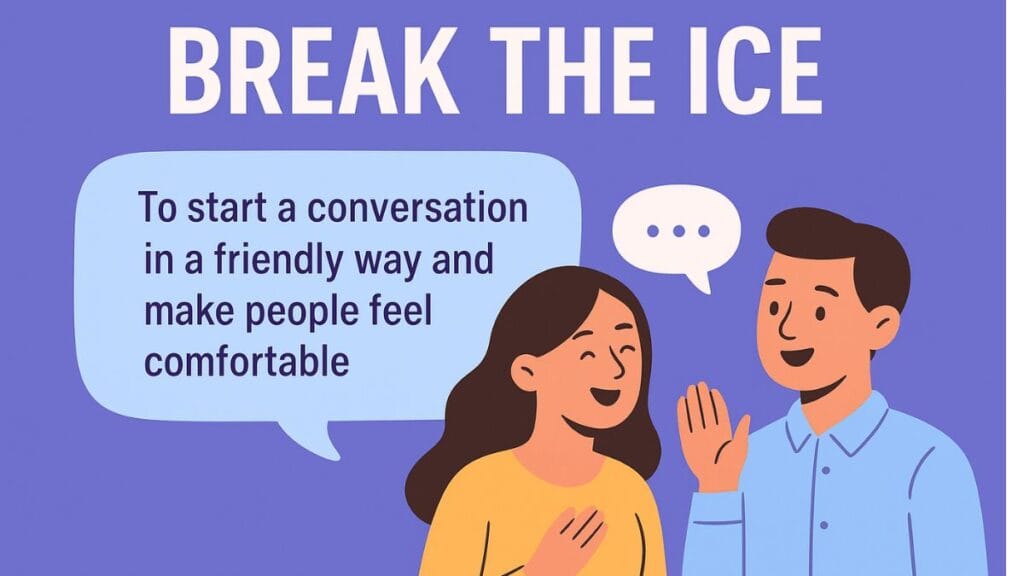
Break the Ice
Meaning: To do or say something that eases tension and starts a conversation or interaction in a more relaxed, friendly way.
The phrase comes from the historical practice of sending smaller ships to break up ice ahead of larger vessels so trade ships could pass through. In social contexts, the “ice” is the stiffness of a new or awkward situation.
Real example: “The team had never met in person before the retreat. The facilitator started with a quick trivia game to break the ice — within twenty minutes people were laughing and the whole energy shifted.”
Spill the Beans
Meaning: To reveal a secret — usually accidentally or before the intended time.
Real example: “We were planning a surprise party for months. Her sister spilled the beans at Thanksgiving dinner. The surprise was still attempted. It was deeply awkward.”
Bury the Hatchet
Meaning: To end a conflict or argument and make peace; to set aside a grudge and move forward.
Native American origin: hatchets (tomahawks) were ceremonially buried as a gesture of peace between warring parties. The phrase entered English in the 17th century and has been a fixture ever since.
Real example: “They hadn’t spoken in three years after the business dispute. Their mother’s illness made them bury the hatchet. Some things put other things in perspective.”
Have a Chip on Your Shoulder
Meaning: To carry a persistent sense of grievance, resentment, or defensiveness — often acting aggressively because of it.
The origin is surprisingly literal: in 19th century America, boys would place a wood chip on their shoulder and dare others to knock it off — a physical challenge to fight. Having a chip on your shoulder now means carrying that same readiness for confrontation.
Real example: “He came into every performance review with a chip on his shoulder — defensive before any feedback was even given. It made honest conversations almost impossible.“
Let Sleeping Dogs Lie
Meaning: To avoid bringing up an old problem, argument, or uncomfortable situation that has been dormant — not disturbing something that’s been peacefully forgotten.
Real example: “Yes, the merger created tension between the two teams. That was three years ago and things have settled. My advice? Let sleeping dogs lie. Relitigating it helps nobody.”
A Wolf in Sheep’s Clothing
Meaning: Someone who appears friendly, harmless, or trustworthy but is actually dangerous, deceptive, or malicious.
From Aesop’s fables, reinforced in the Bible. The image is universal and the phrase remains common in American speech.
Real example: “He presented himself as a mentor who wanted to help young entrepreneurs. In reality he was a wolf in sheep’s clothing — three people I know lost significant money based on his “advice.”“
The Elephant in the Room
Meaning: An obvious problem or uncomfortable truth that everyone is aware of but nobody is willing to acknowledge or discuss.
Real example: “We spent an hour and a half discussing Q3 marketing strategy without once mentioning that the product had a quality issue that was driving the returns. The elephant in the room trumped everything else.”
On Thin Ice
Meaning: In a risky or precarious situation where any mistake could have serious consequences.
Real example: “After showing up late three times in his first month, he knew he was on thin ice. The fourth time was his last.”
Straight from the Horse’s Mouth
Meaning: Information received directly from the most reliable or authoritative source — firsthand, not secondhand.
From horse racing, where the most reliable way to assess a horse’s age was to look directly at its teeth — not to trust a dealer’s claim.
Real example: “Don’t take my word for it — hear it straight from the horse’s mouth. The CEO is doing a public town hall on Thursday.”
Pull Someone’s Leg
Meaning: To joke with someone; to tease or playfully deceive someone — not in a harmful way.
Real example: “When he said he’d been offered a job on Mars, everyone at the table waited a beat before someone said, ‘You’re pulling our leg.’ He was. But he made them wait for it.”
Section 4: Difficulty, Challenge & Resilience Idioms
American culture is deeply invested in the narrative of overcoming obstacles. This shows up vividly in the idioms used to describe struggle, perseverance, and hard-won success.
Hit Rock Bottom
Meaning: To reach the lowest possible point in a situation — financially, emotionally, or otherwise. Often used as the precursor to recovery.
Real example: “He’ll tell you himself that he hit rock bottom in 2019. Lost the job, lost the apartment, lost the relationship. He also says it was the most important thing that ever happened to him, because it finally made him change.”
In Hot Water
Meaning: In trouble; in a difficult situation with serious consequences likely to follow.
Real example: “The senator found himself in hot water after the leaked emails contradicted everything he’d said publicly. His communications team was in full crisis mode by noon.”
Hang in There
Meaning: To persist through a difficult situation; to not give up even when things are hard.
One of the most genuinely encouraging phrases in everyday American speech — simple, direct, and widely used.
Real example: “The first year of any small business is brutal. Hang in there. The ones that make it through year one have the skills and the scars to grow.”
Through Thick and Thin
Meaning: Through both good times and bad; remaining loyal or committed regardless of circumstances.
Real example: “They’ve been friends since third grade. Moved to different states, had completely different lives, went years without seeing each other — but through thick and thin, they showed up when it mattered.”
The Last Straw
Meaning: The final problem in a series of problems that finally breaks someone’s patience or tolerance — the thing that tips the balance.
From “the straw that broke the camel’s back” — a camel can carry a lot, but eventually one more piece of straw, no matter how light, is too much.
Real example: “Three missed deadlines, two client complaints, and one unexplained no-show to a department meeting. The no-show was the last straw. He was let go that afternoon.”
Miss the Boat
Meaning: To miss an opportunity — usually because of delay, indecision, or not acting in time.
Real example: “We debated acquiring that startup for six months while a competitor moved. We missed the boat completely. They were acquired for $40 million. We’d have paid $8 million a year earlier.”
A Blessing in Disguise
Meaning: Something that initially seems negative or unfortunate but turns out to have a positive outcome.
Real example: “Getting rejected from her first-choice program was devastating. In retrospect, it was a blessing in disguise — the program she attended instead gave her connections and opportunities the other one never would have.”
Out of the Woods
Meaning: Past the most dangerous or difficult part of a situation; no longer in serious trouble.
Real example: “The surgery went well, but the doctors are keeping him for observation. He’s not out of the woods yet, but the prognosis is better than it was 24 hours ago.”
Throw in the Towel
Meaning: To give up; to admit defeat and stop trying.
From boxing — a trainer throws a towel into the ring to signal that their fighter is done and the match should be stopped.
Real example: “She fought the insurance company for eight months before finally throwing in the towel. The legal fees were approaching the amount they owed her. Sometimes the math doesn’t work.”
Keep Your Chin Up
Meaning: Stay positive and hopeful during a difficult time — don’t let discouragement show or take over.
Real example: “Job searching after a layoff is genuinely demoralizing. Keep your chin up. The right thing takes longer than you think it should, and then it happens.”
Section 5: Communication & Understanding Idioms
Hit the Nail on the Head
Meaning: To describe or identify something exactly right; to be precisely accurate in an assessment.
Real example: “When she said the problem wasn’t the product but the sales process, she hit the nail on the head. That’s exactly what the data was showing.”
Beating Around the Bush
Meaning: To avoid saying what you actually mean directly; to talk around a subject rather than addressing it.
From bird hunting: beaters would hit bushes to drive birds out into the open. “Beating around the bush” describes someone who does the indirect work without ever getting to the point.
Real example: “Stop beating around the bush — do you want the promotion or don’t you? I need an answer this week.”
Get to the Point
Meaning: To stop giving unnecessary background or context and say the most important thing directly.
Real example: “He spent twelve minutes explaining the history of the department before his actual request, which took forty-five seconds. His manager finally said, ‘I appreciate the context — can you get to the point?'”
Read Between the Lines
Meaning: To understand the hidden or implied meaning of something, beyond what is explicitly stated.
Real example: “Her email said she was ‘exploring other opportunities’ — read between the lines, she’s already been offered something and is giving notice soon. We need a plan.”
A Picture Is Worth a Thousand Words
Meaning: Visual information often communicates more quickly and effectively than verbal explanation.
Real example: “I spent ten minutes trying to explain the UX problem in words. Then I pulled up the screen recording and showed it. A picture is worth a thousand words — the whole team immediately understood.”
Get Straight to the Point
Meaning: To say the most important thing first, without preamble.
Real example: “She got straight to the point in the interview: ‘My last role underpaid me and I’m looking for compensation that reflects my actual experience. What does this role pay?’ Fifteen minutes in. Refreshing.”
Section 6: Risk, Opportunity & Decision-Making Idioms
Jump the Gun
Meaning: To act before the right moment; to start something too early, before conditions are ready.
From track and field — a runner who starts before the starting gun fires has “jumped the gun.”
Real example: “We jumped the gun on the product announcement — it went out before the inventory was in place and we had to backpedal immediately. The PR fallout was manageable, but embarrassing.”
The Ball Is in Your Court
Meaning: It’s now your responsibility to take the next action; the decision or move belongs to you.
From tennis — once the ball is in your court, it’s your turn to respond.
Real example: “We’ve made our offer. We’ve answered every question. We’ve been as transparent as we can be. The ball is in their court now. All we can do is wait.”
Barking Up the Wrong Tree
Meaning: Pursuing the wrong target, theory, or approach; directing effort in the wrong direction.
Literally: hunting dogs who followed a scent to the wrong tree, barking at an animal that had already moved on.
Real example: “The investigation focused on the CFO for months. Eventually it became clear they’d been barking up the wrong tree. The fraud originated in a regional office nobody had looked at.”
Take the Bull by the Horns
Meaning: To confront a difficult situation directly and with confidence; to deal with a problem head-on.
Real example: “The conversation with her co-founder had been avoided for three months. She finally took the bull by the horns, scheduled a three-hour working session, and they resolved six months of tension in an afternoon.”
Sit on the Fence
Meaning: To avoid committing to a decision or position; to remain neutral when a choice is required.
Real example: “He’d been sitting on the fence about the partnership for so long that both potential partners moved on. Indecision is its own decision.”
A Double-Edged Sword
Meaning: Something that has both advantages and disadvantages; a solution that also creates problems.
Real example: “Remote work is a double-edged sword. The flexibility is real and valuable. So is the isolation, and the way it blurs the line between work and rest.”
Go Out on a Limb
Meaning: To take a risk by saying or doing something that puts you in a vulnerable position — not supported by the mainstream view.
Real example: “I’ll go out on a limb and say this film is going to be seriously underrated when it comes out. Not everything lands with critics on release.”
If you want to learn about all the American Idioms, then here is our best curated complete list of A-Z Idioms list in one place.
MASTER REFERENCE TABLE: 100+ American Idioms
The complete reference. Every idiom in this guide, plus additional entries, organized by category.
💼Work & Professional Life Idioms
| Idiom | Meaning | Quick Example |
| Hit the ground running | Start a new role immediately with full energy | She hit the ground running on day one. |
| Drop the ball | Fail to follow through on a responsibility | I dropped the ball on the deadline. |
| On the same page | In agreement or shared understanding | Are we on the same page about pricing? |
| Go back to the drawing board | Start planning from scratch after failure | The launch failed — back to the drawing board. |
| Cut corners | Do something carelessly to save time or money | They cut corners and failed the inspection. |
| Touch base | Make brief contact to check in or update | I’ll touch base with the team Friday. |
| In the loop | Kept informed of what’s happening | Keep me in the loop on this one. |
| Out of the loop | Not informed of what’s happening | She was out of the loop after her leave. |
| Bite the bullet | Endure something unpleasant that must be done | We bit the bullet and paid the legal fees. |
| Pass the buck | Shift responsibility to someone else | Stop passing the buck — own the mistake. |
| By the book | Following rules and procedures exactly | The audit was done strictly by the book. |
| The bottom line | The most important fact; the final conclusion | The bottom line is: can we afford this? |
| Ahead of the curve | More advanced than others | They were ahead of the curve on AI tools. |
| A ballpark figure | A rough, approximate estimate | Give me a ballpark figure for the budget. |
| Pull strings | Use personal influence behind the scenes | He pulled strings to get that contract. |
| Think outside the box | Approach a problem creatively | We need to think outside the box here. |
| Call it a day | Stop working for the day | Let’s call it a day and pick this up Monday. |
| Get the ball rolling | Start something; initiate a process | Someone needs to get the ball rolling on this. |
| Run the show | Be in charge of everything | While the director’s out, Priya runs the show. |
| Raise the bar | Set a higher standard | Their last product really raised the bar. |
| A steep learning curve | A difficult or challenging learning process | The new software has a steep learning curve. |
| Learn the ropes | Learn how a new job or system works | Give her a month to learn the ropes. |
| Pull your weight | Contribute fairly and do your share | Everyone needs to pull their weight this quarter. |
| A shot in the dark | A guess with very little information | My answer was a complete shot in the dark. |
| Step up to the plate | Take on responsibility when needed | When the manager left, he stepped up to the plate. |
💰Money & Finance Idioms
| Idiom | Meaning | Quick Example |
| Cost an arm and a leg | Be very expensive | Concert tickets cost an arm and a leg. |
| In the red | Operating at a loss or in debt | The company was in the red for two years. |
| In the black | Financially profitable | After the restructuring, they’re in the black. |
| Tighten your belt | Reduce spending due to financial pressure | We need to tighten our belts this quarter. |
| Break the bank | Be extremely expensive | A nice vacation doesn’t have to break the bank. |
| Put all your eggs in one basket | Risk everything on one option | Don’t put all your eggs in one basket investing. |
| A dime a dozen | Very common; not valuable or rare | Generic apps like this are a dime a dozen. |
| Rake it in | Earn large amounts of money | After the viral post, they were raking it in. |
| Nickel and dime someone | Charge many small fees that add up | Airlines nickel and dime you with every fee. |
| Foot the bill | Pay for something, often unexpectedly | The company footed the bill for the damages. |
| Penny-wise, pound-foolish | Saving small amounts while wasting large ones | Skipping maintenance is penny-wise, pound-foolish. |
| Splash out | Spend a lot of money, usually on a treat | We splashed out on a nice dinner to celebrate. |
| Money doesn’t grow on trees | Money is limited and must be earned | You can’t keep buying things — money doesn’t grow on trees. |
| Living paycheck to paycheck | Spending all earnings with nothing saved | Millions of Americans are living paycheck to paycheck. |
| On a shoestring (budget) | With very little money | They launched the whole campaign on a shoestring. |
👥Relationships & Social Life Idioms
| Idiom | Meaning | Quick Example |
| Break the ice | Ease tension to start a friendly conversation | The trivia game broke the ice quickly. |
| Spill the beans | Accidentally reveal a secret | Her sister spilled the beans about the party. |
| Bury the hatchet | End a conflict and make peace | They buried the hatchet after years of feuding. |
| Have a chip on your shoulder | Carry persistent resentment or defensiveness | He came in with a chip on his shoulder. |
| Let sleeping dogs lie | Don’t disturb something that has settled | Leave that old argument alone — let sleeping dogs lie. |
| A wolf in sheep’s clothing | Someone dangerous pretending to be harmless | He turned out to be a wolf in sheep’s clothing. |
| The elephant in the room | An obvious problem nobody wants to discuss | The budget issue was the elephant in the room. |
| On thin ice | In a risky position where mistakes have consequences | After two warnings, she was on thin ice. |
| Straight from the horse’s mouth | Directly from the most reliable source | Hear it straight from the horse’s mouth — she’s leaving. |
| Pull someone’s leg | Tease or joke with someone | He was pulling your leg — it’s not real. |
| Give someone the cold shoulder | Deliberately ignore or be unfriendly to someone | She gave him the cold shoulder all evening. |
| See eye to eye | Agree with someone | They rarely see eye to eye on strategy. |
| Hit it off | Immediately like someone; have natural chemistry | They hit it off immediately at the conference. |
| A fair-weather friend | Someone who’s only friendly in good times | He turned out to be a fair-weather friend. |
| An arm’s length | A distance that maintains separation or objectivity | Keep this vendor at arm’s length for now. |
| Mend fences | Repair a damaged relationship | He reached out to mend fences after the falling-out. |
| Put your foot in your mouth | Say something embarrassing or offensive accidentally | I really put my foot in my mouth at that dinner. |
| Talk someone’s ear off | Talk to someone for a very long time | She’ll talk your ear off if you let her. |
💪Difficulty, Challenge & Resilience Idioms
| Idiom | Meaning | Quick Example |
| Hit rock bottom | Reach the absolute lowest point | He hit rock bottom before turning things around. |
| In hot water | In serious trouble | The CEO found himself in hot water fast. |
| Hang in there | Don’t give up during a hard time | Hang in there — it gets better. |
| Through thick and thin | In all circumstances, good and bad | She stood by him through thick and thin. |
| The last straw | The final problem that breaks tolerance | The fourth missed meeting was the last straw. |
| Miss the boat | Miss an opportunity through delay | We missed the boat on that acquisition. |
| A blessing in disguise | Something bad that turns out to be good | Losing that job was a blessing in disguise. |
| Out of the woods | Past the most dangerous part of a situation | He’s recovering but not out of the woods yet. |
| Throw in the towel | Give up; admit defeat | She threw in the towel after months of fighting. |
| Keep your chin up | Stay positive during difficulty | Keep your chin up — better days are coming. |
| Weather the storm | Get through a difficult period | The company weathered the storm of the recession. |
| Light at the end of the tunnel | Signs that difficulty is nearly over | After six months of losses, there’s finally light at the end of the tunnel. |
| An uphill battle | A difficult struggle against unfavorable odds | Changing the culture is an uphill battle. |
| Back against the wall | In a desperate situation with no easy options | With the deadline tomorrow, his back was against the wall. |
| Bite off more than you can chew | Take on more than you can handle | She bit off more than she could chew with three projects at once. |
| Burn the candle at both ends | Work too hard at both ends of the day | He’s burning the candle at both ends and it’s showing. |
🗣️ Communication & Understanding
| Idiom | Meaning | Quick Example |
| Hit the nail on the head | Be exactly right in an assessment | She hit the nail on the head with that diagnosis. |
| Beat around the bush | Avoid saying something directly | Stop beating around the bush — what’s the real issue? |
| Read between the lines | Understand the hidden or implied meaning | Read between the lines — she’s not happy with the direction. |
| A picture is worth a thousand words | Visuals communicate more effectively than words | Show the data in a chart — a picture is worth a thousand words. |
| Get straight to the point | Say the most important thing immediately | I’ll get straight to the point: we need to cut the budget. |
| Speak volumes | Communicate a great deal without words | The fact that nobody showed up spoke volumes. |
| On the tip of my tongue | Almost able to remember something | His name is on the tip of my tongue — I’ll think of it. |
| Actions speak louder than words | What people do matters more than what they say | Apologize less and change more — actions speak louder than words. |
| Get your wires crossed | Have a miscommunication or misunderstanding | I think we got our wires crossed about the meeting time. |
| Talk the talk, walk the walk | Not just say the right things but also do them | He talks the talk — let’s see if he walks the walk. |
🎲Risk, Opportunity & Decision-Making Idioms
| Idiom | Meaning | Quick Example |
| Jump the gun | Act before the right moment | We jumped the gun with that press release. |
| The ball is in your court | It’s your turn to act or decide | We’ve made our offer — the ball is in your court. |
| Barking up the wrong tree | Pursuing the wrong target or approach | The investigation was barking up the wrong tree. |
| Take the bull by the horns | Confront a problem directly and boldly | She took the bull by the horns and had the hard conversation. |
| Sit on the fence | Avoid making a decision or taking a side | He can’t sit on the fence forever on this one. |
| A double-edged sword | Something with both benefits and drawbacks | Transparency is a double-edged sword in negotiations. |
| Go out on a limb | Take a risk by stating a controversial position | I’ll go out on a limb and disagree with the consensus here. |
| Play it by ear | Decide based on the situation as it develops | Let’s not overplan — we’ll play it by ear. |
| A long shot | Something unlikely to succeed | Winning the contract is a long shot, but worth trying. |
| Hedge your bets | Reduce risk by having multiple options | She hedged her bets by applying to twelve programs. |
| Roll the dice | Take a risk; leave something to chance | Starting the business was rolling the dice — it paid off. |
| Burn your bridges | Permanently destroy a relationship or opportunity | Don’t burn your bridges when you quit — the world is small. |
🌟Success, Failure & Effort Idioms
| Idiom | Meaning | Quick Example |
| Knock it out of the park | Perform exceptionally well; exceed all expectations | She knocked it out of the park on that presentation. |
| Hit the jackpot | Achieve great success or a particularly lucky outcome | They hit the jackpot with that product launch. |
| Go the extra mile | Make additional effort beyond what is required | He always goes the extra mile for his clients. |
| Pull it off | Successfully accomplish something difficult | Nobody thought they could pull it off — they did. |
| Fall flat | Fail to achieve the intended effect | The joke fell flat. The silence was loud. |
| On a roll | Experiencing a sustained period of success | Don’t interrupt her — she’s on a roll. |
| Back to square one | Starting completely over from the beginning | The deal fell through. We’re back to square one. |
| Come out on top | End up in the winning or best position | Despite everything, they came out on top. |
| In the bag | Certain to be achieved; already secured | With three votes confirmed, the resolution is in the bag. |
| Give it your best shot | Try as hard as you can | It’s a competitive application — give it your best shot. |
How to Actually Use This Idioms Guide
A master list is only as useful as how you work with it. Here’s what actually works for building idiom fluency in American English:
Don’t try to memorize the whole table. Pick the category most relevant to your life right now — if you’re in a new job, start with Work & Professional Life. If you’re navigating a difficult situation, read Difficulty & Resilience. Learn ten deeply before adding ten more.
Notice when you hear them. Once you know an idiom exists, your brain will start flagging it in real-time. American TV dramas and podcasts are particularly rich sources — news shows, reality competition programs, and workplace dramas use idioms constantly.
Make your own examples. The fastest way to own a phrase is to use it in a sentence about your actual life. “I dropped the ball on calling my landlord about the heater” sticks better than any textbook example.
Pay attention to tone. “Keep your chin up” is warm and encouraging. “The ball is in your court” can feel neutral or slightly pressuring depending on context. Idioms carry emotional register — part of fluency is knowing not just what a phrase means but how it feels to say it in a given situation.
Give yourself permission to be wrong. Using an idiom in a slightly off context is how you learn the edges of its meaning. Native speakers will almost always understand what you’re going for and correct gently if needed.
American idioms aren’t decoration. They’re the connective tissue of everyday communication — the short, loaded phrases that native speakers reach for instinctively when they want to describe something fast and vividly. Learning them isn’t about memorizing a list; it’s about tuning your ear to a frequency that’s been there all along.
Start with the category closest to your daily life. Use the master table as a reference. Notice idioms when they appear in conversation, in news, in shows. Use them yourself — imperfectly at first, then with growing confidence.
Language doesn’t open up all at once. It opens in sections, as you learn each room.
Found this guide useful? Bookmark the master table for quick reference — and share it with someone who’s been nodding politely through American idioms they don’t quite understand.