Welcome to our daily Idiom series, designed to help you sound like a native American English speaker. Today’s idiom is “Burn the Midnight Oil.” In this post, you will learn what it means, where it comes from, how to use it in real sentences, and which common mistakes to avoid.
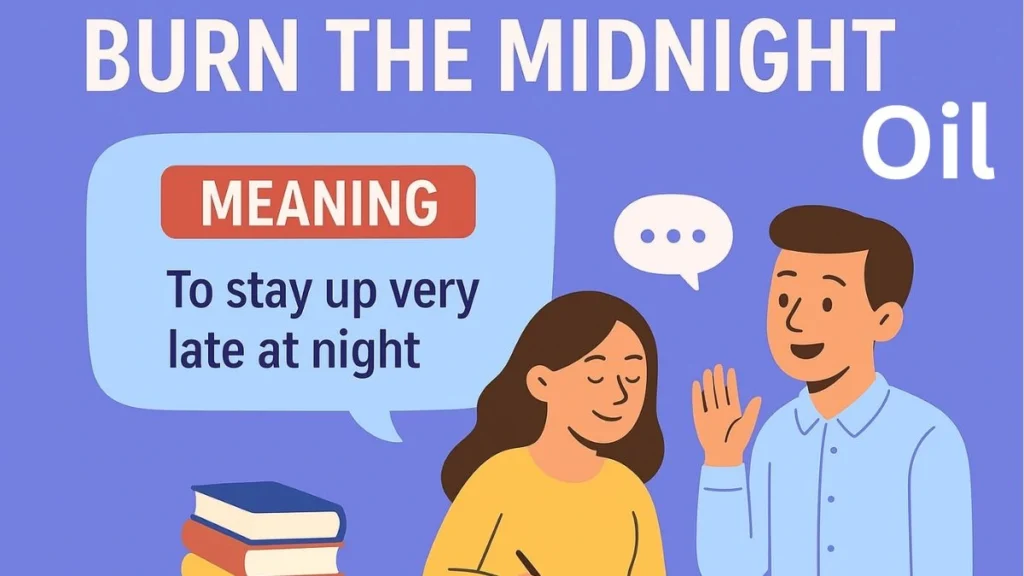
Idiom Burn the Midnight Oil Meaning
Let me take you back to my college days. During my final year exams, I had a huge pile of notes to get through. But if I am honest, I wasted most of the day scrolling on my phone and chatting with friends. Then, the night before the exam, it hit me — I had not even finished half the syllabus.
So I made a strong cup of coffee, spread my books across the desk, and stayed awake studying until four in the morning. My roommates were sleeping peacefully, but I kept the lamp burning and pushed through the night. That is what people mean when they say someone is “burning the midnight oil.”
| Burn the midnight oil = to stay up very late at night working or studying hard |
The idiom does not mean literally burning oil in a lamp — although that is exactly where it comes from. Before electricity, people used oil lamps to light their homes. If you were working so late that you needed your lamp past midnight, you were burning the midnight oil. Today, we use the phrase for anyone who is up past midnight pushing through work, study, or a creative project.
10 Simple Examples of Burn the Midnight Oil Idiom
- Riya burned the midnight oil to finish her school project before the deadline.
- During exam season, Arjun burned the midnight oil to revise all his chapters.
- Meena burned the midnight oil preparing for her dance performance the next morning.
- Rahul burned the midnight oil writing his college assignment that was due at 9 AM.
- Anjali burned the midnight oil practising piano for her upcoming recital.
- At the office, Kavita burned the midnight oil to complete the client presentation.
- Suresh burned the midnight oil studying for his competitive entrance exam.
- Priya burned the midnight oil finishing her artwork for the gallery exhibition.
- Amit burned the midnight oil coding his app for the school technology fair.
- Neha burned the midnight oil reading through all her notes before the big science test.
Want to learn more idioms easily? Check out our Complete Guide to Everyday American Idioms—you’ll find more simple meanings, fun examples, and real-life practice!
Different Sentence Patterns of “Burn the Midnight Oil”
Here are the most common ways to use this idiom in a sentence:
- She burned the midnight oil preparing for the interview. (past — it already happened)
- I have been burning the midnight oil all week. (present perfect — ongoing effort)
- If you want to pass, you will need to burn the midnight oil tonight. (future advice)
- He is the kind of person who burns the midnight oil before every big deadline. (habitual behaviour)
- Stop burning the midnight oil every night — you need to rest too. (advice or warning)
Note that the idiom implies hard work and effort, not just being awake late. Staying up to watch films or scroll social media is not “burning the midnight oil.” The phrase always implies late-night productivity.
Real-Life Conversation Using “Burn the Midnight Oil”
Here is a short conversation between two university students during exam season. Notice how naturally the idiom fits into everyday speech.
| Sanya: | You look exhausted, Rohan. Did you even sleep last night? |
| Rohan: | Barely. I was burning the midnight oil until about 3 AM trying to get through the economics chapters. |
| Sanya: | Three in the morning? That is intense. Do you feel prepared now at least? |
| Rohan: | More or less. I still have the statistics unit left, so I will probably burn the midnight oil again tonight. |
| Sanya: | Just make sure you get some sleep before the exam itself. A tired brain does not remember well. |
| Rohan: | You are right. I will try to finish by midnight this time. |
Similar Idioms to Burn the Midnight Oil
| Idiom | Meaning | Example |
| Pull an all-nighter | Stay awake the entire night to work or study | “She pulled an all-nighter before the final presentation.” |
| Work around the clock | Work continuously for a long time, day and night | “The rescue team worked around the clock after the earthquake.” |
| Stay up late | Be awake late at night, usually to finish tasks | “He stayed up late finishing the report due first thing Monday.” |
| Hit the books | To study seriously or with full focus | “She hit the books all weekend before the board exams.” |
| Nose to the grindstone | Working hard and steadily without stopping | “He kept his nose to the grindstone all month to meet the deadline.” |
Tip: “Burn the midnight oil” and “pull an all-nighter” are similar, but not identical. Burning the midnight oil suggests working very late — not necessarily all night. Pulling an all-nighter means no sleep at all. Use whichever fits the situation more accurately.
If you want to learn about all the American Idioms, then here is our best curated complete list of A-Z Idioms list in one place.
Common Mistakes to Avoid
The first mistake is using this idiom for any late-night activity, not just productive work. “Burning the midnight oil” always implies effort and hard work. Using it for watching films or chatting online would sound strange to a native speaker.
| Correct “She burned the midnight oil revising for her chemistry exam.” |
| Incorrect “He burned the midnight oil watching a web series until 3 AM.” (no effort involved) |
The second mistake is changing the idiom’s wording. Common errors include “burn the midnight candle,” “burn the night oil,” or simply “burn midnight oil” (missing “the”). The fixed phrase is always “burn the midnight oil” — every word matters.
| Correct “The whole team burned the midnight oil to meet the launch deadline.” |
| Incorrect “The team burned the midnight candle.” / “They burned midnight oil.” |
The third mistake is using this idiom in formal or professional writing. It is informal and conversational. In a formal report or academic essay, write “worked late into the night,” “worked extended hours,” or “dedicated significant time outside regular working hours” instead.
Practice & Application: “Burn the Midnight Oil” in Real Situations
Using “Burn the Midnight Oil” in Speaking (IELTS & Real Life)
“Burn the midnight oil” is one of the most naturally useful idioms for IELTS Speaking. It fits perfectly in Part 1 when talking about study habits or work routines, and in Part 2 when describing a time you worked especially hard toward a goal. It immediately signals to the examiner that you can use idiomatic English with confidence and accuracy.
IELTS Speaking Practice
Part 1 — Short Answer
Question: Do you often stay up late to study or work?
Sample Answer:
During normal weeks, I try to keep a healthy routine and get enough sleep. But when exams or important deadlines are approaching, I end up burning the midnight oil more often than I would like. I think most students go through phases like that. The challenge is not making it a habit — a few late nights are manageable, but doing it every night quickly leads to exhaustion and lower productivity.
Part 2 — Cue Card
Describe a time when you worked or studied very hard to achieve something.
Sample Answer:
I would like to talk about the month before my final board examinations in school. The syllabus was enormous, and I knew the results would determine which college I could apply to. So for about four weeks, I burned the midnight oil almost every night. I would study from after dinner until two or three in the morning, going through textbook chapters, solving past papers, and making revision notes. My parents were supportive but worried — my mother would leave a glass of warm milk outside my door each night and remind me to rest. What kept me going was a combination of genuine ambition and, honestly, quite a bit of fear. When the results came out and I saw my scores, every sleepless night felt completely worth it. That experience taught me that hard work and discipline, even when they are uncomfortable, produce results that stay with you for life.
Part 3 — Discussion
Question: Do you think working late at night is an effective way to be productive?
Sample Answer:
It depends on the person and the situation. Some people genuinely do their best thinking late at night when everything is quiet and there are fewer distractions — burning the midnight oil works well for them. But research consistently shows that sleep deprivation reduces concentration, memory, and decision-making ability. So while an occasional late night can help you push through a crisis, making it a regular habit tends to backfire. The most effective approach is to manage your time well enough that you rarely need to stay up past midnight at all — though I will admit that is easier said than done.
Question: Is it common in your country for students to study very late at night?
Sample Answer:
Very much so. In India, especially during board exam season or entrance exam preparation, burning the midnight oil is practically a rite of passage. There is a cultural expectation that serious students push themselves hard, and late-night studying is seen as a sign of dedication. Many coaching centres even run sessions that go well into the evening. While I understand the intention behind this culture, I also think there is a growing awareness that sleep and rest are not luxuries — they are essential parts of effective learning. The best students I know are not necessarily the ones who sleep the least, but the ones who use their study time most efficiently.
Practice Exercise — Advanced Level
Rewrite each sentence below using “burn the midnight oil” without changing the meaning.
- She stayed up very late last night finishing her research paper.
- He studied until 3 AM the night before his entrance exam.
- The design team worked late into the night to finalise the presentation.
- Anjali spent the whole night practising her lines for the school play.
- He regularly stays awake past midnight when a project deadline is approaching.
- The software developers worked through the night to fix the bug before launch.
- She spent several late nights preparing the financial report for the board meeting.
- During the final week of college, most students stay up late revising their notes.
Answer Key
- She burned the midnight oil last night finishing her research paper.
- He burned the midnight oil the night before his entrance exam, studying until 3 AM.
- The design team burned the midnight oil to finalise the presentation.
- Anjali burned the midnight oil practising her lines for the school play.
- He regularly burns the midnight oil when a project deadline is approaching.
- The software developers burned the midnight oil to fix the bug before launch.
- She burned the midnight oil for several nights preparing the financial report.
- During the final week of college, most students burn the midnight oil revising their notes.
The next time you or someone you know is up past midnight pushing through work or study, you will know exactly what to call it. Try using the idiom in your next conversation — it is one of those expressions that sounds effortlessly natural once you start using it.
Frequently Asked Questions
What does “burn the midnight oil” mean?
It means to stay up very late at night working or studying hard — putting in serious effort past midnight to get something done.
How do I use it in a sentence?
Example: “I burned the midnight oil all week to finish my project before the Friday deadline.”
When should I use this idiom?
Use it in casual conversations when describing someone — yourself or others — working or studying very late at night. It always implies hard work, not just being awake late.
Can I use it for watching films late at night?
No — this is a common mistake. ‘Burn the midnight oil’ implies productive, effortful work. Using it for entertainment or leisure sounds unnatural.
What is the difference between this and ‘pull an all-nighter’?
Burning the midnight oil means working very late — you may still sleep eventually. Pulling an all-nighter means no sleep at all, working or studying through the entire night.
Are there similar idioms?
Yes — ‘pull an all-nighter,’ ‘work around the clock,’ ‘hit the books,’ and ‘nose to the grindstone’ are all related to hard work and long hours.