Indians speak English fluently — but we use it very differently from the rest of the world.
Over time, we’ve mixed English with our own languages, habits, and culture so deeply that some everyday Indian phrases completely confuse foreigners.
Not because they’re wrong. Because we’ve made English our own.
Here are some classic Indian English phrases that leave foreigners totally puzzled — and what we actually mean when we say them.
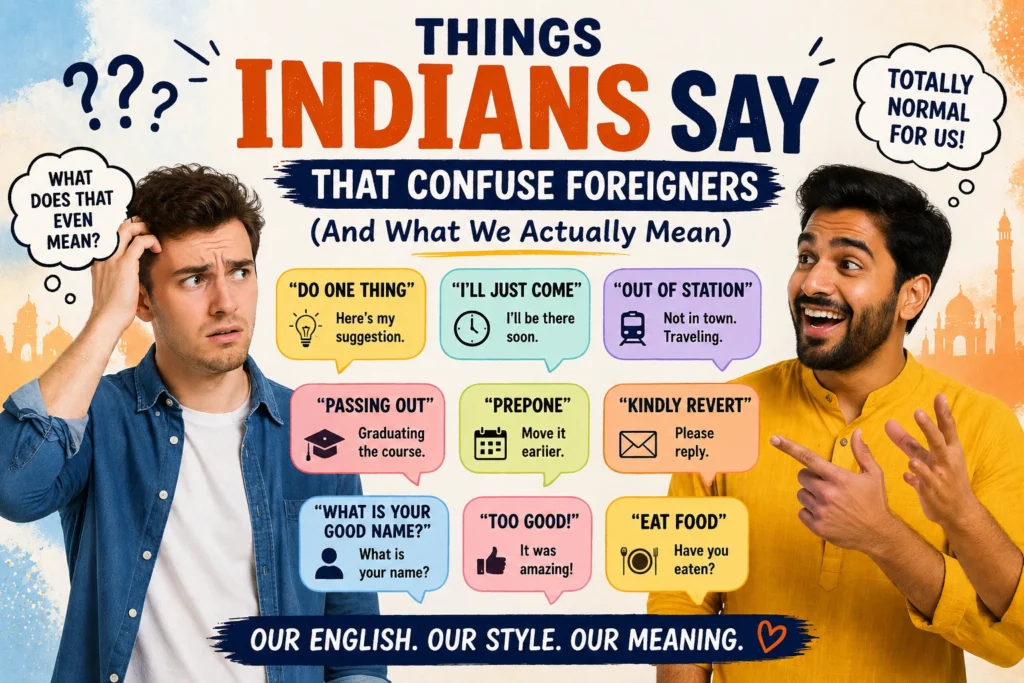
Things Indians Say That Confuse Foreigners (And What We Actually Mean)
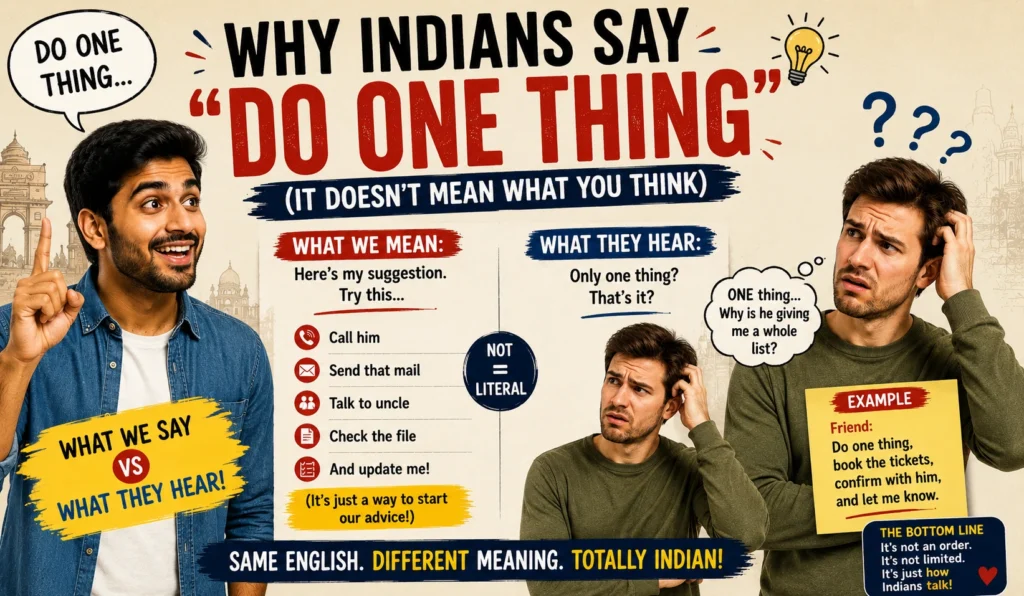
1. “Do One Thing”
What we say: “Do one thing — just call him and ask.”
What foreigners hear: One thing? What’s the one thing? Is there a list coming?
What we mean: It’s just our way of saying “Here’s my suggestion.” An intro phrase. Nothing more.
Foreigners wait for the list. There is no list.
2. “I’ll Just Come”
What we say: “Don’t worry, I’ll just come.”
What foreigners hear: Come where? Right now? To whom?
What we mean: “I’ll be there shortly.” The word “just” here means “soon” — not “only.” A foreigner spends ten minutes figuring out where you’re going. You’re going to them.
3. “Out of Station”
What we say: “He’s out of station this week.”
What foreigners hear: Station? Like a railway station? Is he stranded?
What we mean: He’s traveling. Not in town. Simple.
This phrase comes from British colonial-era English and somehow never left India. The rest of the world moved on. We didn’t — and honestly, it has charm.
4. “Passing Out”
What we say: “My brother is passing out from IIT next month.”
What foreigners hear: Is he okay? Should someone call a doctor?
What we mean: He’s graduating. “Passing out” in India means completing a degree or program. To the rest of the world, it means fainting.
Two very different life events.
5. “Prepone”
What we say: “Can we prepone the meeting to Monday?”
What foreigners hear: …Prepone? Is that even a word?
What we mean: Move it earlier. The opposite of postpone.
Indians invented this word because we needed it. Foreigners have no word for this concept. We filled the gap. Honestly, the whole world should just adopt it.
6. “Kindly Revert”
What we say: “Please kindly revert at the earliest.”
What foreigners hear: Revert to what? What previous state are we going back to?
What we mean: Reply. Just reply to this email.
In standard English, “revert” means to return to a previous condition. In Indian office English, it means respond. Every foreigner who gets this email reads it twice.
7. “What Is Your Good Name?”
What we say: “Excuse me, what is your good name?”
What foreigners hear: My good name? Do I have a bad one too?
What we mean: It’s a warm, respectful way of asking someone’s name — translated directly from Hindi (“Aapka shubh naam kya hai?”). Foreigners find it puzzling. We find it perfectly polite.
8. “Cousin Brother / Cousin Sister”
What we say: “He’s my cousin brother.”
What foreigners hear: Is he a cousin or a brother? Pick one.
What we mean: He’s a male cousin. In India, family relationships are specific. “Cousin” alone doesn’t feel precise enough — so we specify. We’re not about to let one word do all the work.
9. “Too Good!”
What we say: “That movie was too good!”
What foreigners hear: So… was it good or bad?
What we mean: It was amazing. Fantastic. The best. In Indian English, “too” works as an intensifier — like “so” or “very.” It has nothing to do with excess.
When an Indian says something is “too good,” just take the compliment.
10. “Only”
What we say: “I told him only.”
What foreigners hear: Only what? The sentence feels unfinished.
What we mean: The “only” at the end is for emphasis — it comes from South Indian languages where a similar word is used for stress. “I told him only” means “I did tell him — exactly as I said.”
Not incomplete. Just ours.
11. “Have You Eaten Food?”
What we say: “Have you eaten food?”
What foreigners hear: As opposed to eating… what exactly?
What we mean: We care. Deeply. Asking if someone has eaten is one of the most affectionate things an Indian can say. It’s not redundant — it’s love in sentence form.
Foreigners say “have you eaten?” Indians say “have you eaten food?” — because food deserves to be named.
12. “Homely Girl”
What we say: “She’s a very homely girl.”
What foreigners hear: Plain? Boring? Unattractive?
What we mean: Family-oriented, warm, and caring — traditionally considered a sincere compliment in India. In Western English, “homely” means plain-looking.
Same word. Completely opposite meaning. This one causes real confusion at international gatherings.
Why Does This Happen?
India has 22 official languages and hundreds of dialects. When we speak English, we naturally carry our mother tongue’s rhythm, structure, and expressions along with us.
The result is Indian English — a legitimate, widely spoken, and beautifully expressive version of the language.
It’s not broken English. It’s adapted English.
And some of our words — like “prepone” — make so much logical sense that the rest of the world should honestly just adopt them already.
Which One Surprised You the Most?
Which Indian English phrase confuses foreigners the most in your experience?
And if you’re not Indian — which one on this list genuinely surprised you?
Drop it in the comments below.
Want to explore more about how idioms and phrases shape everyday English? Check out our Complete A-Z Idioms Guide.